




The M.I. of a semi-circular ring of mass M and radius R about an axis lying on the plane which is passing through its center and with an angle \[\theta \] with the line joining its end is –
\[\begin{align}
& \text{A) }\dfrac{M{{R}^{2}}}{2}\text{, if }\theta ={{0}^{0}} \\
& \text{B) }\dfrac{M{{R}^{2}}}{2}\text{, if }\theta ={{60}^{0}} \\
& \text{C) }\dfrac{M{{R}^{2}}}{2}\text{, if }\theta ={{120}^{0}} \\
& \text{D) }\dfrac{M{{R}^{2}}}{2}\text{, if }\theta ={{180}^{0}} \\
\end{align}\]
Answer
 Verified
595.8k+ views
Hint: We need to understand the concept of moment of inertia and its dependence on the different planes or axes of the body under consideration. These ideas are required to solve the given problem and find the required moment of inertia.
Complete answer:
The moment of inertia is considered as the rotational analogue of the mass. The mass of the body which causes the effect of rotation in the system is dependent on its axis of rotation and is different along each axis unlike the uniform motion which has a constant mass along any direction. The moment of inertia of the body in the particular axis is important to understand the dynamics of the system in the rotational motion.
In the given situation, a semi-circular ring is considered which has a random axis which is introduced such that it is lying on the plane that passes through the center and with an angle with its diameter.
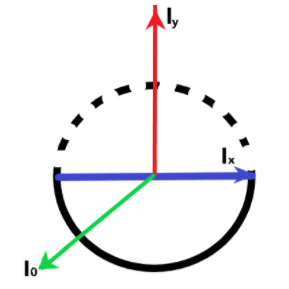
For a circular ring, the moment of inertia through an axis which is perpendicular to the plane through the center is given as –
\[{{I}_{0}}=M{{R}^{2}}\]
Now, we can apply the perpendicular axes theorem in order to obtain the moment of inertia of the circular ring along the diameter as –
\[\begin{align}
& {{I}_{0}}={{I}_{x}}+{{I}_{y}} \\
& \text{but, }{{\text{I}}_{x}}={{I}_{y}} \\
& \Rightarrow M{{R}^{2}}=2I \\
& \therefore I=\dfrac{M{{R}^{2}}}{2} \\
\end{align}\]
This is situation is possible only when the angle between the diameter and the axis under consideration is zero.
So, the correct answer is option A.
Note:
The perpendicular axes theorem states that the sum of the moment of inertia of two axes which are mutually perpendicular to each other will give the moment of inertia of the third axis which is perpendicular to both of the initial axes as we have here.
Complete answer:
The moment of inertia is considered as the rotational analogue of the mass. The mass of the body which causes the effect of rotation in the system is dependent on its axis of rotation and is different along each axis unlike the uniform motion which has a constant mass along any direction. The moment of inertia of the body in the particular axis is important to understand the dynamics of the system in the rotational motion.
In the given situation, a semi-circular ring is considered which has a random axis which is introduced such that it is lying on the plane that passes through the center and with an angle with its diameter.
For a circular ring, the moment of inertia through an axis which is perpendicular to the plane through the center is given as –
\[{{I}_{0}}=M{{R}^{2}}\]
Now, we can apply the perpendicular axes theorem in order to obtain the moment of inertia of the circular ring along the diameter as –
\[\begin{align}
& {{I}_{0}}={{I}_{x}}+{{I}_{y}} \\
& \text{but, }{{\text{I}}_{x}}={{I}_{y}} \\
& \Rightarrow M{{R}^{2}}=2I \\
& \therefore I=\dfrac{M{{R}^{2}}}{2} \\
\end{align}\]
This is situation is possible only when the angle between the diameter and the axis under consideration is zero.
So, the correct answer is option A.
Note:
The perpendicular axes theorem states that the sum of the moment of inertia of two axes which are mutually perpendicular to each other will give the moment of inertia of the third axis which is perpendicular to both of the initial axes as we have here.
Recently Updated Pages
Master Class 12 Business Studies: Engaging Questions & Answers for Success

Master Class 12 Chemistry: Engaging Questions & Answers for Success
Master Class 12 Biology: Engaging Questions & Answers for Success
Class 12 Question and Answer - Your Ultimate Solutions Guide
Master Class 11 English: Engaging Questions & Answers for Success
Master Class 11 Social Science: Engaging Questions & Answers for Success
Trending doubts
The end of compass needle which points towards north class 12 physics CBSE
In order to find out the different types of gametes class 12 biology NEET_UG
Hormone responsible for the secretion of milk after class 12 biology CBSE
Yeast reproduces by A Spore formation B Multiple fission class 12 biology CBSE
Draw a well labelled diagram of LS of the human ki class 12 biology CBSE
Draw a diagram of a flower and name the parts class 12 biology ICSE