




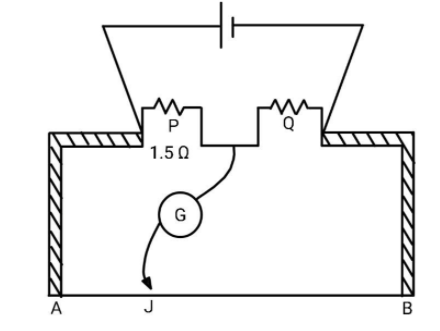
The meter bridge circuit shown in figure is balanced when jockey$J$ divides wire AB in two parts AJ and BJ in the ratio of $1:2$. The unknown resistance Q has value
(A) $1$$\Omega $
(B) $3$$\Omega $
(C) $4$$\Omega $
(D) $7$$\Omega $
Answer
 Verified
609.9k+ views
Hint: It is given that the meter bridge circuit is balanced, which means that the above circuit can be considered as a Wheatstone bridge. Find the resistance of the resistor Q by applying the condition for Wheatstone bridge.
Complete step by step answer:
The meter bridge works on the principle of Wheatstone bridge. The condition for balanced Wheatstone bridge is given as $\dfrac{{{R_1}}}{{{R_2}}} = \dfrac{{{R_3}}}{{{R_4}}}$.
In meter bridge ${R_1},{R_2},{R_3}\& {R_4}$ are as follows:
${R_1} = P$, ${R_2} = \rho \dfrac{{{l_1}}}{A}$ where ${l_1}$ is the length AJ, ${R_3} = Q$ and ${R_4} = \rho \dfrac{{{l_2}}}{A}$ where ${l_2}$ is the length BJ.
Here, $\rho $ is the resistivity of the wire and $A$ is the cross section of the wire.
Now, using the given data and applying the condition for Wheatstone bridge
$
\dfrac{P}{{\rho \dfrac{{{l_1}}}{A}}} = \dfrac{Q}{{\rho \dfrac{{{l_2}}}{A}}} \\
\Rightarrow \dfrac{P}{{{l_1}}} = \dfrac{Q}{{{l_2}}} \\
\Rightarrow \dfrac{P}{Q} = \dfrac{{{l_1}}}{{{l_2}}} \\
$
Given that $\dfrac{{{l_1}}}{{{l_2}}} = \dfrac{1}{2}$
$
\Rightarrow \dfrac{P}{Q} = \dfrac{1}{2} \\
\Rightarrow Q = 2P \\
\Rightarrow Q = \left( 2 \right)\left( {1.5} \right) \\
$
$Q = 3$$\Omega $
Therefore, the unknown resistance Q has value $3$$\Omega $.
So, the correct answer is “Option B”.
Note:
Remember that while finding the resistance of the wire, it is possible that the wire may have variable resistivity and area of cross section which will change the resistances of the wire in the two parts. The meter bridge is used to find the unknown resistance. The jockey is slide on wire until there is no deflection in the galvanometer. This is known as the null point.
Complete step by step answer:
The meter bridge works on the principle of Wheatstone bridge. The condition for balanced Wheatstone bridge is given as $\dfrac{{{R_1}}}{{{R_2}}} = \dfrac{{{R_3}}}{{{R_4}}}$.
In meter bridge ${R_1},{R_2},{R_3}\& {R_4}$ are as follows:
${R_1} = P$, ${R_2} = \rho \dfrac{{{l_1}}}{A}$ where ${l_1}$ is the length AJ, ${R_3} = Q$ and ${R_4} = \rho \dfrac{{{l_2}}}{A}$ where ${l_2}$ is the length BJ.
Here, $\rho $ is the resistivity of the wire and $A$ is the cross section of the wire.
Now, using the given data and applying the condition for Wheatstone bridge
$
\dfrac{P}{{\rho \dfrac{{{l_1}}}{A}}} = \dfrac{Q}{{\rho \dfrac{{{l_2}}}{A}}} \\
\Rightarrow \dfrac{P}{{{l_1}}} = \dfrac{Q}{{{l_2}}} \\
\Rightarrow \dfrac{P}{Q} = \dfrac{{{l_1}}}{{{l_2}}} \\
$
Given that $\dfrac{{{l_1}}}{{{l_2}}} = \dfrac{1}{2}$
$
\Rightarrow \dfrac{P}{Q} = \dfrac{1}{2} \\
\Rightarrow Q = 2P \\
\Rightarrow Q = \left( 2 \right)\left( {1.5} \right) \\
$
$Q = 3$$\Omega $
Therefore, the unknown resistance Q has value $3$$\Omega $.
So, the correct answer is “Option B”.
Note:
Remember that while finding the resistance of the wire, it is possible that the wire may have variable resistivity and area of cross section which will change the resistances of the wire in the two parts. The meter bridge is used to find the unknown resistance. The jockey is slide on wire until there is no deflection in the galvanometer. This is known as the null point.
Recently Updated Pages
Master Class 12 Business Studies: Engaging Questions & Answers for Success

Master Class 12 Chemistry: Engaging Questions & Answers for Success
Master Class 12 Biology: Engaging Questions & Answers for Success
Class 12 Question and Answer - Your Ultimate Solutions Guide
Master Class 11 English: Engaging Questions & Answers for Success
Master Class 11 Social Science: Engaging Questions & Answers for Success
Trending doubts
Which are the Top 10 Largest Countries of the World?
Draw a labelled sketch of the human eye class 12 physics CBSE
Differentiate between homogeneous and heterogeneous class 12 chemistry CBSE
Differentiate between Pyramid of energy and pyramid class 12 biology CBSE
Why is the cell called the structural and functional class 12 biology CBSE
Draw the diagram of the pyramid of energy Explain In class 12 biology CBSE