




The metal ion involved in the stomatal regulation is
A. Iron
B. Magnesium
C. Zinc
D. Potassium
Answer
 Verified
609.3k+ views
Hint: Plants need to exchange gasses and remove excess water via stomata
Stomatal regulation is controlling the opening and closing of stomata with the help of osmotic pressure.
Complete answer:
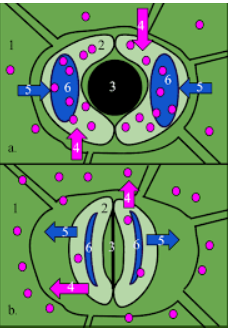
(1) Epidermal cell
(2) Guard cell
(3) Stoma
(4) Movement of potassium ions
(5) Movement of water molecules
(6) Vacuole
The opening and closing of stomata are regulated by guard cells with the help of osmotic pressure.
Stomata open when the guard cells fill up with water (becomes turgid).
Here the inner and outer layer of the guard cells moves outwards and stomata close when water comes out of the guard cells (becomes flaccid).
Here inner and outer layers of the guard cells move towards the pore.
Most widely it is accepted that due to potassium ions movement, the turgidity of the guard cells changes. The guard cells become turgid as the potential ions move inside the guard cells, which lowers the concentration of water inside the guard cells. So water moves inside the guard cells.
Similarly, when the potassium ions move outside of guard cells, the concentration of water becomes higher on the outside. So water moves outside of the guard cells.
So, the correct answer is “Option A”.
Note: Stomata (singular: stoma) are pores present in the leaves of the plant.
A higher number of stomata are present on the lower surface of the leaves. The pore is surrounded by two bean-shaped cells (parenchyma cells) called guard cells.
Stomatal regulation is controlling the opening and closing of stomata with the help of osmotic pressure.
Complete answer:
(1) Epidermal cell
(2) Guard cell
(3) Stoma
(4) Movement of potassium ions
(5) Movement of water molecules
(6) Vacuole
The opening and closing of stomata are regulated by guard cells with the help of osmotic pressure.
Stomata open when the guard cells fill up with water (becomes turgid).
Here the inner and outer layer of the guard cells moves outwards and stomata close when water comes out of the guard cells (becomes flaccid).
Here inner and outer layers of the guard cells move towards the pore.
Most widely it is accepted that due to potassium ions movement, the turgidity of the guard cells changes. The guard cells become turgid as the potential ions move inside the guard cells, which lowers the concentration of water inside the guard cells. So water moves inside the guard cells.
Similarly, when the potassium ions move outside of guard cells, the concentration of water becomes higher on the outside. So water moves outside of the guard cells.
So, the correct answer is “Option A”.
Note: Stomata (singular: stoma) are pores present in the leaves of the plant.
A higher number of stomata are present on the lower surface of the leaves. The pore is surrounded by two bean-shaped cells (parenchyma cells) called guard cells.
Recently Updated Pages
Master Class 11 English: Engaging Questions & Answers for Success

Master Class 11 Maths: Engaging Questions & Answers for Success
Class 11 Question and Answer - Your Ultimate Solutions Guide
Master Class 11 Biology: Engaging Questions & Answers for Success
Master Class 11 Physics: Engaging Questions & Answers for Success
Master Class 11 Accountancy: Engaging Questions & Answers for Success
Trending doubts
Differentiate between an exothermic and an endothermic class 11 chemistry CBSE
One Metric ton is equal to kg A 10000 B 1000 C 100 class 11 physics CBSE
In what year Guru Nanak Dev ji was born A15 April 1469 class 11 social science CBSE
Difference Between Prokaryotic Cells and Eukaryotic Cells
Draw a diagram of a plant cell and label at least eight class 11 biology CBSE
1 Quintal is equal to a 110 kg b 10 kg c 100kg d 1000 class 11 physics CBSE