




The meiospores of yeast are nonmotile and called-
(A)Aeciospores
(B)Aplanospores
(C)Ascospores
(D)Basidiospores
Answer
 Verified
592.8k+ views
Hint: The meiospores of yeast are nonmotile and are contained in an ascus or that was produced inside an ascus. This type of spore is particular to fungi classified as ascomycetes. Ascomycetes are spore shooters.
Complete answer:
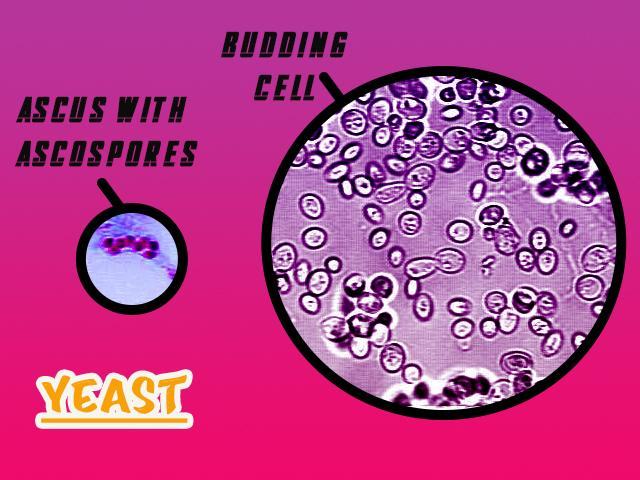
The meiospores of yeast are nonmotile and called Ascospores. Ascospores are formed in ascus under optimal conditions. Typically, one ascus will contain eight ascospores (or octad). An ascus is defined as the sexual spore-bearing cell produced in ascomycete fungi.
Additional Information: Ascomycota - It is a phylum of the Fungi that, along with the Basidiomycota, forms the very known subkingdom Dikarya. Its members are commonly referred to as the sac fungi or ascomycetes. It's the biggest phylum of Fungi, with over 64,000 species. The eight spores are produced by the meiosis which is then followed by a mitotic division. Two meiotic divisions turn the first diploid zygote nucleus into four haploid ones. That is, the only original diploid cell from which the entire process begins contains two complete sets of chromosomes. In preparation for meiosis, all the DNA of both sets is duplicated, to form a complete of 4 sets. The nucleus that contains the four sets divides two times, due to which separating into four new nuclei – each of which has one complete set of chromosomes. Following this process, the four new nuclei duplicate its DNA and undergoes a division by the process known as mitosis. As a result, the ascus will contain 4 pairs of spores in it. Then the ascospores are released from the ascus.
So, the correct answer is ‘Ascospores’.
Note: Many of us get confused between Aeciospores and Ascospores. The Aeciospores are one of several different types of spores formed by Rusts. They each have 2 nuclei and are typically seen in the chain-like formations in the aecium.
Complete answer:
The meiospores of yeast are nonmotile and called Ascospores. Ascospores are formed in ascus under optimal conditions. Typically, one ascus will contain eight ascospores (or octad). An ascus is defined as the sexual spore-bearing cell produced in ascomycete fungi.
Additional Information: Ascomycota - It is a phylum of the Fungi that, along with the Basidiomycota, forms the very known subkingdom Dikarya. Its members are commonly referred to as the sac fungi or ascomycetes. It's the biggest phylum of Fungi, with over 64,000 species. The eight spores are produced by the meiosis which is then followed by a mitotic division. Two meiotic divisions turn the first diploid zygote nucleus into four haploid ones. That is, the only original diploid cell from which the entire process begins contains two complete sets of chromosomes. In preparation for meiosis, all the DNA of both sets is duplicated, to form a complete of 4 sets. The nucleus that contains the four sets divides two times, due to which separating into four new nuclei – each of which has one complete set of chromosomes. Following this process, the four new nuclei duplicate its DNA and undergoes a division by the process known as mitosis. As a result, the ascus will contain 4 pairs of spores in it. Then the ascospores are released from the ascus.
So, the correct answer is ‘Ascospores’.
Note: Many of us get confused between Aeciospores and Ascospores. The Aeciospores are one of several different types of spores formed by Rusts. They each have 2 nuclei and are typically seen in the chain-like formations in the aecium.
Recently Updated Pages
Three beakers labelled as A B and C each containing 25 mL of water were taken A small amount of NaOH anhydrous CuSO4 and NaCl were added to the beakers A B and C respectively It was observed that there was an increase in the temperature of the solutions contained in beakers A and B whereas in case of beaker C the temperature of the solution falls Which one of the following statements isarecorrect i In beakers A and B exothermic process has occurred ii In beakers A and B endothermic process has occurred iii In beaker C exothermic process has occurred iv In beaker C endothermic process has occurred

Master Class 11 Social Science: Engaging Questions & Answers for Success
Master Class 11 Physics: Engaging Questions & Answers for Success
Master Class 11 Maths: Engaging Questions & Answers for Success
Master Class 11 Economics: Engaging Questions & Answers for Success
Master Class 11 Computer Science: Engaging Questions & Answers for Success
Three beakers labelled as A B and C each containing 25 mL of water were taken A small amount of NaOH anhydrous CuSO4 and NaCl were added to the beakers A B and C respectively It was observed that there was an increase in the temperature of the solutions contained in beakers A and B whereas in case of beaker C the temperature of the solution falls Which one of the following statements isarecorrect i In beakers A and B exothermic process has occurred ii In beakers A and B endothermic process has occurred iii In beaker C exothermic process has occurred iv In beaker C endothermic process has occurred
Master Class 11 Social Science: Engaging Questions & Answers for Success
Master Class 11 Physics: Engaging Questions & Answers for Success
Trending doubts
One Metric ton is equal to kg A 10000 B 1000 C 100 class 11 physics CBSE
There are 720 permutations of the digits 1 2 3 4 5 class 11 maths CBSE
State and prove Bernoullis theorem class 11 physics CBSE
Draw a diagram of a plant cell and label at least eight class 11 biology CBSE
Difference Between Prokaryotic Cells and Eukaryotic Cells
1 Quintal is equal to a 110 kg b 10 kg c 100kg d 1000 class 11 physics CBSE