




The material used for permanent magnet has
A) Low retentivity, high coercivity
B) High retentivity, low coercivity
C) High retentivity, high coercivity
D) Low retentivity, low coercivity
Answer
 Verified
622.2k+ views
Hint: Permanent magnets just like the other magnets have two poles: the North pole and South pole. Retentivity and coercivity are the properties of the magnet which helps in determining the strength of the magnet. These are the abilities of the magnet to stay in some other state or come back in its original state.
Complete step by step answer:
Step I:
In order to make a good permanent magnet, it should have a high value of retentivity and a high value of coercivity.
Retentivity is the ability of the magnetic material by which the magnetic field remains in the material even after removing the source of the external magnetic field. Whereas, coercivity or coercive force is the minimum amount of magnetic intensity needed to bring back the magnet in a state where the magnetic field is zero is known as coercivity.
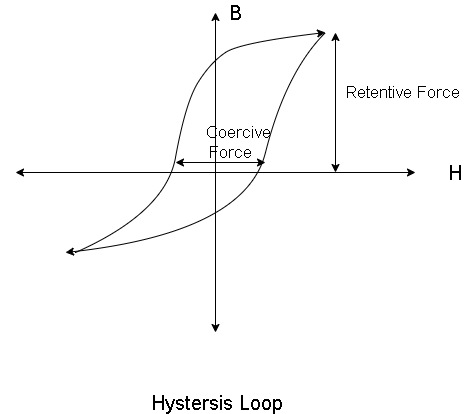
Here $B$ refers to the retentivity of the magnet and $H$ shows the coercive power of the magnet. A hysteresis loop is used to show the relation between magnetic force $B$ and magnetic flux $H$.
Step II:
Permanent magnets do not require an external magnetic field. They produce their own magnetic field which is available all the time. Some examples of permanent magnets are steel and alnico. Due to their ability to produce their own magnetic fields, they are used in hard drives, phones, sensors, generators, and many other electronics.
Permanent magnets have high values of retentivity and coercivity. Therefore, Option (C) is the correct answer.
Note:
Sometimes there arises a question, whether permanent magnets are similar to electromagnets or not? So, they both are different. A permanent magnet creates its own magnetic field. But an electromagnet is a coil of wire which behaves like a magnet when a current is made to pass through it.
Complete step by step answer:
Step I:
In order to make a good permanent magnet, it should have a high value of retentivity and a high value of coercivity.
Retentivity is the ability of the magnetic material by which the magnetic field remains in the material even after removing the source of the external magnetic field. Whereas, coercivity or coercive force is the minimum amount of magnetic intensity needed to bring back the magnet in a state where the magnetic field is zero is known as coercivity.
Here $B$ refers to the retentivity of the magnet and $H$ shows the coercive power of the magnet. A hysteresis loop is used to show the relation between magnetic force $B$ and magnetic flux $H$.
Step II:
Permanent magnets do not require an external magnetic field. They produce their own magnetic field which is available all the time. Some examples of permanent magnets are steel and alnico. Due to their ability to produce their own magnetic fields, they are used in hard drives, phones, sensors, generators, and many other electronics.
Permanent magnets have high values of retentivity and coercivity. Therefore, Option (C) is the correct answer.
Note:
Sometimes there arises a question, whether permanent magnets are similar to electromagnets or not? So, they both are different. A permanent magnet creates its own magnetic field. But an electromagnet is a coil of wire which behaves like a magnet when a current is made to pass through it.
Recently Updated Pages
Master Class 12 Business Studies: Engaging Questions & Answers for Success

Master Class 12 Chemistry: Engaging Questions & Answers for Success
Master Class 12 Biology: Engaging Questions & Answers for Success
Class 12 Question and Answer - Your Ultimate Solutions Guide
Master Class 11 English: Engaging Questions & Answers for Success
Master Class 11 Social Science: Engaging Questions & Answers for Success
Trending doubts
Which are the Top 10 Largest Countries of the World?
Draw a labelled sketch of the human eye class 12 physics CBSE
The end of compass needle which points towards north class 12 physics CBSE
Differentiate between homogeneous and heterogeneous class 12 chemistry CBSE
Why is the cell called the structural and functional class 12 biology CBSE
When was the first election held in India a 194748 class 12 sst CBSE