



The major product of the following is:
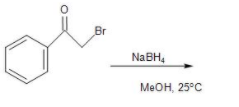
(A)

(B)
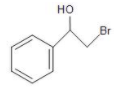
(C)
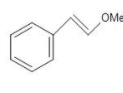
(D)
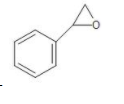
Answer
 Verified
636k+ views
Hint: The carbonyl group present in the given compound, in presence of the selective reducing agent undergoes reduction with a formation of new C-H bond, followed by the protonation of the oxygen on the carbonyl carbon.
Complete step by step answer:
In the given compound, that is, 2-Bromoacetophenone the reaction taking place in presence of a reducing agent, that is sodium borohydride in methanol solvent. It causes the reduction of the ketone group present in the compound. In the mechanism, the hydride $({{H}^{-}})$ detaches from the sodium borohydride and attacks the partially positive carbonyl carbon of the ketone group. Thus, a new C-H bond is formed, followed by a negative charge on the oxygen. Thus, forming an alkoxide ion.
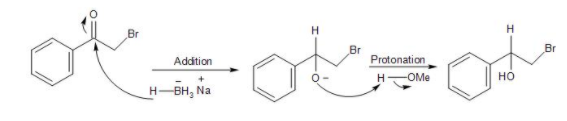
This is followed by the protonation of the ion by the methyl alcohol to form a secondary alcohol, that is, 2-Bromo-1-phenyl-ethanol compound. Thus, the reduction of the ketone to alcohol took place by the sodium borohydride in MeOH solvent.
Therefore, the major product formed from the reduction of the given compound is option (B) 2-Bromo-1-phenyl-ethanol.
Note: The $NaB{{H}_{4}}$ is a very selective reducing agent. It can only cause reduction of the aldehyde, ketones, and acid chloride to alcohols. Even though we get a primary alcohol in case of aldehydes and acid chlorides. Whereas the ketone generally forms secondary alcohol.
Also, due to the minimal difference in the electronegativity of boron (2.0) and hydrogen (2.1). The bond is less polar, thus less electron density of the hydrides. This makes them less nucleophilic and thus a mild reducing agent.
Complete step by step answer:
In the given compound, that is, 2-Bromoacetophenone the reaction taking place in presence of a reducing agent, that is sodium borohydride in methanol solvent. It causes the reduction of the ketone group present in the compound. In the mechanism, the hydride $({{H}^{-}})$ detaches from the sodium borohydride and attacks the partially positive carbonyl carbon of the ketone group. Thus, a new C-H bond is formed, followed by a negative charge on the oxygen. Thus, forming an alkoxide ion.
This is followed by the protonation of the ion by the methyl alcohol to form a secondary alcohol, that is, 2-Bromo-1-phenyl-ethanol compound. Thus, the reduction of the ketone to alcohol took place by the sodium borohydride in MeOH solvent.
Therefore, the major product formed from the reduction of the given compound is option (B) 2-Bromo-1-phenyl-ethanol.
Note: The $NaB{{H}_{4}}$ is a very selective reducing agent. It can only cause reduction of the aldehyde, ketones, and acid chloride to alcohols. Even though we get a primary alcohol in case of aldehydes and acid chlorides. Whereas the ketone generally forms secondary alcohol.
Also, due to the minimal difference in the electronegativity of boron (2.0) and hydrogen (2.1). The bond is less polar, thus less electron density of the hydrides. This makes them less nucleophilic and thus a mild reducing agent.
Recently Updated Pages
A concave lens of focal length 15 cm forms an image class 12 physics CBSE

Draw a diagram of nuclear power reactor and label the class 12 physics CBSE
Define relaxation time of the free electrons drifting class 12 physics CBSE
Draw a ray diagram of compound microscope when the class 12 physics CBSE
Suicide bags of cells are aEndoplasmic reticulum bLysosome class 12 biology CBSE
Why is AC more dangerous than DC class 12 physics CBSE
Trending doubts
Draw a labelled sketch of the human eye class 12 physics CBSE
Which are the Top 10 Largest Countries of the World?
Draw ray diagrams each showing i myopic eye and ii class 12 physics CBSE
Which is the correct genotypic ratio of mendel dihybrid class 12 biology CBSE
Differentiate between homogeneous and heterogeneous class 12 chemistry CBSE
Which animal never drinks water in its entire life class 12 biology CBSE