




The magnification produced by a convex lens for two different positions of an object are ${m_1}$ and ${m_2}$ respectively (${m_1} > {m_2}$). If $'d'$ is the separation between the two positions of the object then the focal length of the lens is
A. $\sqrt {{m_1}{m_2}} $
B. $\dfrac{1}{{\sqrt {{m_1} - {m_2}} }}$
C. $\dfrac{{d\,{m_1}{m_2}}}{{{m_1} - {m_2}}}$
D. $\dfrac{d}{{{m_1} - {m_2}}}$
Answer
 Verified
606.6k+ views
Hint: Here, we will use the formula of magnification of the lens and the lens formula to calculate the focal length of the lens. Focal length is defined as the distance of the lens from the focal point of the lens.
Complete step by step answer:
Here, we will consider a convex lens placed in between the object and the screen
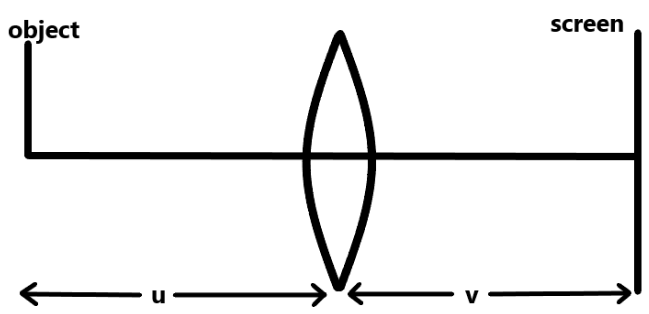
Where, $u$ is the distance of the object from the lens and $v$ is the distance of the image from the lens.
Here, in this case, magnification is given by
${m_1} = \dfrac{v}{u}$
$v = {m_1}u$
Now, let the object be displaced from its original position at a distance $d$ from its original position as shown below.
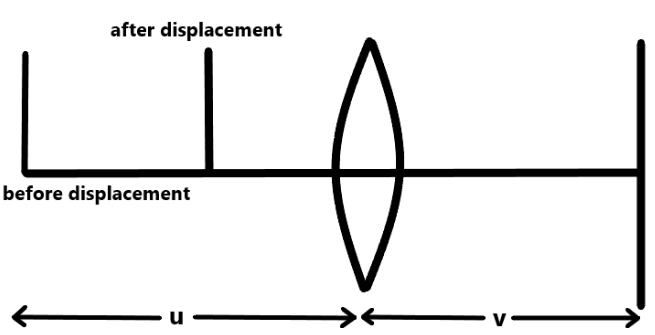
Where, $d$ is the distance of the lens from its original position.
Here, in this case, the magnification is given by
${m_2} = \dfrac{u}{v}$
$u = {m_2}v$
Now, multiplying both the magnifications, we get
${m_1} \times {m_2} = \dfrac{v}{u} \times \dfrac{u}{v}$
$ \Rightarrow \,{m_1} \times {m_2} = 1$
Now, using lens formula,
$\dfrac{1}{f} = \dfrac{1}{v} + \dfrac{1}{u}$
Now, putting the value of $v$ in the above equation, we get
$\dfrac{1}{f} = \dfrac{1}{{u{m_1}}} + \dfrac{1}{u}$
$ \Rightarrow \,\dfrac{1}{f} = \dfrac{{1 + {m_1}}}{{u{m_1}}}$
From here, we can get the value of $u$ , as shown below
$u = \dfrac{{f\left( {1 + {m_1}} \right)}}{{{m_1}}}$
Also, by putting the value of $v$ by using lens formula as
$\dfrac{1}{f} = \dfrac{1}{v} + \dfrac{1}{u}$
$ \Rightarrow \,\dfrac{1}{f} = \dfrac{1}{v} + \dfrac{1}{{{m_2}v}}$
$ \Rightarrow \,\dfrac{1}{f} = \dfrac{{{m_2} + 1}}{{{m_2}v}}$
From here, we can get the value of $v$ as
$v = \dfrac{{f\left( {{m_2} + 1} \right)}}{{{m_2}}}$
Now, when the object is displaced from its original position the distance between the original position and the displaced of the object is given by
$d = v - u$
Now, putting the values of $v$ and $u$ , we get
$d = \dfrac{{f\left( {{m_2} + 1} \right)}}{{{m_2}}} - \dfrac{{f\left( {{m_1} + 1} \right)}}{{{m_1}}}$
$ \Rightarrow \,d = \dfrac{{{m_1}f\left( {{m_2} + 1} \right) - {m_2}f\left( {{m_1} + 1} \right)}}{{{m_1}{m_2}}}$
Now taking $f$ common, we get
$d = f\dfrac{{{m_1}\left( {{m_2} + 1} \right) - {m_2}\left( {{m_1} + 1} \right)}}{{{m_1}{m_2}}}$
Now, we will get the value of $f$ as
$f = \dfrac{{d{m_1}{m_2}}}{{{m_1}\left( {{m_2} + 1} \right) - {m_2}\left( {{m_1} + 1} \right)}}$
$ \Rightarrow \,f = \dfrac{{d{m_1}{m_2}}}{{{m_1}{m_2} + {m_1} - {m_1}{m_2} - {m_2}}}$
$ \Rightarrow \,f = \dfrac{{d{m_1}{m_2}}}{{{m_1} - {m_2}}}$
But, $\,{m_1} \times {m_2} = 1$
Therefore, we get
$\therefore f = \dfrac{d}{{{m_1} - {m_2}}}$
Therefore, the focal length of the lens is $f = \dfrac{d}{{{m_1} - {m_2}}}$
Hence, option D is the correct option.
Note:Magnifying is the process in which the object is magnified or enlarged so that one must have a clear vision of the distant object. In some cases, we can also magnify an image. It is also defined as the ratio of the height of an image to the height of an object.
Complete step by step answer:
Here, we will consider a convex lens placed in between the object and the screen
Where, $u$ is the distance of the object from the lens and $v$ is the distance of the image from the lens.
Here, in this case, magnification is given by
${m_1} = \dfrac{v}{u}$
$v = {m_1}u$
Now, let the object be displaced from its original position at a distance $d$ from its original position as shown below.
Where, $d$ is the distance of the lens from its original position.
Here, in this case, the magnification is given by
${m_2} = \dfrac{u}{v}$
$u = {m_2}v$
Now, multiplying both the magnifications, we get
${m_1} \times {m_2} = \dfrac{v}{u} \times \dfrac{u}{v}$
$ \Rightarrow \,{m_1} \times {m_2} = 1$
Now, using lens formula,
$\dfrac{1}{f} = \dfrac{1}{v} + \dfrac{1}{u}$
Now, putting the value of $v$ in the above equation, we get
$\dfrac{1}{f} = \dfrac{1}{{u{m_1}}} + \dfrac{1}{u}$
$ \Rightarrow \,\dfrac{1}{f} = \dfrac{{1 + {m_1}}}{{u{m_1}}}$
From here, we can get the value of $u$ , as shown below
$u = \dfrac{{f\left( {1 + {m_1}} \right)}}{{{m_1}}}$
Also, by putting the value of $v$ by using lens formula as
$\dfrac{1}{f} = \dfrac{1}{v} + \dfrac{1}{u}$
$ \Rightarrow \,\dfrac{1}{f} = \dfrac{1}{v} + \dfrac{1}{{{m_2}v}}$
$ \Rightarrow \,\dfrac{1}{f} = \dfrac{{{m_2} + 1}}{{{m_2}v}}$
From here, we can get the value of $v$ as
$v = \dfrac{{f\left( {{m_2} + 1} \right)}}{{{m_2}}}$
Now, when the object is displaced from its original position the distance between the original position and the displaced of the object is given by
$d = v - u$
Now, putting the values of $v$ and $u$ , we get
$d = \dfrac{{f\left( {{m_2} + 1} \right)}}{{{m_2}}} - \dfrac{{f\left( {{m_1} + 1} \right)}}{{{m_1}}}$
$ \Rightarrow \,d = \dfrac{{{m_1}f\left( {{m_2} + 1} \right) - {m_2}f\left( {{m_1} + 1} \right)}}{{{m_1}{m_2}}}$
Now taking $f$ common, we get
$d = f\dfrac{{{m_1}\left( {{m_2} + 1} \right) - {m_2}\left( {{m_1} + 1} \right)}}{{{m_1}{m_2}}}$
Now, we will get the value of $f$ as
$f = \dfrac{{d{m_1}{m_2}}}{{{m_1}\left( {{m_2} + 1} \right) - {m_2}\left( {{m_1} + 1} \right)}}$
$ \Rightarrow \,f = \dfrac{{d{m_1}{m_2}}}{{{m_1}{m_2} + {m_1} - {m_1}{m_2} - {m_2}}}$
$ \Rightarrow \,f = \dfrac{{d{m_1}{m_2}}}{{{m_1} - {m_2}}}$
But, $\,{m_1} \times {m_2} = 1$
Therefore, we get
$\therefore f = \dfrac{d}{{{m_1} - {m_2}}}$
Therefore, the focal length of the lens is $f = \dfrac{d}{{{m_1} - {m_2}}}$
Hence, option D is the correct option.
Note:Magnifying is the process in which the object is magnified or enlarged so that one must have a clear vision of the distant object. In some cases, we can also magnify an image. It is also defined as the ratio of the height of an image to the height of an object.
Recently Updated Pages
Master Class 12 Business Studies: Engaging Questions & Answers for Success

Master Class 12 Chemistry: Engaging Questions & Answers for Success
Master Class 12 Biology: Engaging Questions & Answers for Success
Class 12 Question and Answer - Your Ultimate Solutions Guide
Master Class 11 English: Engaging Questions & Answers for Success
Master Class 11 Social Science: Engaging Questions & Answers for Success
Trending doubts
Which are the Top 10 Largest Countries of the World?
Draw a labelled sketch of the human eye class 12 physics CBSE
Differentiate between homogeneous and heterogeneous class 12 chemistry CBSE
Differentiate between Pyramid of energy and pyramid class 12 biology CBSE
Why is the cell called the structural and functional class 12 biology CBSE
Draw the diagram of the pyramid of energy Explain In class 12 biology CBSE