




The magnetic length of a bar magnet is 10 cm then its geometric length is:
A. 10 cm
B. 12 cm
C. 5 cm
D. 6 cm
Answer
 Verified
609.6k+ views
Hint: Magnetic field is the space around the magnet where the effect of magnet can be felt by another magnet or iron piece. Magnetic fields can also be produced by a moving charge whose intensity can be determined by the velocity and magnitude of charge or using a magnet having definite pole strength. The S.I unit of magnetic field is Tesla (T) whereas the C.G.S unit is Gauss (G).
Complete answer:
Inside the earth, we can find several natural occurring materials which produce the magnetic field around them naturally. The reason for this is the arrangement of domain inside the magnet. Such a material is called a natural magnet and bar magnet is an example of this. Every material of magnet has a defined magnetic field associated with it. This can be measured by its pole strength. Hence the amount of magnetic field a magnet will produce is directly associated with its pole strength.
Geometric length: It may be defined as the length which appears to us or the actual length of magnet.
Magnetic length: It may be defined as the distance between two poles of the magnet and poles could actually be defined as the point inside the magnetic material from where maximum magnetic lines are getting originated.
This can be located by drawing tangents at the magnetic lines of the field where they cut the surface of the magnet, as shown in figure.
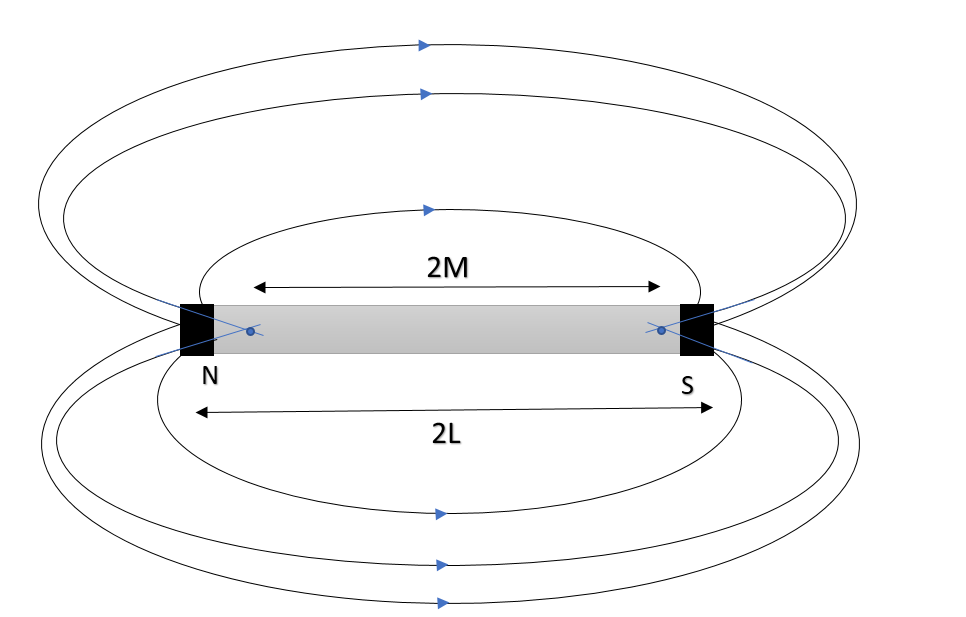
Thus, we can see that magnetic length is 2M which is surely less than 2L.
Hence, geometric length is always greater than magnetic length.
So, the correct answer is “Option B”.
Note:
Always remember that the geometric length of a magnet is always little greater than the magnetic length because it’s always assumed that the poles of the magnet lie little bit inside the material. But practically this distance is very less and one can neglect while doing calculations.
Complete answer:
Inside the earth, we can find several natural occurring materials which produce the magnetic field around them naturally. The reason for this is the arrangement of domain inside the magnet. Such a material is called a natural magnet and bar magnet is an example of this. Every material of magnet has a defined magnetic field associated with it. This can be measured by its pole strength. Hence the amount of magnetic field a magnet will produce is directly associated with its pole strength.
Geometric length: It may be defined as the length which appears to us or the actual length of magnet.
Magnetic length: It may be defined as the distance between two poles of the magnet and poles could actually be defined as the point inside the magnetic material from where maximum magnetic lines are getting originated.
This can be located by drawing tangents at the magnetic lines of the field where they cut the surface of the magnet, as shown in figure.
Thus, we can see that magnetic length is 2M which is surely less than 2L.
Hence, geometric length is always greater than magnetic length.
So, the correct answer is “Option B”.
Note:
Always remember that the geometric length of a magnet is always little greater than the magnetic length because it’s always assumed that the poles of the magnet lie little bit inside the material. But practically this distance is very less and one can neglect while doing calculations.
Recently Updated Pages
Master Class 12 Business Studies: Engaging Questions & Answers for Success

Master Class 12 Biology: Engaging Questions & Answers for Success
Master Class 12 Chemistry: Engaging Questions & Answers for Success
Class 12 Question and Answer - Your Ultimate Solutions Guide
Master Class 11 Social Science: Engaging Questions & Answers for Success
Master Class 11 English: Engaging Questions & Answers for Success
Trending doubts
Which is more stable and why class 12 chemistry CBSE
Which are the Top 10 Largest Countries of the World?
Draw a labelled sketch of the human eye class 12 physics CBSE
Differentiate between homogeneous and heterogeneous class 12 chemistry CBSE
What are the major means of transport Explain each class 12 social science CBSE
Sulphuric acid is known as the king of acids State class 12 chemistry CBSE