




The magnetic field energy in an inductor changes from maximum value to minimum value in 5.0 ms when connected to an AC source. The frequency of the source is:
A. 20 Hz
B. 50 Hz
C. 200 Hz
D. 500 Hz
Answer
 Verified
654.9k+ views
Hint:The magnetic energy stored in an inductor coil is given by the formula :
$E = \dfrac{1}{2}L{I^2}$
where I = current flowing through the coil in ampere (A) and L = self-inductance of the coil in henry(H).
Complete step-by-step answer:
Consider an inductor of inductance L connected to a voltage source of instantaneous voltage V of angular frequency $\omega $.
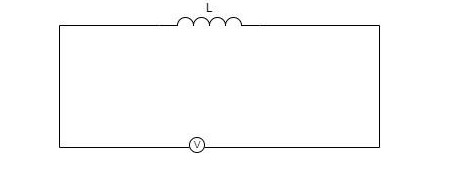
The voltage, $V\left( t \right) = {V_0}\sin \omega t$
In a pure inductive circuit, the current delays by ${90^ \circ }$ by the voltage.
The current, $I\left( t \right) = {I_0}\sin \left( {\omega t - \dfrac{\pi }{2}} \right)$
The energy stored in the inductor, $E = \dfrac{1}{2}L{I^2}$
Substituting, we get –
$E = \dfrac{1}{2}L{I_0}^2{\sin ^2}\left( {\omega t - \dfrac{\pi }{2}} \right)$
The maximum and minimum values of the magnetic energy in this case are when values of current are ${I_0}$ and 0 in which cases the value of${\sin ^2}\left( {\omega t - \dfrac{\pi }{2}} \right)$ are 1 and 0 respectively.
The angles or phases at which they become 1 and 0 respectively, are given by :
${\sin^2}{\omega {t_1}} - \dfrac{\pi }{2} = 1 {\sin ^2}\left( {\omega {t_2} - \dfrac{\pi }{2}} \right) = 0 $
$ \omega {t_1} - \dfrac{\pi }{2} = \dfrac{\pi }{2} \omega {t_2} - \dfrac{\pi }{2} = 0 $
$ \omega {t_1} = \pi \omega {t_2} = \dfrac{\pi }{2} $
By subtracting the maximum and minimum values of phase, we get –
$\omega {t_1} - \omega {t_2} = \pi - \dfrac{\pi }{2}$
Taking $\omega $ common and substituting from the given data that, $\left( {{t_1} - {t_2}} \right) = 5ms = 5 \times {10^{ - 3}}\sec $,we get –
$
\omega \left( {{t_1} - {t_2}} \right) = \dfrac{\pi }{2} \\
\to \omega \left( {5 \times {{10}^{ - 3}}} \right) = \dfrac{\pi }{2} \\
$
The angular frequency , $\omega = 2\pi f$ where f is the frequency in hertz (Hz)
Thus,
\[
2\pi f\left( {5 \times {{10}^{ - 3}}} \right) = \dfrac{\pi }{2} \\
\to 2\pi f\left( {5 \times {{10}^{ - 3}}} \right) = \dfrac{\pi }{2} \\
\to f = \dfrac{1}{{2 \times 2 \times 5 \times {{10}^{ - 3}}}} = \dfrac{{{{10}^3}}}{{20}} \\
\to f = \dfrac{{1000}}{{20}} = 50Hz \\
\]
Therefore, the frequency, f = 50 Hz.
Hence, the correct option is Option B.
Note:The inductor works on the principle of electromagnetic induction. This is the principle on which the inductor is able to store the magnetic energy inside.
When there is changing current in the coil, the magnetic flux arising from that current changes. Whenever the flux changes, it sets up an emf called back emf in the coil, which opposes the change in the magnetic field inside the coil. This phenomenon is called self-inductance. Through this self-inductance, by passing current over time, the coil is able to store the magnetic energy.
$E = \dfrac{1}{2}L{I^2}$
where I = current flowing through the coil in ampere (A) and L = self-inductance of the coil in henry(H).
Complete step-by-step answer:
Consider an inductor of inductance L connected to a voltage source of instantaneous voltage V of angular frequency $\omega $.
The voltage, $V\left( t \right) = {V_0}\sin \omega t$
In a pure inductive circuit, the current delays by ${90^ \circ }$ by the voltage.
The current, $I\left( t \right) = {I_0}\sin \left( {\omega t - \dfrac{\pi }{2}} \right)$
The energy stored in the inductor, $E = \dfrac{1}{2}L{I^2}$
Substituting, we get –
$E = \dfrac{1}{2}L{I_0}^2{\sin ^2}\left( {\omega t - \dfrac{\pi }{2}} \right)$
The maximum and minimum values of the magnetic energy in this case are when values of current are ${I_0}$ and 0 in which cases the value of${\sin ^2}\left( {\omega t - \dfrac{\pi }{2}} \right)$ are 1 and 0 respectively.
The angles or phases at which they become 1 and 0 respectively, are given by :
${\sin^2}{\omega {t_1}} - \dfrac{\pi }{2} = 1 {\sin ^2}\left( {\omega {t_2} - \dfrac{\pi }{2}} \right) = 0 $
$ \omega {t_1} - \dfrac{\pi }{2} = \dfrac{\pi }{2} \omega {t_2} - \dfrac{\pi }{2} = 0 $
$ \omega {t_1} = \pi \omega {t_2} = \dfrac{\pi }{2} $
By subtracting the maximum and minimum values of phase, we get –
$\omega {t_1} - \omega {t_2} = \pi - \dfrac{\pi }{2}$
Taking $\omega $ common and substituting from the given data that, $\left( {{t_1} - {t_2}} \right) = 5ms = 5 \times {10^{ - 3}}\sec $,we get –
$
\omega \left( {{t_1} - {t_2}} \right) = \dfrac{\pi }{2} \\
\to \omega \left( {5 \times {{10}^{ - 3}}} \right) = \dfrac{\pi }{2} \\
$
The angular frequency , $\omega = 2\pi f$ where f is the frequency in hertz (Hz)
Thus,
\[
2\pi f\left( {5 \times {{10}^{ - 3}}} \right) = \dfrac{\pi }{2} \\
\to 2\pi f\left( {5 \times {{10}^{ - 3}}} \right) = \dfrac{\pi }{2} \\
\to f = \dfrac{1}{{2 \times 2 \times 5 \times {{10}^{ - 3}}}} = \dfrac{{{{10}^3}}}{{20}} \\
\to f = \dfrac{{1000}}{{20}} = 50Hz \\
\]
Therefore, the frequency, f = 50 Hz.
Hence, the correct option is Option B.
Note:The inductor works on the principle of electromagnetic induction. This is the principle on which the inductor is able to store the magnetic energy inside.
When there is changing current in the coil, the magnetic flux arising from that current changes. Whenever the flux changes, it sets up an emf called back emf in the coil, which opposes the change in the magnetic field inside the coil. This phenomenon is called self-inductance. Through this self-inductance, by passing current over time, the coil is able to store the magnetic energy.
Recently Updated Pages
Which of the following graphs shows the variation of class 12 physics CBSE

Draw a labelled diagram of the human male reproductive class 12 biology CBSE
Describe the experiment to compare the emf of two cells class 12 physics CBSE
What is standard hydrogen electrode
What is conventional current and electric current class 12 physics CBSE
2Bromopentane is treated with an alcoholic KOH solution class 12 chemistry CBSE
Trending doubts
Draw a labelled sketch of the human eye class 12 physics CBSE
Which are the Top 10 Largest Countries of the World?
Differentiate between homogeneous and heterogeneous class 12 chemistry CBSE
Draw ray diagrams each showing i myopic eye and ii class 12 physics CBSE
Which is the correct genotypic ratio of mendel dihybrid class 12 biology CBSE
What is the Full Form of PVC, PET, HDPE, LDPE, PP and PS ?