




The magnetic field at the center of a current-carrying loop of the radius $0.1m$ is $5\sqrt{5}$ times that at a point along its axis. The distance of this point from the center of the loop is
A. $0.2m$
B. $0.05m$
C. \[0.1m\]
D. $0.25m$
Answer
 Verified
603.3k+ views
Hint: Every current-carrying conductor produces a magnetic field around its circumference. The field lines which are produced never intersect each other. The magnetic field at a point generated around a current-carrying conductor decreases with the increase in the distance of the point from the center.
As per the given data,
The radius (R) of the circle is $0.1m$ $\left( 10cm \right)$
The magnetic field at the center $\left( {{B}_{center}} \right)$ is \[~5\sqrt{5}\left( {{B}_{axis}} \right)\]
Complete answer:
The condition given in the question can be visualized as shown in the diagram below.
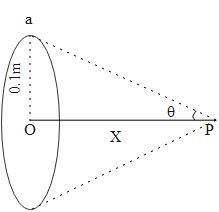
According to the Biot-Savart's Law, the magnetic field at the center of the circular loop is given as,
${{B}_{center}}=\dfrac{{{\mu }_{0}}I}{2R}$
So from the given information
${{B}_{center}}=5\sqrt{5}{{B}_{axis}}=\dfrac{{{\mu }_{0}}I}{2R}\quad ...\left( 1 \right)$
In the case of a circular conductor loop, every point of the conductor has its impact on the magnetic field at a point tangentially to the loop. The magnetic field can be divided into Cartesian coordinates x and y.

The sin component of the magnetic field will be canceled out. So the magnetic field on a point on the axis of the current-carrying loop is given by,
${{B}_{axis}}=\dfrac{{{\mu }_{0}}I{{R}^{2}}}{2{{({{R}^{2}}+{{X}^{2}})}^{\dfrac{3}{2}}}}\quad ....(2)$
Where,
$R$ Is the radius of the circle
$X$ Is the distance of the point from the center of the circle
Combining equations (1) and (2),
$\begin{align}
& {{B}_{center}}=5\sqrt{5}\left( \dfrac{{{\mu }_{0}}I{{R}^{2}}}{2{{({{R}^{2}}+{{X}^{2}})}^{\dfrac{3}{2}}}} \right) \\
& \Rightarrow \dfrac{{{\mu }_{0}}I}{2R}=\left( \dfrac{{{\mu }_{0}}I{{R}^{2}}}{2{{({{R}^{2}}+{{X}^{2}})}^{\dfrac{3}{2}}}} \right) \\
\end{align}$
This equation can be simplified as,
$\begin{align}
& {{\left( 5\sqrt{5} \right)}^{2}}=\dfrac{{{\left( {{R}^{2}}+{{X}^{2}} \right)}^{3}}}{{{R}^{6}}} \\
& \Rightarrow 125=\dfrac{{{\left( {{R}^{2}}+{{X}^{2}} \right)}^{3}}}{{{R}^{6}}} \\
& \Rightarrow 125=1+\left( \dfrac{{{X}^{2}}}{{{R}^{2}}} \right) \\
& \Rightarrow \dfrac{{{X}^{2}}}{{{R}^{2}}}=124 \\
& \Rightarrow X=2R \\
\end{align}$
By putting the value of radius in $cm$
$\begin{align}
& X=2(10) \\
& \therefore X=20cm=0.2m \\
\end{align}$
So, from the above calculation, we can conclude that the distance of the point $P$ from the center of the loop is $0.2m$.
And the correct option which satisfies the given situation in the question is Option A.
Note:
The Biot-Savart's Law was discovered by Sir Jean-Baptiste Biot and Sir Félix Savart in 1820. This law was resultant of the discovery of magnetic induction $(B)$ which is proportional to The magnetic field $\left( H \right)$. They mathematically formulated an equation of the magnetic induction produced due to a current-carrying conductor.
As per the given data,
The radius (R) of the circle is $0.1m$ $\left( 10cm \right)$
The magnetic field at the center $\left( {{B}_{center}} \right)$ is \[~5\sqrt{5}\left( {{B}_{axis}} \right)\]
Complete answer:
The condition given in the question can be visualized as shown in the diagram below.
According to the Biot-Savart's Law, the magnetic field at the center of the circular loop is given as,
${{B}_{center}}=\dfrac{{{\mu }_{0}}I}{2R}$
So from the given information
${{B}_{center}}=5\sqrt{5}{{B}_{axis}}=\dfrac{{{\mu }_{0}}I}{2R}\quad ...\left( 1 \right)$
In the case of a circular conductor loop, every point of the conductor has its impact on the magnetic field at a point tangentially to the loop. The magnetic field can be divided into Cartesian coordinates x and y.
The sin component of the magnetic field will be canceled out. So the magnetic field on a point on the axis of the current-carrying loop is given by,
${{B}_{axis}}=\dfrac{{{\mu }_{0}}I{{R}^{2}}}{2{{({{R}^{2}}+{{X}^{2}})}^{\dfrac{3}{2}}}}\quad ....(2)$
Where,
$R$ Is the radius of the circle
$X$ Is the distance of the point from the center of the circle
Combining equations (1) and (2),
$\begin{align}
& {{B}_{center}}=5\sqrt{5}\left( \dfrac{{{\mu }_{0}}I{{R}^{2}}}{2{{({{R}^{2}}+{{X}^{2}})}^{\dfrac{3}{2}}}} \right) \\
& \Rightarrow \dfrac{{{\mu }_{0}}I}{2R}=\left( \dfrac{{{\mu }_{0}}I{{R}^{2}}}{2{{({{R}^{2}}+{{X}^{2}})}^{\dfrac{3}{2}}}} \right) \\
\end{align}$
This equation can be simplified as,
$\begin{align}
& {{\left( 5\sqrt{5} \right)}^{2}}=\dfrac{{{\left( {{R}^{2}}+{{X}^{2}} \right)}^{3}}}{{{R}^{6}}} \\
& \Rightarrow 125=\dfrac{{{\left( {{R}^{2}}+{{X}^{2}} \right)}^{3}}}{{{R}^{6}}} \\
& \Rightarrow 125=1+\left( \dfrac{{{X}^{2}}}{{{R}^{2}}} \right) \\
& \Rightarrow \dfrac{{{X}^{2}}}{{{R}^{2}}}=124 \\
& \Rightarrow X=2R \\
\end{align}$
By putting the value of radius in $cm$
$\begin{align}
& X=2(10) \\
& \therefore X=20cm=0.2m \\
\end{align}$
So, from the above calculation, we can conclude that the distance of the point $P$ from the center of the loop is $0.2m$.
And the correct option which satisfies the given situation in the question is Option A.
Note:
The Biot-Savart's Law was discovered by Sir Jean-Baptiste Biot and Sir Félix Savart in 1820. This law was resultant of the discovery of magnetic induction $(B)$ which is proportional to The magnetic field $\left( H \right)$. They mathematically formulated an equation of the magnetic induction produced due to a current-carrying conductor.
Recently Updated Pages
Master Class 12 Business Studies: Engaging Questions & Answers for Success

Master Class 12 Chemistry: Engaging Questions & Answers for Success
Master Class 12 Biology: Engaging Questions & Answers for Success
Class 12 Question and Answer - Your Ultimate Solutions Guide
Master Class 11 Social Science: Engaging Questions & Answers for Success
Master Class 11 Chemistry: Engaging Questions & Answers for Success
Trending doubts
Which are the Top 10 Largest Countries of the World?
Draw a labelled sketch of the human eye class 12 physics CBSE
Name the crygenes that control cotton bollworm and class 12 biology CBSE
Differentiate between homogeneous and heterogeneous class 12 chemistry CBSE
Ribosomal RNA is actively synthesised in A Nucleoplasm class 12 biology CBSE
How many molecules of ATP and NADPH are required information class 12 biology CBSE