




The magnetic field at a distance x on the axis of a circular coil of radius R is $\dfrac{1}{8}th$ of that of the centre. The value of x is
A) $\dfrac{R}{\sqrt{3}}$
B)$\dfrac{2R}{\sqrt{3}}$
C)$R\sqrt{3}$
D)$R\sqrt{2}$
Answer
 Verified
568.8k+ views
Hint: In the above question the magnetic field along the axis of the coil is at its centre is given to us. The magnetic field along the axis is governed by a particular relation. Hence comparing the magnetic field at the centre of the coil and at distance x such that the magnetic field is $\dfrac{1}{8}th$ of that of the centre, will enable us to determine the required value of x.
Formula used:
$B=\dfrac{{{\mu }_{\circ }}i{{R}^{2}}}{2{{({{x}^{2}}+{{R}^{2}})}^{3/2}}}$
Complete step-by-step answer:
Let us say we have a circular coil of radius R carrying current ‘i’ as shown in the figure below.
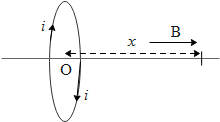
The magnetic field at a distance x from the centre of the coil is given by,
$B=\dfrac{{{\mu }_{\circ }}i{{R}^{2}}}{2{{({{x}^{2}}+{{R}^{2}})}^{3/2}}}$ where ${{\mu }_{\circ }}$ is the permeability of free space.
At x = 0, i.e. the centre of the coil the magnetic field is equal to,
$\begin{align}
& B=\dfrac{{{\mu }_{\circ }}i{{R}^{2}}}{2{{({{x}^{2}}+{{R}^{2}})}^{3/2}}} \\
& \Rightarrow B=\dfrac{{{\mu }_{\circ }}i{{R}^{2}}}{2{{({{\left( 0 \right)}^{2}}+{{R}^{2}})}^{3/2}}} \\
& \therefore B=\dfrac{{{\mu }_{\circ }}i}{2R}.....(1) \\
\end{align}$
Similarly the magnetic field at a distance x from the centre is equal to,
${{B}_{1}}=\dfrac{{{\mu }_{\circ }}i{{R}^{2}}}{2{{({{x}^{2}}+{{R}^{2}})}^{3/2}}}.....(2)$
In the question it is given that the magnetic field at a distance x on the axis of a circular coil of radius R is $\dfrac{1}{8}th$ of that of the centre. Therefore taking the ratio of equation 1 and 2 we get,
$\begin{align}
& \dfrac{{{B}_{1}}}{B}=\dfrac{\dfrac{{{\mu }_{\circ }}i{{R}^{2}}}{2{{({{x}^{2}}+{{R}^{2}})}^{3/2}}}}{\dfrac{{{\mu }_{\circ }}i}{2R}} \\
& \Rightarrow \dfrac{{{B}_{1}}}{B}=\dfrac{{{R}^{3}}}{{{({{x}^{2}}+{{R}^{2}})}^{3/2}}} \\
& \because {{B}_{1}}=\dfrac{1}{8}B \\
& \Rightarrow \dfrac{{{B}_{1}}}{8{{B}_{1}}}=\dfrac{{{R}^{3}}}{{{({{x}^{2}}+{{R}^{2}})}^{3/2}}} \\
& \Rightarrow 8{{R}^{3}}={{({{x}^{2}}+{{R}^{2}})}^{3/2}} \\
& \Rightarrow 2R={{({{x}^{2}}+{{R}^{2}})}^{1/2}} \\
& \Rightarrow 4{{R}^{2}}={{x}^{2}}+{{R}^{2}} \\
& \Rightarrow {{x}^{2}}=3{{R}^{2}} \\
& \therefore x=\sqrt{3}R \\
\end{align}$
So, the correct answer is “Option C”.
Note: It is to be noted that we have taken the cube root on both the sides of the equation so that the power 3 on both the sides becomes 1. Further squaring on both the sides will help to get rid of the square root in the subsequent step. In the above question we have assumed the coil to be of single loop as the value of magnetic field in case of comparison does not matter.
Formula used:
$B=\dfrac{{{\mu }_{\circ }}i{{R}^{2}}}{2{{({{x}^{2}}+{{R}^{2}})}^{3/2}}}$
Complete step-by-step answer:
Let us say we have a circular coil of radius R carrying current ‘i’ as shown in the figure below.
The magnetic field at a distance x from the centre of the coil is given by,
$B=\dfrac{{{\mu }_{\circ }}i{{R}^{2}}}{2{{({{x}^{2}}+{{R}^{2}})}^{3/2}}}$ where ${{\mu }_{\circ }}$ is the permeability of free space.
At x = 0, i.e. the centre of the coil the magnetic field is equal to,
$\begin{align}
& B=\dfrac{{{\mu }_{\circ }}i{{R}^{2}}}{2{{({{x}^{2}}+{{R}^{2}})}^{3/2}}} \\
& \Rightarrow B=\dfrac{{{\mu }_{\circ }}i{{R}^{2}}}{2{{({{\left( 0 \right)}^{2}}+{{R}^{2}})}^{3/2}}} \\
& \therefore B=\dfrac{{{\mu }_{\circ }}i}{2R}.....(1) \\
\end{align}$
Similarly the magnetic field at a distance x from the centre is equal to,
${{B}_{1}}=\dfrac{{{\mu }_{\circ }}i{{R}^{2}}}{2{{({{x}^{2}}+{{R}^{2}})}^{3/2}}}.....(2)$
In the question it is given that the magnetic field at a distance x on the axis of a circular coil of radius R is $\dfrac{1}{8}th$ of that of the centre. Therefore taking the ratio of equation 1 and 2 we get,
$\begin{align}
& \dfrac{{{B}_{1}}}{B}=\dfrac{\dfrac{{{\mu }_{\circ }}i{{R}^{2}}}{2{{({{x}^{2}}+{{R}^{2}})}^{3/2}}}}{\dfrac{{{\mu }_{\circ }}i}{2R}} \\
& \Rightarrow \dfrac{{{B}_{1}}}{B}=\dfrac{{{R}^{3}}}{{{({{x}^{2}}+{{R}^{2}})}^{3/2}}} \\
& \because {{B}_{1}}=\dfrac{1}{8}B \\
& \Rightarrow \dfrac{{{B}_{1}}}{8{{B}_{1}}}=\dfrac{{{R}^{3}}}{{{({{x}^{2}}+{{R}^{2}})}^{3/2}}} \\
& \Rightarrow 8{{R}^{3}}={{({{x}^{2}}+{{R}^{2}})}^{3/2}} \\
& \Rightarrow 2R={{({{x}^{2}}+{{R}^{2}})}^{1/2}} \\
& \Rightarrow 4{{R}^{2}}={{x}^{2}}+{{R}^{2}} \\
& \Rightarrow {{x}^{2}}=3{{R}^{2}} \\
& \therefore x=\sqrt{3}R \\
\end{align}$
So, the correct answer is “Option C”.
Note: It is to be noted that we have taken the cube root on both the sides of the equation so that the power 3 on both the sides becomes 1. Further squaring on both the sides will help to get rid of the square root in the subsequent step. In the above question we have assumed the coil to be of single loop as the value of magnetic field in case of comparison does not matter.
Recently Updated Pages
Master Class 12 Business Studies: Engaging Questions & Answers for Success

Master Class 12 Biology: Engaging Questions & Answers for Success
Master Class 12 Chemistry: Engaging Questions & Answers for Success
Class 12 Question and Answer - Your Ultimate Solutions Guide
Master Class 11 English: Engaging Questions & Answers for Success
Master Class 11 Social Science: Engaging Questions & Answers for Success
Trending doubts
Which are the Top 10 Largest Countries of the World?
Draw a labelled sketch of the human eye class 12 physics CBSE
Differentiate between homogeneous and heterogeneous class 12 chemistry CBSE
Why is the cell called the structural and functional class 12 biology CBSE
Draw ray diagrams each showing i myopic eye and ii class 12 physics CBSE
Which is the correct genotypic ratio of mendel dihybrid class 12 biology CBSE