




The living cells of phloem are
A. Phloem fiber
B. Companion cells
C. Sieve tube
D. Both B and C
Answer
 Verified
623.1k+ views
Hint: In phloem both companion cell and sieve tubes are living cells.
These both have cytoplasm.
Complete answer: In plants phloem and Xylem are found as vascular bundles.
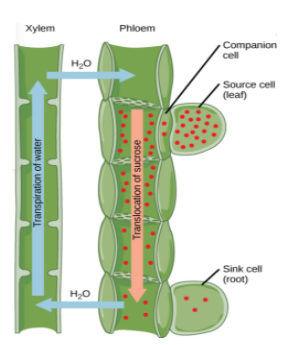
Phloem is responsible for the translocation of food.
Phloem includes four types of cells i.e. sieve tubes, companion cells, phloem fiber, and phloem parenchyma.
Phloem parenchyma has dense cytoplasm and a nucleus.
Sieve tubes have peripheral cytoplasm and large vacuole but lack a nucleus.
Phloem companion cells are parenchymatous and these have a nucleus.
These are also the living cells of phloem. Phloem fibers are dead. It has a thick wall and lacks a cytoplasm.
So, the correct answer is “Option Both B and C”.
Note: Sieve tubes lack nucleus. The function of the sieve tube is regulated by the nucleus of companion cells. Sieve tubs have the function for translocation of food in plants for this pressure gradient is maintained by companion cells so the companion cell helps sieve tubes in translocation of food.
These both have cytoplasm.
Complete answer: In plants phloem and Xylem are found as vascular bundles.
Phloem is responsible for the translocation of food.
Phloem includes four types of cells i.e. sieve tubes, companion cells, phloem fiber, and phloem parenchyma.
Phloem parenchyma has dense cytoplasm and a nucleus.
Sieve tubes have peripheral cytoplasm and large vacuole but lack a nucleus.
Phloem companion cells are parenchymatous and these have a nucleus.
These are also the living cells of phloem. Phloem fibers are dead. It has a thick wall and lacks a cytoplasm.
So, the correct answer is “Option Both B and C”.
Note: Sieve tubes lack nucleus. The function of the sieve tube is regulated by the nucleus of companion cells. Sieve tubs have the function for translocation of food in plants for this pressure gradient is maintained by companion cells so the companion cell helps sieve tubes in translocation of food.
Recently Updated Pages
Master Class 12 Business Studies: Engaging Questions & Answers for Success

Master Class 12 Chemistry: Engaging Questions & Answers for Success
Master Class 12 Biology: Engaging Questions & Answers for Success
Class 12 Question and Answer - Your Ultimate Solutions Guide
Master Class 11 English: Engaging Questions & Answers for Success
Master Class 11 Social Science: Engaging Questions & Answers for Success
Trending doubts
Which are the Top 10 Largest Countries of the World?
Draw a labelled sketch of the human eye class 12 physics CBSE
Differentiate between homogeneous and heterogeneous class 12 chemistry CBSE
In order to find out the different types of gametes class 12 biology NEET_UG
Why is the cell called the structural and functional class 12 biology CBSE
Draw ray diagrams each showing i myopic eye and ii class 12 physics CBSE