




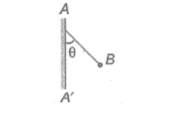
The line AA’ is charged by an infinite conducting plane which is perpendicular to the plane of paper. The plane has surface density of charge $\sigma $and B is ball of mass m with a like charge of magnitude q. B is connected by string from a point on the line AA’ The tangent of angle $\left( \theta \right)$formed between the line AA’ and the string is:
$
A.\dfrac{{q\sigma }}{{2{\varepsilon _0}mg}} \\
B.\dfrac{{q\sigma }}{{2\pi {\varepsilon _0}mg}} \\
C.\dfrac{{q\sigma }}{{6\pi {\varepsilon _0}mg}} \\
D.\dfrac{{q\sigma }}{{{\varepsilon _0}mg}} \\
$
Answer
 Verified
621k+ views
Hint: This problem can be solved by applying the concept of Gauss’s Law which states that, “The net electric flux through any hypothetical closed surface is equal to $\dfrac{1}{{{\varepsilon _0}}}$ times the net electric charge within that closed surface.”
Complete step-by-step answer:
Step 1: Calculate the forces acting on the ball.
Let us draw the free-body diagram of the ball as follows:
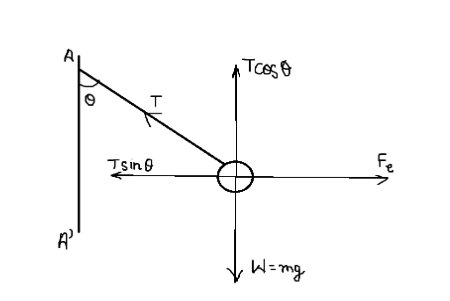
There are 3 forces acting on the ball: - Tension force, T due to the string. - Weight, $W = mg$ acting downward. - Electric force, ${F_e}$ due to the electric field due to an infinite plane.
The tension force can be resolved into 2 components as shown: $T\sin \theta \& T\cos \theta $
To calculate electric force, ${F_e}$, we have to apply Gauss’s law for an infinite plane carrying charge density of $\sigma $.
Electric field due to infinite charge carrying plane, $E = \dfrac{\sigma }{{2{\varepsilon _0}}}$
Electric force,
$
{F_e} = qE \\
Substituting, \\
{F_e} = \dfrac{{q\sigma }}{{2{\varepsilon _0}}} \\
$
By equating the forces in the free-body diagram, we get two equations –
$
T\cos \theta = mg \\
T\sin \theta = {F_e} \\
$
Dividing the equations –
$
\dfrac{{T\sin \theta }}{{T\cos \theta }} = \dfrac{{{F_e}}}{{mg}} \\
\tan \theta = \dfrac{{{F_e}}}{{mg}} \to \left( {\because \dfrac{{\sin \theta }}{{\cos \theta }} = \tan \theta } \right) \\
$
Substituting for ${F_e}$ –
$
\tan \theta = \dfrac{{{F_e}}}{{mg}} \\
\tan \theta = \dfrac{{\left( {\dfrac{{q\sigma }}{{2{\varepsilon _0}}}} \right)}}{{mg}} \\
\tan \theta = \dfrac{{q\sigma }}{{2{\varepsilon _0}mg}} \\
$
Hence, the correct option is Option A.
Note: Students generally confuse while writing the horizontal and vertical components of a vector. You can use a simple and handy thumb rule as shown here:
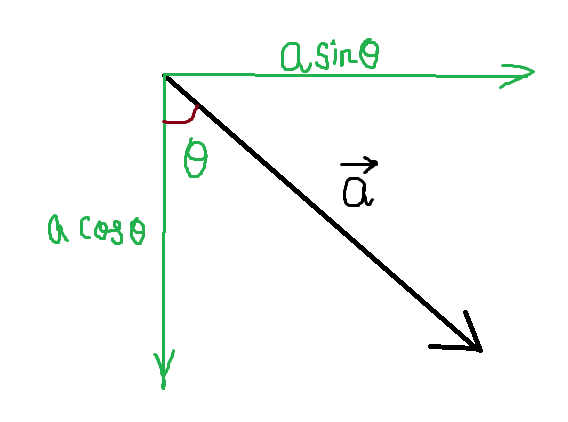
Consider a vector $\vec a$ inclined at angle $\theta $ as shown in the above figure: - The line that is attached to the angle $\theta $ is designated as $\cos \theta $. - The other line that is not attached to the angle$\theta $ is designated as $\sin \theta $
Complete step-by-step answer:
Step 1: Calculate the forces acting on the ball.
Let us draw the free-body diagram of the ball as follows:
There are 3 forces acting on the ball: - Tension force, T due to the string. - Weight, $W = mg$ acting downward. - Electric force, ${F_e}$ due to the electric field due to an infinite plane.
The tension force can be resolved into 2 components as shown: $T\sin \theta \& T\cos \theta $
To calculate electric force, ${F_e}$, we have to apply Gauss’s law for an infinite plane carrying charge density of $\sigma $.
Electric field due to infinite charge carrying plane, $E = \dfrac{\sigma }{{2{\varepsilon _0}}}$
Electric force,
$
{F_e} = qE \\
Substituting, \\
{F_e} = \dfrac{{q\sigma }}{{2{\varepsilon _0}}} \\
$
By equating the forces in the free-body diagram, we get two equations –
$
T\cos \theta = mg \\
T\sin \theta = {F_e} \\
$
Dividing the equations –
$
\dfrac{{T\sin \theta }}{{T\cos \theta }} = \dfrac{{{F_e}}}{{mg}} \\
\tan \theta = \dfrac{{{F_e}}}{{mg}} \to \left( {\because \dfrac{{\sin \theta }}{{\cos \theta }} = \tan \theta } \right) \\
$
Substituting for ${F_e}$ –
$
\tan \theta = \dfrac{{{F_e}}}{{mg}} \\
\tan \theta = \dfrac{{\left( {\dfrac{{q\sigma }}{{2{\varepsilon _0}}}} \right)}}{{mg}} \\
\tan \theta = \dfrac{{q\sigma }}{{2{\varepsilon _0}mg}} \\
$
Hence, the correct option is Option A.
Note: Students generally confuse while writing the horizontal and vertical components of a vector. You can use a simple and handy thumb rule as shown here:
Consider a vector $\vec a$ inclined at angle $\theta $ as shown in the above figure: - The line that is attached to the angle $\theta $ is designated as $\cos \theta $. - The other line that is not attached to the angle$\theta $ is designated as $\sin \theta $
Recently Updated Pages
Master Class 12 Economics: Engaging Questions & Answers for Success

Master Class 12 English: Engaging Questions & Answers for Success
Master Class 12 Social Science: Engaging Questions & Answers for Success
Master Class 12 Maths: Engaging Questions & Answers for Success
Master Class 12 Physics: Engaging Questions & Answers for Success
Master Class 12 Business Studies: Engaging Questions & Answers for Success
Trending doubts
The ratio of E to B in electromagnetic waves is equal class 12 physics CBSE
Which of the following is referred to as the Evil Quartet class 12 biology CBSE
What causes instant death by hanging class 12 biology CBSE
Percentage of photosynthetically active radiation PAR class 12 biology CBSE
The electric field due to a uniformly charged nonconducting class 12 physics CBSE
One megawatt is equal to how many units of electri class 12 physics CBSE