




The limit of Ballmer series is $3646\,\mathop A\limits^0 $ the wavelength to first member of this series will be
(A) $6563\,\mathop A\limits^0 $
(B) $3646\,\mathop A\limits^0 $
(C) $7200\,\mathop A\limits^0 $
(D) $1000\,\mathop A\limits^0 $
Answer
 Verified
593.4k+ views
Hint:Use the formula of the wavelength of the Balmer series and substitute the assumed values to find the Rydberg constant. Substitute this in the wavelength formula again to find the value of the wavelength when the electron moves from the first member.
Useful formula:
The wavelength in the Balmer series is given by
$\dfrac{1}{\lambda } = R\left[ {\dfrac{1}{{{n_1}^2}} - \dfrac{1}{{{n_2}^2}}} \right]$
Where $\lambda $ is the wavelength of the Balmer series, $R$ is the Rydberg constant , ${n_1}\,and\,{n_2}$ are the level of the orbit.
Complete step by step solution:
It is given that the
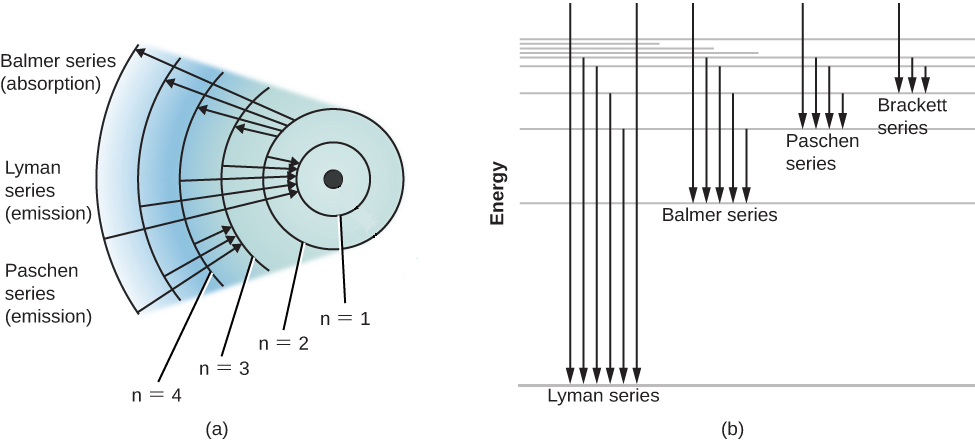
Limit of the Balmer series, $\lambda = 3646\,\mathop A\limits^0 $
It is known that the Balmer series have ${n_1} = 2$ and ${n_2} = 3,4,........,\infty $
Use the formula of the wavelength and let us consider the value of the value of ${n_1}\,and\,{n_2}$ as $2\,and\,\infty $ respectively.
$\dfrac{1}{{3646}} = R\left[ {\dfrac{1}{{{2^2}}} - \dfrac{1}{{{\infty ^2}}}} \right]$
By simplifying the above equation, we get
$\dfrac{1}{{3646}} = \left[ {\dfrac{R}{4}} \right]$
$R = \dfrac{4}{{3646}}$
Hence the value of the Rydberg constant is obtained as $\dfrac{4}{{3646}}$.
Again using the same formula of the wavelength of the Balmers series.
$\dfrac{1}{\lambda } = R\left[ {\dfrac{1}{{{n_1}^2}} - \dfrac{1}{{{n_2}^2}}} \right]$
In the question, it is asked to find the wavelength of the first member. Hence the value of ${n_1}$ is considered as $2$ and the value of the ${n_2}$ is considered as $3$ . And also substituting the value of the Rydberg constant.
$\dfrac{1}{\lambda } = \dfrac{4}{{3646}}\left[ {\dfrac{1}{4} - \dfrac{1}{9}} \right]$
By simplifying the above equation,
$\lambda = \dfrac{{131256}}{{20}}$
By performing the basic arithmetic operations,
$\lambda = 6562.8\,\mathop A\limits^0 \approx 6563\,\mathop A\limits^0 $
Thus the option (A) is correct.
Note:If the electrons from the higher levels move to the second orbit, it is the Balmer series. If the electron moves to the first orbit, then it is a Lyman series. It has to gain some energy to move from lower to higher orbitals and has to release energy when moving to lower energy orbitals.
Useful formula:
The wavelength in the Balmer series is given by
$\dfrac{1}{\lambda } = R\left[ {\dfrac{1}{{{n_1}^2}} - \dfrac{1}{{{n_2}^2}}} \right]$
Where $\lambda $ is the wavelength of the Balmer series, $R$ is the Rydberg constant , ${n_1}\,and\,{n_2}$ are the level of the orbit.
Complete step by step solution:
It is given that the
Limit of the Balmer series, $\lambda = 3646\,\mathop A\limits^0 $
It is known that the Balmer series have ${n_1} = 2$ and ${n_2} = 3,4,........,\infty $
Use the formula of the wavelength and let us consider the value of the value of ${n_1}\,and\,{n_2}$ as $2\,and\,\infty $ respectively.
$\dfrac{1}{{3646}} = R\left[ {\dfrac{1}{{{2^2}}} - \dfrac{1}{{{\infty ^2}}}} \right]$
By simplifying the above equation, we get
$\dfrac{1}{{3646}} = \left[ {\dfrac{R}{4}} \right]$
$R = \dfrac{4}{{3646}}$
Hence the value of the Rydberg constant is obtained as $\dfrac{4}{{3646}}$.
Again using the same formula of the wavelength of the Balmers series.
$\dfrac{1}{\lambda } = R\left[ {\dfrac{1}{{{n_1}^2}} - \dfrac{1}{{{n_2}^2}}} \right]$
In the question, it is asked to find the wavelength of the first member. Hence the value of ${n_1}$ is considered as $2$ and the value of the ${n_2}$ is considered as $3$ . And also substituting the value of the Rydberg constant.
$\dfrac{1}{\lambda } = \dfrac{4}{{3646}}\left[ {\dfrac{1}{4} - \dfrac{1}{9}} \right]$
By simplifying the above equation,
$\lambda = \dfrac{{131256}}{{20}}$
By performing the basic arithmetic operations,
$\lambda = 6562.8\,\mathop A\limits^0 \approx 6563\,\mathop A\limits^0 $
Thus the option (A) is correct.
Note:If the electrons from the higher levels move to the second orbit, it is the Balmer series. If the electron moves to the first orbit, then it is a Lyman series. It has to gain some energy to move from lower to higher orbitals and has to release energy when moving to lower energy orbitals.
Recently Updated Pages
Master Class 12 Business Studies: Engaging Questions & Answers for Success

Master Class 12 Biology: Engaging Questions & Answers for Success
Master Class 12 Chemistry: Engaging Questions & Answers for Success
Class 12 Question and Answer - Your Ultimate Solutions Guide
Master Class 11 Social Science: Engaging Questions & Answers for Success
Master Class 11 English: Engaging Questions & Answers for Success
Trending doubts
Which is more stable and why class 12 chemistry CBSE
Which are the Top 10 Largest Countries of the World?
Draw a labelled sketch of the human eye class 12 physics CBSE
Differentiate between homogeneous and heterogeneous class 12 chemistry CBSE
What are the major means of transport Explain each class 12 social science CBSE
Sulphuric acid is known as the king of acids State class 12 chemistry CBSE