




The light yellow compound produced when acetone reacts with iodine and alkali is,
(A) $ C{H_3}.CO.C{H_2}I $
(B) $ C{H_3}I $
(C) $ CH{I_3} $
(D) None of these
Answer
 Verified
605.1k+ views
Hint: When acetone reacts with iodine in the presence of alkali, iodoform is formed which is a light yellow color precipitate and the reaction is known as iodoform reaction. Iodoform test is a qualitative test, meaning it can be used for the verification of specific quality or characteristics. Basically, it is used for the detection of ketones and aldehydes having an alpha methyl group. The reagents used are iodine and a base which may be $ NaOH $ or $ KOH $ .
Complete step by step solution:
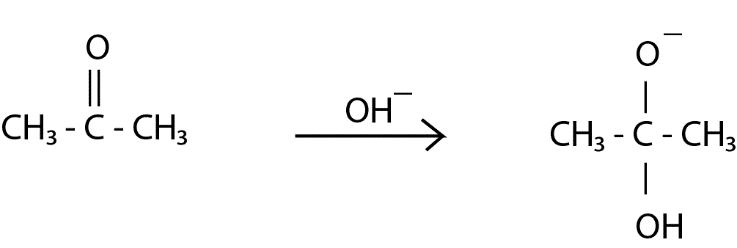
Step $ 1 $ : The base ( $ O{H^ - } $ ) attacks at the $ s{p^2} $ hybridized electrophilic carbon of acetone which breaks the pie bond between carbon and oxygen developing a negative charge on oxygen atom.
Step $ 2 $ : Again, the base ( $ O{H^ - } $ ) attacks but this time it takes $ H $ from the $ C{H_3} $ moiety and forms water.
Simultaneously, $ {I_2} $ reacts with the formed molecule where $ {I^ + } $ gets attached to the $ C{H_2}^ - $ formed and $ {I^ - } $ ion remains in the solution.
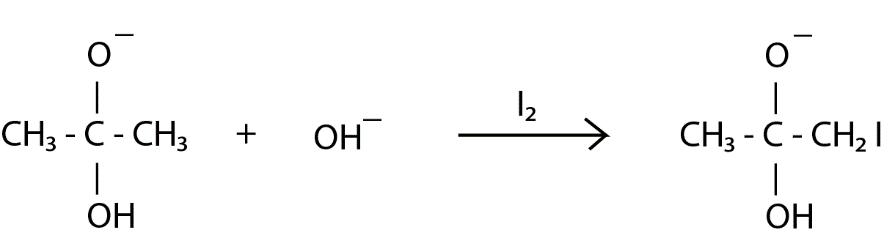
This step is repeated for the remaining two $ H $ present in methyl moiety. Now, oxygen donated its lone pair forming a pie bond with carbon and $ C{I_3}^ - $ goes away forming acetic acid. From the molecules of $ {H_2}O $ formed, one molecule reacts with $ C{I_3}^ - $ and $ CH{I_3} $ (iodoform) is formed which is light yellow color precipitate.

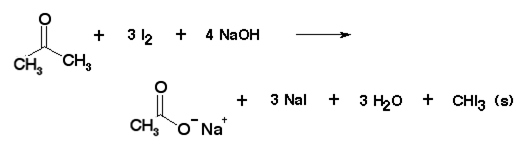
So, the complete balanced reaction combining all the steps is

If $ NaOH $ is taken as the base for the above reaction, then the reaction would be,
Additional information:
When iodine and sodium hydroxide are added to a compound that contains either a methyl ketone or a secondary alcohol with a methyl group in the alpha position, a pale yellow precipitate of iodoform or triiodomethane is formed. It can be used to identify aldehydes and ketones. The only aldehyde which gives this test is acetaldehyde since it is the only aldehyde which costs $ C{H_3}CO $ group.
Note:
The test can also be used to identify alcohols; if the alcohol is secondary alcohol then it gives no results as it cannot be oxidized. If the alcohol is primary alcohol, then it must be ethanol (as it can be oxidized to ethanal, which is the only aldehyde that gives a positive result with the iodoform test). All secondary alcohols give the positive result as they are oxidized to ketones.
Complete step by step solution:
Step $ 1 $ : The base ( $ O{H^ - } $ ) attacks at the $ s{p^2} $ hybridized electrophilic carbon of acetone which breaks the pie bond between carbon and oxygen developing a negative charge on oxygen atom.
Step $ 2 $ : Again, the base ( $ O{H^ - } $ ) attacks but this time it takes $ H $ from the $ C{H_3} $ moiety and forms water.
Simultaneously, $ {I_2} $ reacts with the formed molecule where $ {I^ + } $ gets attached to the $ C{H_2}^ - $ formed and $ {I^ - } $ ion remains in the solution.
This step is repeated for the remaining two $ H $ present in methyl moiety. Now, oxygen donated its lone pair forming a pie bond with carbon and $ C{I_3}^ - $ goes away forming acetic acid. From the molecules of $ {H_2}O $ formed, one molecule reacts with $ C{I_3}^ - $ and $ CH{I_3} $ (iodoform) is formed which is light yellow color precipitate.
So, the complete balanced reaction combining all the steps is
If $ NaOH $ is taken as the base for the above reaction, then the reaction would be,
Additional information:
When iodine and sodium hydroxide are added to a compound that contains either a methyl ketone or a secondary alcohol with a methyl group in the alpha position, a pale yellow precipitate of iodoform or triiodomethane is formed. It can be used to identify aldehydes and ketones. The only aldehyde which gives this test is acetaldehyde since it is the only aldehyde which costs $ C{H_3}CO $ group.
Note:
The test can also be used to identify alcohols; if the alcohol is secondary alcohol then it gives no results as it cannot be oxidized. If the alcohol is primary alcohol, then it must be ethanol (as it can be oxidized to ethanal, which is the only aldehyde that gives a positive result with the iodoform test). All secondary alcohols give the positive result as they are oxidized to ketones.
Recently Updated Pages
Lysosomes are known as suicidal bags of cell why class 11 biology CBSE

Father s age is three times the sum of the ages of-class-11-maths-CBSE
Give a comparative account of the classes of kingdom class 11 biology CBSE
The ceiling of a long hall is 25m high What is the class 11 physics CBSE
Name the Largest and the Smallest Cell in the Human Body ?
Draw a welllabelled diagram of a plant cell class 11 biology CBSE
Trending doubts
Find the value of the expression given below sin 30circ class 11 maths CBSE
One Metric ton is equal to kg A 10000 B 1000 C 100 class 11 physics CBSE
10 examples of friction in our daily life
Draw a diagram of nephron and explain its structur class 11 biology CBSE
Proton was discovered by A Thomson B Rutherford C Chadwick class 11 chemistry CBSE
Frogs heart when taken out of the body continues to class 11 biology CBSE