




The lens forms an upright and diminished image of an object when the object is placed at the focal point of the given lens. Draw a ray diagram to show the image formation.
Answer
 Verified
601.2k+ views
Hint:When the image is placed at the focus of the lens the image formed is diminished, this condition is shown by the concave lens.
On placing the image at focus, the concave lens will form the image which is diminished and is upright.
Using the above property of the concave lens we will draw the diagram of the location of the object placed and image formed.
Complete step by step answer:
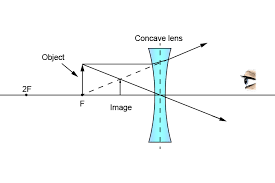
The above figure shows the image formed by the concave mirror.
Let's discuss the Concave lens and its properties.
A concave lens is a lens that possesses at least one surface that curves inwards. It is a diverging lens, meaning that it spreads out light rays that have been refracted through it. A concave lens is thinner at its centre than at its edges, and is used to correct short-sightedness(myopia). Image formed by a Concave lens is virtual meaning that it will appear to be far away than it actually is, and therefore smaller than the object itself.
Concave lens forms images at different locations when the object is placed at different locations. Like in the question above we are given that the object is placed at the focal point and the image formed is diminished and upright.
Incoming rays of light are made to enter the lens surface when the object is placed at the focal point as shown in the figure above, when the rays meet at a point that point is where image is formed and that image is diminished and upright.
Note:Concave lens has many applications such as used in telescope, binoculars, spectacles, laser cameras, Flashlights to magnify the light produced by the bulb, Peepholes(small security devices that provide a panoramic view of objects and environment outside doors or walls.
On placing the image at focus, the concave lens will form the image which is diminished and is upright.
Using the above property of the concave lens we will draw the diagram of the location of the object placed and image formed.
Complete step by step answer:
The above figure shows the image formed by the concave mirror.
Let's discuss the Concave lens and its properties.
A concave lens is a lens that possesses at least one surface that curves inwards. It is a diverging lens, meaning that it spreads out light rays that have been refracted through it. A concave lens is thinner at its centre than at its edges, and is used to correct short-sightedness(myopia). Image formed by a Concave lens is virtual meaning that it will appear to be far away than it actually is, and therefore smaller than the object itself.
Concave lens forms images at different locations when the object is placed at different locations. Like in the question above we are given that the object is placed at the focal point and the image formed is diminished and upright.
Incoming rays of light are made to enter the lens surface when the object is placed at the focal point as shown in the figure above, when the rays meet at a point that point is where image is formed and that image is diminished and upright.
Note:Concave lens has many applications such as used in telescope, binoculars, spectacles, laser cameras, Flashlights to magnify the light produced by the bulb, Peepholes(small security devices that provide a panoramic view of objects and environment outside doors or walls.
Recently Updated Pages
Master Class 12 Economics: Engaging Questions & Answers for Success

Master Class 12 English: Engaging Questions & Answers for Success
Master Class 12 Social Science: Engaging Questions & Answers for Success
Master Class 12 Maths: Engaging Questions & Answers for Success
Master Class 12 Physics: Engaging Questions & Answers for Success
Master Class 9 General Knowledge: Engaging Questions & Answers for Success
Trending doubts
Which are the Top 10 Largest Countries of the World?
Draw a labelled sketch of the human eye class 12 physics CBSE
Differentiate between homogeneous and heterogeneous class 12 chemistry CBSE
Why is the cell called the structural and functional class 12 biology CBSE
Draw ray diagrams each showing i myopic eye and ii class 12 physics CBSE
Which is the correct genotypic ratio of mendel dihybrid class 12 biology CBSE