



The lengths of the shorter and longer parallel sides of a trapezium are x cm and y cm respectively. If the area of the trapezium is ($x^2 – y^2$), then the height of the trapezium is
A.x
B.(x+y)
C.y
D.2(x+y)
Answer
 Verified
639.3k+ views
Hint: We know that ${\rm{Area\, of\, Trapezium = }}\dfrac{1}{2} \times {\rm{sum\, of\, parallel\, side}} \times {\rm{height}}$
so, from this formula we will find height in terms of x and y.
Complete step-by-step answer:
We know that
${\text{Area of Trapezium = }}\dfrac{1}{2} \times {\text{sum of parallel side}} \times {\text{height}}$
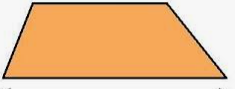
So, In the Question given that area of trapezium is ($x^2-y^2$)
So,
$({x^2} - {y^2}) = \dfrac{1}{2} \times (x + y) \times height$
So, $height = \dfrac{{2({x^2} - {y^2})}}{{x + y}}$
$ = \dfrac{{2(x + {y})(x - y)}}{{x + {y}}} = 2(x - y)$
[ ∵ $x^2$ – $y^2$ = (x + y) (x – y) ]
So, the height of trapezium = 2 (x – y)
So, from the above option only the D option is correct.
Note: In this type of question, first write the given/known values and use formula to find unknown values. If three values are known in the area of trapezium, then we can easily find the unknown value.
so, from this formula we will find height in terms of x and y.
Complete step-by-step answer:
We know that
${\text{Area of Trapezium = }}\dfrac{1}{2} \times {\text{sum of parallel side}} \times {\text{height}}$
So, In the Question given that area of trapezium is ($x^2-y^2$)
So,
$({x^2} - {y^2}) = \dfrac{1}{2} \times (x + y) \times height$
So, $height = \dfrac{{2({x^2} - {y^2})}}{{x + y}}$
$ = \dfrac{{2(x + {y})(x - y)}}{{x + {y}}} = 2(x - y)$
[ ∵ $x^2$ – $y^2$ = (x + y) (x – y) ]
So, the height of trapezium = 2 (x – y)
So, from the above option only the D option is correct.
Note: In this type of question, first write the given/known values and use formula to find unknown values. If three values are known in the area of trapezium, then we can easily find the unknown value.
Recently Updated Pages
Basicity of sulphurous acid and sulphuric acid are

Master Class 12 Economics: Engaging Questions & Answers for Success
Master Class 12 Biology: Engaging Questions & Answers for Success
Master Class 11 English: Engaging Questions & Answers for Success
Master Class 11 Physics: Engaging Questions & Answers for Success
Master Class 11 Computer Science: Engaging Questions & Answers for Success
Trending doubts
Difference Between Plant Cell and Animal Cell
Fill the blanks with the suitable prepositions 1 The class 9 english CBSE
What is pollution? How many types of pollution? Define it
What is the full form of pH?
What is the Full Form of ICSE, CBSE and SSC
Name 10 Living and Non living things class 9 biology CBSE