




What would be the length of the perpendicular from the point (2,-1, 4) on the straight line \[\dfrac{x+3}{10}=\dfrac{y-2}{-7}=\dfrac{z}{1}\]?
A. less than 2
B. greater than 3 but less than 4
C. greater than 4
D. greater than 2 but less than 3
Answer
 Verified
585.9k+ views
Hint: Here, we can start by equating a given equation of line with constant r. Then, we will get coordinates of a point, A, in the terms of r. We can also get the direction ratios of the given line as (10, -7, 1). Then, we will also get the direction ratios of the perpendicular drawn to the given line by subtracting P(2, -1, 4) and A. We know the condition for perpendicular lines is given by ${{a}_{1}}{{a}_{2}}+{{b}_{1}}{{b}_{2}}+{{c}_{1}}{{c}_{2}}=0$, where $\left( {{a}_{1}},{{b}_{1}},{{c}_{1}} \right)\text{ and }\left( {{a}_{2}},{{b}_{2}},{{c}_{2}} \right)$ are direction ratios. Applying this, we will get the value of r and hence the coordinates of point A. Then, we can find the length of perpendicular PA using distance formula \[PA=\sqrt{{{\left( {{x}_{2}}-{{x}_{1}} \right)}^{2}}+{{\left( {{y}_{2}}-{{y}_{1}} \right)}^{2}}+{{\left( {{z}_{2}}-{{z}_{1}} \right)}^{2}}}\].
Complete step by step answer:
Equation of given straight line is
\[\dfrac{x+3}{10}=\dfrac{y-2}{7}=\dfrac{z}{1}=r\]...(i)
Now, we can solve this equation to get values of x, y and z. Here, we get equation for x as follows,
\[\begin{align}
& \Rightarrow \dfrac{x+3}{10}=r \\
& \Rightarrow x=10r-3 \\
\end{align}\]
Now, we get the equation for y as
\[\begin{align}
& \Rightarrow \dfrac{y-2}{7}=r \\
& \Rightarrow y=7r+2 \\
\end{align}\]
Now, we will get the equation for z as
\[\begin{align}
& \Rightarrow \dfrac{z}{1}=r \\
& \Rightarrow z=r \\
\end{align}\]
Thus, we know the direction ratios of the line (i) are \[\left( 10,-7,1 \right)\] and any point lying on this line will have coordinates as \[A\left( 10r-3,-7r+2,r \right)\] .
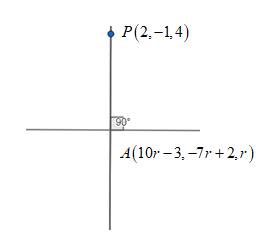
Now, we know that the line joining the points \[P\left( 2,-1,4 \right)\] and \[A\left( 10r-3,-7r+2,r \right)\] is perpendicular to line (i). We can get the direction ratios of this line by subtracting the direction ratios of line containing P and A.
Direction ratio of perpendicular line will be
\[\begin{align}
& \left( 10r-3-2,-7r+2+1,r-4 \right) \\
& \Rightarrow \left( 10r-5,-7r+3,r-4 \right) \\
\end{align}\]
Now, we know that the direction ratio of the given line (i) is (10, -7, 1).
We also know the condition for perpendicular lines when direction ratios $\left( {{a}_{1}},{{b}_{1}},{{c}_{1}} \right)\text{ and }\left( {{a}_{2}},{{b}_{2}},{{c}_{2}} \right)$ are known is ${{a}_{1}}{{a}_{2}}+{{b}_{1}}{{b}_{2}}+{{c}_{1}}{{c}_{2}}=0$ .
Now, applying this, we get
$\begin{align}
& \left[ \left( 10r-5 \right)\times 10 \right]+\left[ \left( -7r+3 \right)\times -7 \right]+\left[ \left( r-4 \right)\times 1 \right]=0 \\
& \Rightarrow 100r-50+49r-21+r-4=0 \\
& \Rightarrow 150r-75=0 \\
& \Rightarrow 150r=75 \\
& \Rightarrow r=\dfrac{1}{2} \\
\end{align}$
Now, substituting r in A, we get \[A\left( 10\times \dfrac{1}{2}-3,-7\times \dfrac{1}{2}+2,\dfrac{1}{2} \right)\Rightarrow A\left( 2,-\dfrac{3}{2},\dfrac{1}{2} \right)\] .
So, the foot of perpendicular is \[A\left( 2,-\dfrac{3}{2},\dfrac{1}{2} \right)\].
Now, we can find the perpendicular distance of point P(2,−1,4) from the line (i), i.e \[A\left( 2,-\dfrac{3}{2},\dfrac{1}{2} \right)\] as
\[\begin{align}
& PA=\sqrt{{{\left( {{x}_{2}}-{{x}_{1}} \right)}^{2}}+{{\left( {{y}_{2}}-{{y}_{1}} \right)}^{2}}+{{\left( {{z}_{2}}-{{z}_{1}} \right)}^{2}}} \\
& \Rightarrow \sqrt{{{\left( 2-2 \right)}^{2}}+{{\left( -\dfrac{3}{2}+1 \right)}^{2}}+{{\left( \dfrac{1}{2}-4 \right)}^{2}}} \\
& \Rightarrow \sqrt{0+{{\left( \dfrac{-1}{2} \right)}^{2}}+{{\left( \dfrac{-7}{2} \right)}^{2}}} \\
\end{align}\]
On simplification, we get
\[\begin{align}
& PA=\sqrt{\dfrac{1}{4}+\dfrac{49}{4}}=\sqrt{\dfrac{50}{4}} \\
& =\dfrac{\sqrt{50}}{2} \\
& =\dfrac{5\sqrt{2}}{2} \\
& =\dfrac{5}{2}\times 1.414 \\
& =3.535 \\
\end{align}\]
We can see that it lies between 3 and 4.
So, the correct answer is “Option B”.
Note: Students should know how to calculate direction ratios of a given line and a perpendicular. We can also use the fact that the dot product of perpendicular lines will be 0. So, we could have obtained the vector of given line as $10\hat{i}-7\hat{j}+\hat{k}$ and for the perpendicular line as \[\left( 10r-5 \right)\hat{i}+\left( -7r+3 \right)\hat{j}+\left( r-4 \right)\hat{k}\]. Applying the dot product and simplifying, we get
$\begin{align}
& \left[ \left( 10r-5 \right)\times 10 \right]+\left[ \left( -7r+3 \right)\times -7 \right]+\left[ \left( r-4 \right)\times 1 \right]=0 \\
& \Rightarrow 100r-50+49r-21+r-4=0 \\
& \Rightarrow 150r-75=0 \\
& \Rightarrow 150r=75 \\
& \Rightarrow r=\dfrac{1}{2} \\
\end{align}$
Thus, we have got the value of r and then we can proceed as usual.
Complete step by step answer:
Equation of given straight line is
\[\dfrac{x+3}{10}=\dfrac{y-2}{7}=\dfrac{z}{1}=r\]...(i)
Now, we can solve this equation to get values of x, y and z. Here, we get equation for x as follows,
\[\begin{align}
& \Rightarrow \dfrac{x+3}{10}=r \\
& \Rightarrow x=10r-3 \\
\end{align}\]
Now, we get the equation for y as
\[\begin{align}
& \Rightarrow \dfrac{y-2}{7}=r \\
& \Rightarrow y=7r+2 \\
\end{align}\]
Now, we will get the equation for z as
\[\begin{align}
& \Rightarrow \dfrac{z}{1}=r \\
& \Rightarrow z=r \\
\end{align}\]
Thus, we know the direction ratios of the line (i) are \[\left( 10,-7,1 \right)\] and any point lying on this line will have coordinates as \[A\left( 10r-3,-7r+2,r \right)\] .
Now, we know that the line joining the points \[P\left( 2,-1,4 \right)\] and \[A\left( 10r-3,-7r+2,r \right)\] is perpendicular to line (i). We can get the direction ratios of this line by subtracting the direction ratios of line containing P and A.
Direction ratio of perpendicular line will be
\[\begin{align}
& \left( 10r-3-2,-7r+2+1,r-4 \right) \\
& \Rightarrow \left( 10r-5,-7r+3,r-4 \right) \\
\end{align}\]
Now, we know that the direction ratio of the given line (i) is (10, -7, 1).
We also know the condition for perpendicular lines when direction ratios $\left( {{a}_{1}},{{b}_{1}},{{c}_{1}} \right)\text{ and }\left( {{a}_{2}},{{b}_{2}},{{c}_{2}} \right)$ are known is ${{a}_{1}}{{a}_{2}}+{{b}_{1}}{{b}_{2}}+{{c}_{1}}{{c}_{2}}=0$ .
Now, applying this, we get
$\begin{align}
& \left[ \left( 10r-5 \right)\times 10 \right]+\left[ \left( -7r+3 \right)\times -7 \right]+\left[ \left( r-4 \right)\times 1 \right]=0 \\
& \Rightarrow 100r-50+49r-21+r-4=0 \\
& \Rightarrow 150r-75=0 \\
& \Rightarrow 150r=75 \\
& \Rightarrow r=\dfrac{1}{2} \\
\end{align}$
Now, substituting r in A, we get \[A\left( 10\times \dfrac{1}{2}-3,-7\times \dfrac{1}{2}+2,\dfrac{1}{2} \right)\Rightarrow A\left( 2,-\dfrac{3}{2},\dfrac{1}{2} \right)\] .
So, the foot of perpendicular is \[A\left( 2,-\dfrac{3}{2},\dfrac{1}{2} \right)\].
Now, we can find the perpendicular distance of point P(2,−1,4) from the line (i), i.e \[A\left( 2,-\dfrac{3}{2},\dfrac{1}{2} \right)\] as
\[\begin{align}
& PA=\sqrt{{{\left( {{x}_{2}}-{{x}_{1}} \right)}^{2}}+{{\left( {{y}_{2}}-{{y}_{1}} \right)}^{2}}+{{\left( {{z}_{2}}-{{z}_{1}} \right)}^{2}}} \\
& \Rightarrow \sqrt{{{\left( 2-2 \right)}^{2}}+{{\left( -\dfrac{3}{2}+1 \right)}^{2}}+{{\left( \dfrac{1}{2}-4 \right)}^{2}}} \\
& \Rightarrow \sqrt{0+{{\left( \dfrac{-1}{2} \right)}^{2}}+{{\left( \dfrac{-7}{2} \right)}^{2}}} \\
\end{align}\]
On simplification, we get
\[\begin{align}
& PA=\sqrt{\dfrac{1}{4}+\dfrac{49}{4}}=\sqrt{\dfrac{50}{4}} \\
& =\dfrac{\sqrt{50}}{2} \\
& =\dfrac{5\sqrt{2}}{2} \\
& =\dfrac{5}{2}\times 1.414 \\
& =3.535 \\
\end{align}\]
We can see that it lies between 3 and 4.
So, the correct answer is “Option B”.
Note: Students should know how to calculate direction ratios of a given line and a perpendicular. We can also use the fact that the dot product of perpendicular lines will be 0. So, we could have obtained the vector of given line as $10\hat{i}-7\hat{j}+\hat{k}$ and for the perpendicular line as \[\left( 10r-5 \right)\hat{i}+\left( -7r+3 \right)\hat{j}+\left( r-4 \right)\hat{k}\]. Applying the dot product and simplifying, we get
$\begin{align}
& \left[ \left( 10r-5 \right)\times 10 \right]+\left[ \left( -7r+3 \right)\times -7 \right]+\left[ \left( r-4 \right)\times 1 \right]=0 \\
& \Rightarrow 100r-50+49r-21+r-4=0 \\
& \Rightarrow 150r-75=0 \\
& \Rightarrow 150r=75 \\
& \Rightarrow r=\dfrac{1}{2} \\
\end{align}$
Thus, we have got the value of r and then we can proceed as usual.
Recently Updated Pages
Master Class 12 Economics: Engaging Questions & Answers for Success

Master Class 12 Physics: Engaging Questions & Answers for Success
Master Class 12 English: Engaging Questions & Answers for Success
Master Class 12 Social Science: Engaging Questions & Answers for Success
Master Class 12 Maths: Engaging Questions & Answers for Success
Master Class 12 Business Studies: Engaging Questions & Answers for Success
Trending doubts
Which are the Top 10 Largest Countries of the World?
What are the major means of transport Explain each class 12 social science CBSE
Draw a labelled sketch of the human eye class 12 physics CBSE
Why cannot DNA pass through cell membranes class 12 biology CBSE
Differentiate between insitu conservation and exsitu class 12 biology CBSE
Draw a neat and well labeled diagram of TS of ovary class 12 biology CBSE