




The length of the common chord of the circle ${{\text{x}}^{\text{2}}}{\text{ + }}{{\text{y}}^{\text{2}}}$+6x=0 and ${{\text{x}}^{\text{2}}}{\text{ + }}{{\text{y}}^{\text{2}}}$+3y=0 is
A. $\dfrac{6}{{\sqrt 5 }}$
B. $\dfrac{{\sqrt 6 }}{{10}}$
C. $\dfrac{6}{{10}}$
D. $\dfrac{3}{{\sqrt 5 }}$
Answer
 Verified
612.9k+ views
Hint: To solve this question we use the basic theory related to the topic common chord between two circles. As we know if we have two circles ${{\text{x}}^{\text{2}}}{\text{ + }}{{\text{y}}^{\text{2}}}$+6x=0 and${{\text{x}}^{\text{2}}}{\text{ + }}{{\text{y}}^{\text{2}}}$+3y=0. then equation of common chord of the circles can be written as ${{\text{S}}_{\text{1}}}$- ${{\text{S}}_{\text{2}}}$=$0$. And then after using geometry we simply calculate the length of the common chord of the circle.
Complete step-by-step answer:
Let, ${{\text{S}}_{\text{1}}}$: ${{\text{x}}^{\text{2}}}{\text{ + }}{{\text{y}}^{\text{2}}}$+6x=0
${{\text{S}}_{\text{2}}}$: ${{\text{x}}^{\text{2}}}{\text{ + }}{{\text{y}}^{\text{2}}}$+3y=0
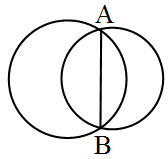
As we know,
Equation of common chord is: -
${{\text{S}}_{\text{1}}}$- ${{\text{S}}_{\text{2}}}$=$0$
$ \Rightarrow $${{\text{x}}^{\text{2}}}{\text{ + }}{{\text{y}}^{\text{2}}}$+6x-(${{\text{x}}^{\text{2}}}{\text{ + }}{{\text{y}}^{\text{2}}}$+3y)=0
$ \Rightarrow $ 6x-3y=0
$ \Rightarrow $ 2x=y
$ \Rightarrow $ 2x-y=0
Now, we have an equation of the common chord of given circles.
Perpendicular distance of 2x-y= 0 from (-3, 0).
Now, for simplification, we consider a single circle with a common chord of length AC.
Let, the first circle having radius OA and common chord is AC.
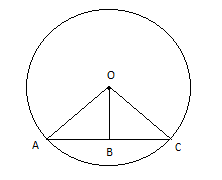
Here, OB=$\dfrac{{2 \times ( - 3) - 0}}{{\sqrt {4 + 1} }}$=$\dfrac{{ - 6}}{{\sqrt 5 }}$
And OA=r=3 (given)
Now use Pythagoras for AB.
AB=$\sqrt {{\text{O}}{{\text{A}}^{\text{2}}}{\text{ - O}}{{\text{B}}^{\text{2}}}} $
= $\sqrt {{3^{\text{2}}}{\text{ - }}{{\left( {\dfrac{{ - 6}}{{\sqrt 5 }}} \right)}^{\text{2}}}} $
= $\sqrt {9 - \dfrac{{36}}{5}} $
= $\sqrt {\dfrac{{45 - 36}}{5}} $
= $\dfrac{3}{{\sqrt 5 }}$
Thus, The length of the common chord of the circle ${{\text{x}}^{\text{2}}}{\text{ + }}{{\text{y}}^{\text{2}}}$+6x=0 and ${{\text{x}}^{\text{2}}}{\text{ + }}{{\text{y}}^{\text{2}}}$+3y=0 is$\dfrac{3}{{\sqrt 5 }}$.
Therefore, option (D) is the correct answer.
Note- In this question we have to used Pythagoras theorem which states that, in a right-angled triangle, the square of the hypotenuse side is equal to the sum of squares of the other two sides (i.e. base and height of the given right-angled triangle) “.
Complete step-by-step answer:
Let, ${{\text{S}}_{\text{1}}}$: ${{\text{x}}^{\text{2}}}{\text{ + }}{{\text{y}}^{\text{2}}}$+6x=0
${{\text{S}}_{\text{2}}}$: ${{\text{x}}^{\text{2}}}{\text{ + }}{{\text{y}}^{\text{2}}}$+3y=0
As we know,
Equation of common chord is: -
${{\text{S}}_{\text{1}}}$- ${{\text{S}}_{\text{2}}}$=$0$
$ \Rightarrow $${{\text{x}}^{\text{2}}}{\text{ + }}{{\text{y}}^{\text{2}}}$+6x-(${{\text{x}}^{\text{2}}}{\text{ + }}{{\text{y}}^{\text{2}}}$+3y)=0
$ \Rightarrow $ 6x-3y=0
$ \Rightarrow $ 2x=y
$ \Rightarrow $ 2x-y=0
Now, we have an equation of the common chord of given circles.
Perpendicular distance of 2x-y= 0 from (-3, 0).
Now, for simplification, we consider a single circle with a common chord of length AC.
Let, the first circle having radius OA and common chord is AC.
Here, OB=$\dfrac{{2 \times ( - 3) - 0}}{{\sqrt {4 + 1} }}$=$\dfrac{{ - 6}}{{\sqrt 5 }}$
And OA=r=3 (given)
Now use Pythagoras for AB.
AB=$\sqrt {{\text{O}}{{\text{A}}^{\text{2}}}{\text{ - O}}{{\text{B}}^{\text{2}}}} $
= $\sqrt {{3^{\text{2}}}{\text{ - }}{{\left( {\dfrac{{ - 6}}{{\sqrt 5 }}} \right)}^{\text{2}}}} $
= $\sqrt {9 - \dfrac{{36}}{5}} $
= $\sqrt {\dfrac{{45 - 36}}{5}} $
= $\dfrac{3}{{\sqrt 5 }}$
Thus, The length of the common chord of the circle ${{\text{x}}^{\text{2}}}{\text{ + }}{{\text{y}}^{\text{2}}}$+6x=0 and ${{\text{x}}^{\text{2}}}{\text{ + }}{{\text{y}}^{\text{2}}}$+3y=0 is$\dfrac{3}{{\sqrt 5 }}$.
Therefore, option (D) is the correct answer.
Note- In this question we have to used Pythagoras theorem which states that, in a right-angled triangle, the square of the hypotenuse side is equal to the sum of squares of the other two sides (i.e. base and height of the given right-angled triangle) “.
Recently Updated Pages
Master Class 12 Economics: Engaging Questions & Answers for Success

Master Class 12 Physics: Engaging Questions & Answers for Success
Master Class 12 English: Engaging Questions & Answers for Success
Master Class 12 Social Science: Engaging Questions & Answers for Success
Master Class 12 Maths: Engaging Questions & Answers for Success
Master Class 12 Business Studies: Engaging Questions & Answers for Success
Trending doubts
Which are the Top 10 Largest Countries of the World?
What are the major means of transport Explain each class 12 social science CBSE
Draw a labelled sketch of the human eye class 12 physics CBSE
Why cannot DNA pass through cell membranes class 12 biology CBSE
Differentiate between insitu conservation and exsitu class 12 biology CBSE
Draw a neat and well labeled diagram of TS of ovary class 12 biology CBSE