




The length of a tangent from a point A at distance 5 cm from the centre of the circle is 4cm. Find the radius of the circle.
Answer
 Verified
632.7k+ views
- Hint: Draw a neat diagram with the help of the given information in the problem. Tangent at any point on the circle is perpendicular to the radius of the circle to it. Pythagoras theorem for a right angle is given as
${{\left( \text{Hypotenuse} \right)}^{2}}={{\left( \text{Base} \right)}^{{}}}+{{\left( \text{Perpendicular} \right)}^{2}}$
Use the identity and property to get the length of the radius.
Complete step-by-step solution -
As we know the property of tangent from a point A to the circle is 4cm and the distance between the point A and centre is given as ‘5’ and hence, we need to find the radius of the circle. So, we can draw a diagram with the above information as
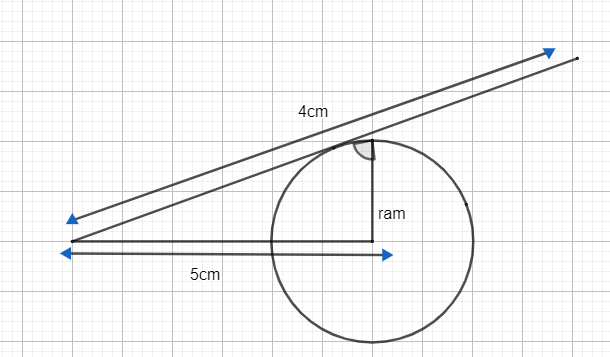
Let the radius of the circle be r cm. Now, using the property of a tangent to a circle as mentioned above, we get
$\angle ATO={{90}^{\circ }}$
Hence, $\Delta ATO$ is a right angled triangle. Now, we know that the Pythagoras theorem can be applied to the right angled triangle, which is given as
${{\left( \text{Hypotenuse} \right)}^{2}}={{\left( \text{Base} \right)}^{{}}}+{{\left( \text{Perpendicular} \right)}^{2}}$ ……………..(i)
Hence, we can put values of sides of $\Delta ATO$ to the equation (i) and we get
$\begin{align}
& {{\left( OA \right)}^{2}}=A{{T}^{2}}+O{{T}^{2}} \\
& {{\left( 5 \right)}^{2}}={{4}^{2}}+{{r}^{2}} \\
& 25=16+{{r}^{2}} \\
& {{r}^{2}}=25-16 \\
& {{r}^{2}}=9 \\
\end{align}$
Now, taking square to both the sides, we get value of ‘r’ as
r = 3cm
Hence, radius of the circle is 3cm, if the length of a tangent from a point is 4cm and distance of that point from the centre is 5cm.
So, 3cm is the correct answer.
Note: Drawing and relating the diagram from the given information of the problem is the key point of the question. Apply Pythagoras theorem carefully. As one may put distance AT as hypotenuse and OA and OT as base and perpendicular, which are wrong. So, show the right angle in the triangle and apply the Pythagoras theorem accordingly.
${{\left( \text{Hypotenuse} \right)}^{2}}={{\left( \text{Base} \right)}^{{}}}+{{\left( \text{Perpendicular} \right)}^{2}}$
Use the identity and property to get the length of the radius.
Complete step-by-step solution -
As we know the property of tangent from a point A to the circle is 4cm and the distance between the point A and centre is given as ‘5’ and hence, we need to find the radius of the circle. So, we can draw a diagram with the above information as
Let the radius of the circle be r cm. Now, using the property of a tangent to a circle as mentioned above, we get
$\angle ATO={{90}^{\circ }}$
Hence, $\Delta ATO$ is a right angled triangle. Now, we know that the Pythagoras theorem can be applied to the right angled triangle, which is given as
${{\left( \text{Hypotenuse} \right)}^{2}}={{\left( \text{Base} \right)}^{{}}}+{{\left( \text{Perpendicular} \right)}^{2}}$ ……………..(i)
Hence, we can put values of sides of $\Delta ATO$ to the equation (i) and we get
$\begin{align}
& {{\left( OA \right)}^{2}}=A{{T}^{2}}+O{{T}^{2}} \\
& {{\left( 5 \right)}^{2}}={{4}^{2}}+{{r}^{2}} \\
& 25=16+{{r}^{2}} \\
& {{r}^{2}}=25-16 \\
& {{r}^{2}}=9 \\
\end{align}$
Now, taking square to both the sides, we get value of ‘r’ as
r = 3cm
Hence, radius of the circle is 3cm, if the length of a tangent from a point is 4cm and distance of that point from the centre is 5cm.
So, 3cm is the correct answer.
Note: Drawing and relating the diagram from the given information of the problem is the key point of the question. Apply Pythagoras theorem carefully. As one may put distance AT as hypotenuse and OA and OT as base and perpendicular, which are wrong. So, show the right angle in the triangle and apply the Pythagoras theorem accordingly.
Recently Updated Pages
Master Class 11 Social Science: Engaging Questions & Answers for Success

Master Class 11 English: Engaging Questions & Answers for Success
Master Class 11 Maths: Engaging Questions & Answers for Success
Master Class 11 Chemistry: Engaging Questions & Answers for Success
Master Class 11 Biology: Engaging Questions & Answers for Success
Master Class 11 Physics: Engaging Questions & Answers for Success
Trending doubts
How many of the following diseases can be studied with class 11 biology CBSE
Which of the following enzymes is used for carboxylation class 11 biology CBSE
Draw a diagram of a plant cell and label at least eight class 11 biology CBSE
Receptor sites for neurotransmitters are present on class 11 biology CBSE
JGA JuxtaGlomerular Apparatus a sensitive region which class 11 biology CBSE
Root hairs develop from the region of A Meristematic class 11 biology CBSE