




The laws of reflection hold good for –
A) Plane mirror only
B) Concave mirror only
C) Convex mirror only
D) All mirrors irrespective of their shape.
Answer
 Verified
608.4k+ views
Hint: We need to understand the laws of reflection and the parameter involved in the law to analyse whether these laws hold good for spherical mirrors or plane mirrors or for both. We can use this information to solve the given problem easily.
Complete answer:
We know that there are two laws of reflection. These laws help us understand the possible ways for a light incident on a reflecting surface to follow with much precision. The laws of reflection of light falling on a reflecting surface are –
1.The normal, the incident ray and the reflected ray all lie in the same plane. i.e., we can easily draw a schematic representation on a paper without considering a third dimension.
2.The angle of incidence of the light ray, i, is always equal to the angle of reflection of the light ray, r. It is given mathematically as –
\[i=r\]
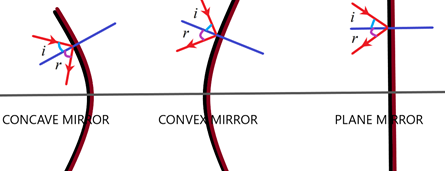
Now, let us consider different mirrors or reflecting surfaces. The normal is the perpendicular line to the face of the surface for a plane mirror or a perpendicular to the tangent at a point for a spherical mirror. The first law holds good for both the mirrors.
The angle of reflection and the angle of incidence are determined by the normal as we can see in the above figure. These values are always constant no matter what the shape of the mirror is.
Therefore, we understand that the laws of reflection hold good for all types of reflecting surfaces.
The correct answer is option D.
Note:
We have to strictly follow the laws of reflection when we draw a ray diagram to get the most accurate drawings and observations. Unlike the other drawings in Physics which are for reference, the ray diagrams give correct inference if drawn well.
Complete answer:
We know that there are two laws of reflection. These laws help us understand the possible ways for a light incident on a reflecting surface to follow with much precision. The laws of reflection of light falling on a reflecting surface are –
1.The normal, the incident ray and the reflected ray all lie in the same plane. i.e., we can easily draw a schematic representation on a paper without considering a third dimension.
2.The angle of incidence of the light ray, i, is always equal to the angle of reflection of the light ray, r. It is given mathematically as –
\[i=r\]
Now, let us consider different mirrors or reflecting surfaces. The normal is the perpendicular line to the face of the surface for a plane mirror or a perpendicular to the tangent at a point for a spherical mirror. The first law holds good for both the mirrors.
The angle of reflection and the angle of incidence are determined by the normal as we can see in the above figure. These values are always constant no matter what the shape of the mirror is.
Therefore, we understand that the laws of reflection hold good for all types of reflecting surfaces.
The correct answer is option D.
Note:
We have to strictly follow the laws of reflection when we draw a ray diagram to get the most accurate drawings and observations. Unlike the other drawings in Physics which are for reference, the ray diagrams give correct inference if drawn well.
Recently Updated Pages
Master Class 12 Business Studies: Engaging Questions & Answers for Success

Master Class 12 Chemistry: Engaging Questions & Answers for Success
Master Class 12 Biology: Engaging Questions & Answers for Success
Class 12 Question and Answer - Your Ultimate Solutions Guide
Master Class 11 English: Engaging Questions & Answers for Success
Master Class 11 Social Science: Engaging Questions & Answers for Success
Trending doubts
Which are the Top 10 Largest Countries of the World?
Draw a labelled sketch of the human eye class 12 physics CBSE
Differentiate between homogeneous and heterogeneous class 12 chemistry CBSE
Why is the cell called the structural and functional class 12 biology CBSE
When was the first election held in India a 194748 class 12 sst CBSE
Draw ray diagrams each showing i myopic eye and ii class 12 physics CBSE