




The jelly-like living material found inside the cell wall is known as………..
Answer
 Verified
615k+ views
Hint: Protoplasm is a variety of small molecules such as proteins, polysaccharides, lipids, etc., such as ions, monosaccharides, amino acids and macromolecules. Protoplasm comprises a cell's genetic material. The function of the cell is also regulated by it.
Complete answer:
Protoplasm, composed of various cellular organelles, is the living component of the cell. It is a jelly-like living material found inside the cell wall, colourless, translucent and viscous. In the year 1835, the term protoplasm was suggested and is considered as the primary material, as it is responsible for different living processes.
It was assumed that protoplasm containers were cells. The definition, however, was unable to explain the origin of structures formed within the cell mainly the nucleus.
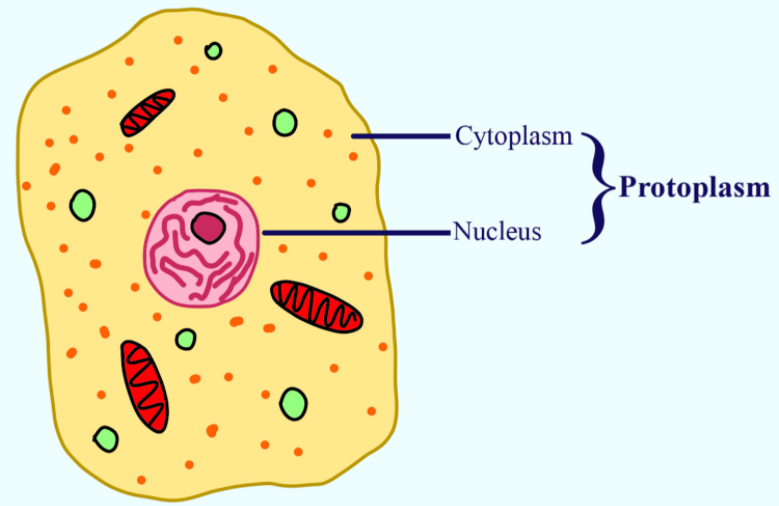
The cytoplasm is the initial portion of a protoplasm found in a eukaryotic cell between the cell membrane and the cell nucleus. A cytoplasm plays a crucial role in preserving the cell environment in the cell, preserves the cell shape and also stores substances that the organelle needs.
The nucleus is the protoplasm's second portion that stores an organism's genetic material. The nucleus, which is important for the development of proteins in the cell, also contains ribosomes. Instead of a nucleus where all the genetic material is contained, prokaryotes produce a nucleoid.
Proteins, proteins, hormones, enzymes, all make up a protoplasm. These are either dissolved in the water portion of the protoplasm or suspended.
The word "Protoplasm" is obsolete and it is no longer used in modern biology. Cytoplasm, nucleus, and organelles are, instead, more important.
So the answer to this question is ‘Protoplasm’.
Additional information:
The nucleus is the second ingredient of the protoplasm's makeup. The genetic material of a cell or organism is found in it. It also plays a part in the cell's activity regulation. In addition, the nucleus is the place where ribosomes are formed, which are important in producing proteins in the cell. Prokaryotes do not have a nucleus, but instead have an area where their genetic material is contained called the nucleoid.
Of course, molecules that comprise proteins, fats, enzymes, hormones and other substances are all part of the protoplasm's composition. We may find these substances either dissolved in the protoplasm's water portion or suspended within it. The protoplasm, then, is very interesting and complex, and not plain or simple at all.
Note:
Protoplast is a naked cell in which enzymatic degradation destroys the cell wall, while protoplasm is the collective term used to refer to both the cytoplasm and the nucleus. Cytoplasm is a portion of a protoplasm that does not include the nucleus, whereas protoplasm is a cell that comprises cytoplasm and the nucleus.
Complete answer:
Protoplasm, composed of various cellular organelles, is the living component of the cell. It is a jelly-like living material found inside the cell wall, colourless, translucent and viscous. In the year 1835, the term protoplasm was suggested and is considered as the primary material, as it is responsible for different living processes.
It was assumed that protoplasm containers were cells. The definition, however, was unable to explain the origin of structures formed within the cell mainly the nucleus.
The cytoplasm is the initial portion of a protoplasm found in a eukaryotic cell between the cell membrane and the cell nucleus. A cytoplasm plays a crucial role in preserving the cell environment in the cell, preserves the cell shape and also stores substances that the organelle needs.
The nucleus is the protoplasm's second portion that stores an organism's genetic material. The nucleus, which is important for the development of proteins in the cell, also contains ribosomes. Instead of a nucleus where all the genetic material is contained, prokaryotes produce a nucleoid.
Proteins, proteins, hormones, enzymes, all make up a protoplasm. These are either dissolved in the water portion of the protoplasm or suspended.
The word "Protoplasm" is obsolete and it is no longer used in modern biology. Cytoplasm, nucleus, and organelles are, instead, more important.
So the answer to this question is ‘Protoplasm’.
Additional information:
The nucleus is the second ingredient of the protoplasm's makeup. The genetic material of a cell or organism is found in it. It also plays a part in the cell's activity regulation. In addition, the nucleus is the place where ribosomes are formed, which are important in producing proteins in the cell. Prokaryotes do not have a nucleus, but instead have an area where their genetic material is contained called the nucleoid.
Of course, molecules that comprise proteins, fats, enzymes, hormones and other substances are all part of the protoplasm's composition. We may find these substances either dissolved in the protoplasm's water portion or suspended within it. The protoplasm, then, is very interesting and complex, and not plain or simple at all.
Note:
Protoplast is a naked cell in which enzymatic degradation destroys the cell wall, while protoplasm is the collective term used to refer to both the cytoplasm and the nucleus. Cytoplasm is a portion of a protoplasm that does not include the nucleus, whereas protoplasm is a cell that comprises cytoplasm and the nucleus.
Recently Updated Pages
Which will be the least stable resonating structure class 11 chemistry CBSE

How many 5 digit telephone numbers can be construc-class-11-maths-CBSE
How do you find the angle of the resultant vector class 11 physics CBSE
Draw labelled diagram of the following i Gram seed class 11 biology CBSE
1 Quintal is equal to a 110 kg b 10 kg c 100kg d 1000 class 11 physics CBSE
What is the need and importance of classification class 11 biology CBSE
Trending doubts
Find the value of the expression given below sin 30circ class 11 maths CBSE
One Metric ton is equal to kg A 10000 B 1000 C 100 class 11 physics CBSE
10 examples of friction in our daily life
Draw a diagram of a plant cell and label at least eight class 11 biology CBSE
Difference between physical and chemical change class 11 chemistry CBSE
Proton was discovered by A Thomson B Rutherford C Chadwick class 11 chemistry CBSE