




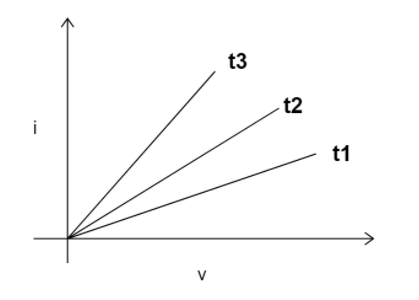
The I-V graph for a resistance at temperature${t_1}$, ${t_2}$, ${t_3}$ is shown in the figure. The highest temperature is:
A. ${t_1}$
B. ${t_2}$
C. ${t_3}$
D. ${t_1} = {t_2} = {t_3}$
Answer
 Verified
593.7k+ views
Hint: In case of resistances, with increase in temperature, the resistance of the conductor also increases. This implies that resistance is directly proportional to temperature. Thus at the highest temperature, resistance is also highest.
Complete step by step answer:
The above graph is a v-I graph. We know, according to the ohm’s law, that in case of conductors, the current flowing through the conductor is directly proportional to potential difference across its two ends provided physical factors like pressure, temperature remain constant.
Thus, mathematically we can say:
$I \propto V$
Where,
$I = $Current through the conductor.
$V = $ Voltage across the ends
The constant of proportionality, in the equation, is resistance, denoted by the letter$R$.
Thus the equation becomes:
$V = IR$
We know, in case of conductors, the ohm’s law graph comes to be a straight line.
As shown above, the x-axis in the graph represents Voltage and Y axis represents Current.
Thus, consider the equation of straight line: $Y = mX$
Comparing, the equation of straight line from the equation of ohm’s law, we obtain:
$R = \dfrac{1}{m}$
Where, $m$ is the slope of the graph.
Thus, we can infer, the steeper the slope, lesser will be the value of resistance.
We can see that steepness of the slope decreases as:
${m_1} < {m_2} < {m_3}$
Where, ${m_1}$, ${m_2}$, ${m_3}$ are the slopes of the respective curves.
Thus, we can say, resistance decreases in the order, ${R_1} > {R_2} > {R_3}$.
Since, temperature is directly proportional to resistance, temperature also decreases in the order:
${t_1} > {t_2} > {t_3}$.
Thus, ${t_1}$is the highest temperature.
Hence, the correct answer is option (A).
Note: We know that resistance of the conductor is also proportional to resistivity of the conductor. Therefore. With increase in temperature, resistivity of the conductor also increases. . Since resistance of the conductor is proportional to the resistivity of it, we can say that resistance also increases.
Complete step by step answer:
The above graph is a v-I graph. We know, according to the ohm’s law, that in case of conductors, the current flowing through the conductor is directly proportional to potential difference across its two ends provided physical factors like pressure, temperature remain constant.
Thus, mathematically we can say:
$I \propto V$
Where,
$I = $Current through the conductor.
$V = $ Voltage across the ends
The constant of proportionality, in the equation, is resistance, denoted by the letter$R$.
Thus the equation becomes:
$V = IR$
We know, in case of conductors, the ohm’s law graph comes to be a straight line.
As shown above, the x-axis in the graph represents Voltage and Y axis represents Current.
Thus, consider the equation of straight line: $Y = mX$
Comparing, the equation of straight line from the equation of ohm’s law, we obtain:
$R = \dfrac{1}{m}$
Where, $m$ is the slope of the graph.
Thus, we can infer, the steeper the slope, lesser will be the value of resistance.
We can see that steepness of the slope decreases as:
${m_1} < {m_2} < {m_3}$
Where, ${m_1}$, ${m_2}$, ${m_3}$ are the slopes of the respective curves.
Thus, we can say, resistance decreases in the order, ${R_1} > {R_2} > {R_3}$.
Since, temperature is directly proportional to resistance, temperature also decreases in the order:
${t_1} > {t_2} > {t_3}$.
Thus, ${t_1}$is the highest temperature.
Hence, the correct answer is option (A).
Note: We know that resistance of the conductor is also proportional to resistivity of the conductor. Therefore. With increase in temperature, resistivity of the conductor also increases. . Since resistance of the conductor is proportional to the resistivity of it, we can say that resistance also increases.
Recently Updated Pages
Master Class 12 Business Studies: Engaging Questions & Answers for Success

Master Class 12 Chemistry: Engaging Questions & Answers for Success
Master Class 12 Biology: Engaging Questions & Answers for Success
Class 12 Question and Answer - Your Ultimate Solutions Guide
Master Class 11 English: Engaging Questions & Answers for Success
Master Class 11 Social Science: Engaging Questions & Answers for Success
Trending doubts
Which are the Top 10 Largest Countries of the World?
Draw a labelled sketch of the human eye class 12 physics CBSE
The end of compass needle which points towards north class 12 physics CBSE
Differentiate between homogeneous and heterogeneous class 12 chemistry CBSE
In order to find out the different types of gametes class 12 biology NEET_UG
Why is the cell called the structural and functional class 12 biology CBSE