



The IUPAC name of the given structure:
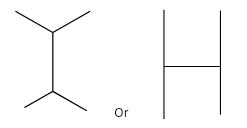
A.2,2- dimethylbutane
B.isohexane
C.2,3- dimethyl butane
D.di-isohexane
Answer
 Verified
616.2k+ views
Hint: IUPAC stands for the International Union of Pure and Applied Chemistry. For the nomenclature of chemical compounds, the IUPAC nomenclature in organic chemistry is a method used for the naming of organic chemical compounds. In the IUPAC system, the name of an organic compound consists of three parts:
-Word root- It is the basic unit of the name of the chemical compound. It depends upon the number of carbon atoms in the longest continuous carbon chain selected, called the parent chain. Depending upon the number of carbons in the chain the compound is assigned a word. For example, a chain containing ${C_2}$ carbons will be Eth, ${C_3}$ which will be a prop.
-The suffix- A suffix is added after the word root to indicate the nature of the carbon-carbon bond. For if the carbon chains contain a double bond then a suffix will be added as “ene”.
-Prefix- The groups which are not regarded as functional but present in the carbon chain as substituents are written before the word root as a prefix.
Complete step by step answer:
Let us draw the given structure in details:
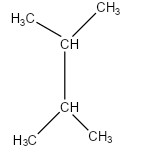
-In this structure, we can see that it is a symmetrical alkane. So if we count the longest carbon chain from any side it will be the same. The longest chain which is known as the parent chain contains four carbon atoms. In the second and third carbon, there is a methyl group attached to it.
-The IUPAC name of the given structure is 2,3- dimethyl butane.
-Hence, the correct option is (C).
Note:
-2,3-dimethyl butane is an isomer of hexane. It is a colorless liquid that boils at ${57.9^ \circ }C$.
-It is used in organic synthesis, as a catalytic agent, and petrochemical additive.
-The density of 2,3-dimethyl butane is $662mgm{L^{ - 1}}$
-Word root- It is the basic unit of the name of the chemical compound. It depends upon the number of carbon atoms in the longest continuous carbon chain selected, called the parent chain. Depending upon the number of carbons in the chain the compound is assigned a word. For example, a chain containing ${C_2}$ carbons will be Eth, ${C_3}$ which will be a prop.
-The suffix- A suffix is added after the word root to indicate the nature of the carbon-carbon bond. For if the carbon chains contain a double bond then a suffix will be added as “ene”.
-Prefix- The groups which are not regarded as functional but present in the carbon chain as substituents are written before the word root as a prefix.
Complete step by step answer:
Let us draw the given structure in details:
-In this structure, we can see that it is a symmetrical alkane. So if we count the longest carbon chain from any side it will be the same. The longest chain which is known as the parent chain contains four carbon atoms. In the second and third carbon, there is a methyl group attached to it.
-The IUPAC name of the given structure is 2,3- dimethyl butane.
-Hence, the correct option is (C).
Note:
-2,3-dimethyl butane is an isomer of hexane. It is a colorless liquid that boils at ${57.9^ \circ }C$.
-It is used in organic synthesis, as a catalytic agent, and petrochemical additive.
-The density of 2,3-dimethyl butane is $662mgm{L^{ - 1}}$
Recently Updated Pages
Master Class 12 Business Studies: Engaging Questions & Answers for Success

Master Class 12 Chemistry: Engaging Questions & Answers for Success
Master Class 12 Biology: Engaging Questions & Answers for Success
Class 12 Question and Answer - Your Ultimate Solutions Guide
Master Class 11 English: Engaging Questions & Answers for Success
Master Class 11 Social Science: Engaging Questions & Answers for Success
Trending doubts
The end of compass needle which points towards north class 12 physics CBSE
When was the first election held in India a 194748 class 12 sst CBSE
Hormone responsible for the secretion of milk after class 12 biology CBSE
Draw a diagram of a flower and name the parts class 12 biology ICSE
Suicide bags of cells are aEndoplasmic reticulum bLysosome class 12 biology CBSE
The first general election of Lok Sabha was held in class 12 social science CBSE