




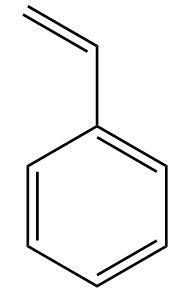
The IUPAC name of the following compound is \[ethenylbenzene\] .
a.True
b.False
Answer
 Verified
509.4k+ views
Hint: The given compound is a benzene derivative with the formula \[{C_6}{H_6}CH = C{H_2}\]. The IUPAC name of the given compound can be found out by correctly naming the substituent. Since there is only substituent and no other functional groups, there is no need for priority orders and assigning positions.
Complete answer:
The IUPAC nomenclature refers to the systematic method of naming chemical compounds given by the International Union of Pure and Applied Chemistry.
The major rules used in naming organic compounds can be written as follows:
1.Find the longest carbon chain that consists of the maximum number of carbons arranged in a straight chain or ring which is called the parent chain.
2.Assign priorities to various functional groups and substituents attached to the parent chain.
3.The priorities of substitutes are based on the alphabetic order of their names.
4.Mention the positions occupied by each functional group or substituent in compound.
5.The naming is done from a side which assigns the lowest positions to all groups attached.
The given organic compound contains a six-membered aromatic ring named benzene. Hence the parent chain in the given organic compound will be benzene and the naming will be done according to it.
With a single substituent there is no need for prioritizing groups and assigning them positions.
The given substituent two-membered compound of the alkene family. Alkenes when added as substituents are named \['alkenyl'\] . A prefix \['eth'\] is used to indicate the presence of two carbons. Hence, the substituent is named \['ethenyl'\] .
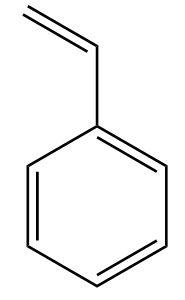
Therefore, the given statement is true and the IUPAC name of the compound is \[ethenylbenzene\].
Note:
Organic compounds can have more than one IUPAC name that are difficult to write with the given set of rules. The given benzene derivative is popularly known as Styrene which is also an IUPAC name of the same compound and is not based upon the simple rules of IUPAC nomenclature.
Complete answer:
The IUPAC nomenclature refers to the systematic method of naming chemical compounds given by the International Union of Pure and Applied Chemistry.
The major rules used in naming organic compounds can be written as follows:
1.Find the longest carbon chain that consists of the maximum number of carbons arranged in a straight chain or ring which is called the parent chain.
2.Assign priorities to various functional groups and substituents attached to the parent chain.
3.The priorities of substitutes are based on the alphabetic order of their names.
4.Mention the positions occupied by each functional group or substituent in compound.
5.The naming is done from a side which assigns the lowest positions to all groups attached.
The given organic compound contains a six-membered aromatic ring named benzene. Hence the parent chain in the given organic compound will be benzene and the naming will be done according to it.
With a single substituent there is no need for prioritizing groups and assigning them positions.
The given substituent two-membered compound of the alkene family. Alkenes when added as substituents are named \['alkenyl'\] . A prefix \['eth'\] is used to indicate the presence of two carbons. Hence, the substituent is named \['ethenyl'\] .
Therefore, the given statement is true and the IUPAC name of the compound is \[ethenylbenzene\].
Note:
Organic compounds can have more than one IUPAC name that are difficult to write with the given set of rules. The given benzene derivative is popularly known as Styrene which is also an IUPAC name of the same compound and is not based upon the simple rules of IUPAC nomenclature.
Recently Updated Pages
Master Class 12 Economics: Engaging Questions & Answers for Success

Master Class 12 Physics: Engaging Questions & Answers for Success
Master Class 12 English: Engaging Questions & Answers for Success
Master Class 12 Social Science: Engaging Questions & Answers for Success
Master Class 12 Maths: Engaging Questions & Answers for Success
Master Class 12 Business Studies: Engaging Questions & Answers for Success
Trending doubts
Which are the Top 10 Largest Countries of the World?
What are the major means of transport Explain each class 12 social science CBSE
Draw a labelled sketch of the human eye class 12 physics CBSE
Why cannot DNA pass through cell membranes class 12 biology CBSE
Differentiate between insitu conservation and exsitu class 12 biology CBSE
Draw a neat and well labeled diagram of TS of ovary class 12 biology CBSE