




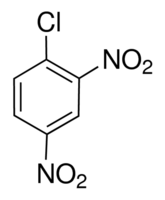
The IUPAC name of the following compound is
A.1- chloro- 2,4 – dinitrobenzene
B.2-chloro-1,4 dinitrobenzene
C.1,3- dinitro 2 chlorobenzene
D.4-chloro-1,3 dinitrobenzene
Answer
 Verified
654.9k+ views
Hint:
The international union of pure and applied chemistry (IUPAC) is an international federation of national adhering organizations that represents chemists in individual countries. Its purpose is to address many global issues involving the chemical sciences. Commas are used between numbers and dashes are used between letters and numbers. There are no spaces in the name.
Complete step by step answer:
-The IUPAC name of this compound is 1-chloro 2-4dinitrobenzene
-The substitutes present in this structure are used as prefixes in the nomenclature. So when such a situation arises when both prefixes are to be taken into consideration we go alphabetically.
-According to it, chlorine will be given first preference and then nitro
So,
-1-chloro and then we have nitro at two positions 2 and 4. So , 1-chloro-2,4-dinitrobenzene.
Hence, option A is correct.
Additional information
Other names of this compound are:
-Dinitrochlorobenzene
-Chlorodinitrobenzene
2,4- dinitrophenyl chloride
4- chloro -1,3 –dinitrobenzene
Note:
It is a yellow solid that is soluble in organic solvents. It is an important intermediate for the industrial production of other compounds. The melting and boiling point of this compound are 53˚C and 315˚C respectively. It has an almond-like odor and can be abbreviated in the form CDNB and DNCB.
The international union of pure and applied chemistry (IUPAC) is an international federation of national adhering organizations that represents chemists in individual countries. Its purpose is to address many global issues involving the chemical sciences. Commas are used between numbers and dashes are used between letters and numbers. There are no spaces in the name.
Complete step by step answer:
-The IUPAC name of this compound is 1-chloro 2-4dinitrobenzene
-The substitutes present in this structure are used as prefixes in the nomenclature. So when such a situation arises when both prefixes are to be taken into consideration we go alphabetically.
-According to it, chlorine will be given first preference and then nitro
So,
-1-chloro and then we have nitro at two positions 2 and 4. So , 1-chloro-2,4-dinitrobenzene.
Hence, option A is correct.
Additional information
Other names of this compound are:
-Dinitrochlorobenzene
-Chlorodinitrobenzene
2,4- dinitrophenyl chloride
4- chloro -1,3 –dinitrobenzene
Note:
It is a yellow solid that is soluble in organic solvents. It is an important intermediate for the industrial production of other compounds. The melting and boiling point of this compound are 53˚C and 315˚C respectively. It has an almond-like odor and can be abbreviated in the form CDNB and DNCB.
Recently Updated Pages
Which will be the least stable resonating structure class 11 chemistry CBSE

How many 5 digit telephone numbers can be construc-class-11-maths-CBSE
How do you find the angle of the resultant vector class 11 physics CBSE
Draw labelled diagram of the following i Gram seed class 11 biology CBSE
What is the need and importance of classification class 11 biology CBSE
The way in which the sparrows expressed their sorrow class 11 english CBSE
Trending doubts
One Metric ton is equal to kg A 10000 B 1000 C 100 class 11 physics CBSE
Find the value of the expression given below sin 30circ class 11 maths CBSE
1 Quintal is equal to a 110 kg b 10 kg c 100kg d 1000 class 11 physics CBSE
Draw a diagram of nephron and explain its structur class 11 biology CBSE
10 examples of friction in our daily life
Proton was discovered by A Thomson B Rutherford C Chadwick class 11 chemistry CBSE