




The input signal given to a CE amplifier having a voltage gain of 150 is $2\text{cos(15t+}\dfrac{\pi }{3})$. The corresponding output signal will be
A. $300\cos (15t+\dfrac{4\pi }{3})$
B. $300\cos (15t+\dfrac{\pi }{3})$
C. $75\cos (15t+\dfrac{2\pi }{3})$
D. $2\cos (15t+\dfrac{5\pi }{6})$
Answer
 Verified
595.5k+ views
Hint: In a CE amplifier, the phase difference between input voltage and output voltage is π. Voltage gain is the ratio of output voltage to input voltage. Output voltage is made the subject and calculated accordingly.
Formula used:
${{A}_{v}}=\dfrac{{{V}_{0}}}{{{V}_{i}}}$
Complete step by step answer:
The common emitter amplifier is a type of bipolar junction transistor which is used as a voltage amplifier. The output of this amplifier is collected from the collector terminal and the input is provided from base terminal while the emitter terminal is common to both. The picture below represents a CE amplifier:
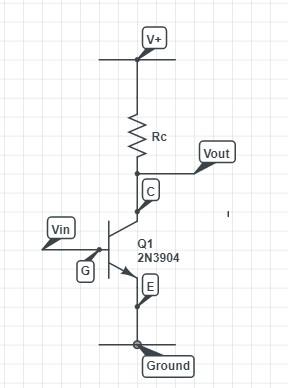
The following numerical data is given to us: V+
$2\text{cos(15t+}\dfrac{\pi }{3})$, Av=150 where Vi is voltage of the input signal and Av is voltage gain.
As we all know,
Voltage gain: ${{A}_{v}}=\dfrac{{{V}_{0}}}{{{V}_{i}}}$ where $V_0$ is the output voltage
We can also write it as ${{V}_{0}}={{A}_{v}}\times {{V}_{i}}$ ……… (1)
So on substituting the given values in equation (1),
${{V}_{0}}=150\times 2\text{cos(15t+}\dfrac{\pi }{3})=300cos(15t+\dfrac{\pi }{3})$
In a CE amplifier, the phase difference between input voltage and output voltage is π. So we have to add π to the phase angle.
${{V}_{0}}=300cos(15t+\dfrac{\pi }{3}+\pi )=300cos(15t+\dfrac{4\pi }{3})$.
Hence the correct option is (a).
Note: The possibility of the mistake is that you may choose option (b) because you may forget to take into account the phase difference between input and output voltage. In order to solve this problem or other problems like these, it is important to remember the characteristics of different transistors and amplifiers.
Formula used:
${{A}_{v}}=\dfrac{{{V}_{0}}}{{{V}_{i}}}$
Complete step by step answer:
The common emitter amplifier is a type of bipolar junction transistor which is used as a voltage amplifier. The output of this amplifier is collected from the collector terminal and the input is provided from base terminal while the emitter terminal is common to both. The picture below represents a CE amplifier:
The following numerical data is given to us: V+
$2\text{cos(15t+}\dfrac{\pi }{3})$, Av=150 where Vi is voltage of the input signal and Av is voltage gain.
As we all know,
Voltage gain: ${{A}_{v}}=\dfrac{{{V}_{0}}}{{{V}_{i}}}$ where $V_0$ is the output voltage
We can also write it as ${{V}_{0}}={{A}_{v}}\times {{V}_{i}}$ ……… (1)
So on substituting the given values in equation (1),
${{V}_{0}}=150\times 2\text{cos(15t+}\dfrac{\pi }{3})=300cos(15t+\dfrac{\pi }{3})$
In a CE amplifier, the phase difference between input voltage and output voltage is π. So we have to add π to the phase angle.
${{V}_{0}}=300cos(15t+\dfrac{\pi }{3}+\pi )=300cos(15t+\dfrac{4\pi }{3})$.
Hence the correct option is (a).
Note: The possibility of the mistake is that you may choose option (b) because you may forget to take into account the phase difference between input and output voltage. In order to solve this problem or other problems like these, it is important to remember the characteristics of different transistors and amplifiers.
Recently Updated Pages
Master Class 12 Economics: Engaging Questions & Answers for Success

Master Class 12 Physics: Engaging Questions & Answers for Success
Master Class 12 English: Engaging Questions & Answers for Success
Master Class 12 Social Science: Engaging Questions & Answers for Success
Master Class 12 Maths: Engaging Questions & Answers for Success
Master Class 12 Business Studies: Engaging Questions & Answers for Success
Trending doubts
Which are the Top 10 Largest Countries of the World?
What are the major means of transport Explain each class 12 social science CBSE
Draw a labelled sketch of the human eye class 12 physics CBSE
Why cannot DNA pass through cell membranes class 12 biology CBSE
Differentiate between insitu conservation and exsitu class 12 biology CBSE
Draw a neat and well labeled diagram of TS of ovary class 12 biology CBSE