




The inelastic scattering of photons is known as:
A. Compton effect
B. Einstein photoelectric effect
C. Raman effect
D. Hall effect
Answer
 Verified
627.9k+ views
Hint: Use the theory of scattering of light to solve the problem.
Complete Step by Step Solution:
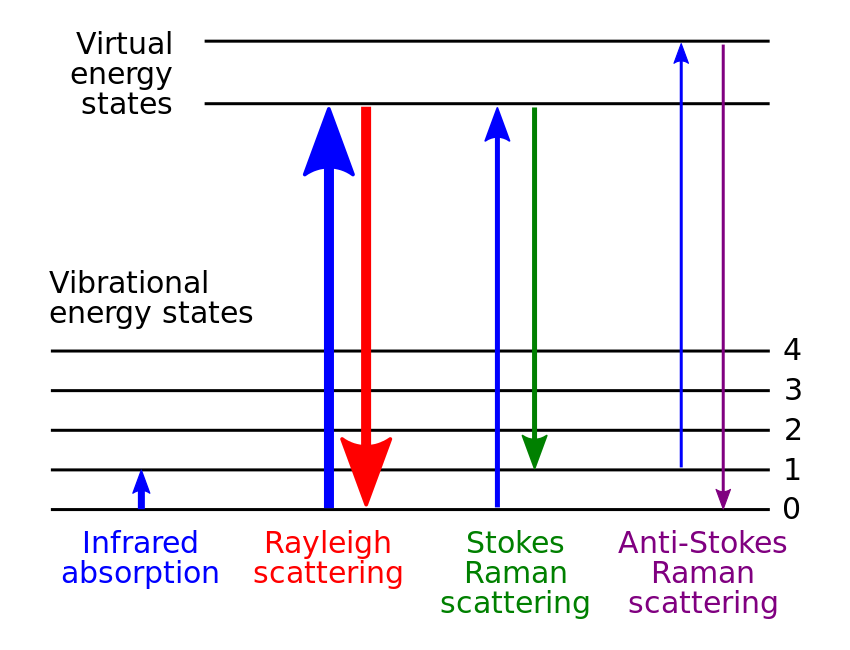
The inelastic scattering mechanism where frequency of scattered radiations changes according to the gain or loss of energy in accordance with the corresponding molecule or atom is known as the Raman Effect. This effect is inelastic in nature since it involves the loss in energy of the photons, which is very similar to losing kinetic energy when two objects collide.
Hence , the correct answer to the given question is option C, Raman Effect.
Additional information:
The phenomenon of scattering occurs when a light wave passes through an atmosphere of particles that get deflected from their original path and scatter in many different directions. There are three primary types of scattering- Rayleigh scattering, Mei scattering and Raman scattering effect. Rayleigh scattering is a type of uniform scattering because this type of scattering only occurs from small bodies such as atoms and molecules. This type of scattering is mainly dependent on wavelengths and the property of shorter wavelength radiations being scattered more. Mie scattering occurs as a type of non-uniform but elastic scattering since it occurs from relatively large bodies. This type of scattering also depends on wavelength and the property of shorter wavelength radiations being scattered more. Two other types of scattering are Brillouin scattering and Thompson scattering. Raman scattering is typically weak and small in comparison with Rayleigh scattering. The Raman Effect can occur in solids, liquids and gases as well.
Note: The scattering of photos by the exciting molecules that are at higher levels is known as Raman’s scattering. The scattering produces the photos with different frequencies that are dependent on the source.
Complete Step by Step Solution:
The inelastic scattering mechanism where frequency of scattered radiations changes according to the gain or loss of energy in accordance with the corresponding molecule or atom is known as the Raman Effect. This effect is inelastic in nature since it involves the loss in energy of the photons, which is very similar to losing kinetic energy when two objects collide.
Hence , the correct answer to the given question is option C, Raman Effect.
Additional information:
The phenomenon of scattering occurs when a light wave passes through an atmosphere of particles that get deflected from their original path and scatter in many different directions. There are three primary types of scattering- Rayleigh scattering, Mei scattering and Raman scattering effect. Rayleigh scattering is a type of uniform scattering because this type of scattering only occurs from small bodies such as atoms and molecules. This type of scattering is mainly dependent on wavelengths and the property of shorter wavelength radiations being scattered more. Mie scattering occurs as a type of non-uniform but elastic scattering since it occurs from relatively large bodies. This type of scattering also depends on wavelength and the property of shorter wavelength radiations being scattered more. Two other types of scattering are Brillouin scattering and Thompson scattering. Raman scattering is typically weak and small in comparison with Rayleigh scattering. The Raman Effect can occur in solids, liquids and gases as well.
Note: The scattering of photos by the exciting molecules that are at higher levels is known as Raman’s scattering. The scattering produces the photos with different frequencies that are dependent on the source.
Recently Updated Pages
Master Class 12 Economics: Engaging Questions & Answers for Success

Master Class 12 English: Engaging Questions & Answers for Success
Master Class 12 Social Science: Engaging Questions & Answers for Success
Master Class 12 Maths: Engaging Questions & Answers for Success
Master Class 12 Physics: Engaging Questions & Answers for Success
Master Class 9 General Knowledge: Engaging Questions & Answers for Success
Trending doubts
Which are the Top 10 Largest Countries of the World?
Draw a labelled sketch of the human eye class 12 physics CBSE
Differentiate between homogeneous and heterogeneous class 12 chemistry CBSE
Sulphuric acid is known as the king of acids State class 12 chemistry CBSE
Why is the cell called the structural and functional class 12 biology CBSE
Draw ray diagrams each showing i myopic eye and ii class 12 physics CBSE