



The incorrect geometry is represented by:
A) \[{\text{N}}{{\text{F}}_3}\] - trigonal planar
B) \[{{\text{H}}_2}{\text{O}}\] - bent
C) \[{\text{As}}{{\text{F}}_3}\] - Trigonal bipyramidal
D) \[{\text{B}}{{\text{F}}_3}\] - trigonal planar
Answer
 Verified
565.2k+ views
Hint:
To determine shapes or geometry of molecules we need to take into account the lone pair and bond pair, On the basis of various combinations geometry and shape of molecule changes.
Complete step by step solution:
The central atom in \[{\text{N}}{{\text{F}}_3}\] is nitrogen, it has five valence shell electrons. Out of five valence shell electrons 3 electrons are forming bonds with fluorine and are known as bond pairs and 2 electrons exist as lone pairs. The geometry formed out of 3 bond pairs and 1 lone pair is trigonal pyramidal and not trigonal planar. Hence it is an incorrect representation of geometry.
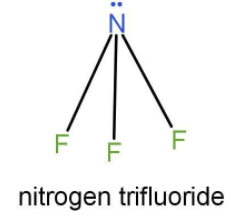
Hence, the correct option is A.
Additional information:
In \[{{\text{H}}_2}{\text{O}}\], the central atom is oxygen which has 6 valence electrons. Out of the six valence electrons 2 electrons are forming bonds with hydrogen and are known as bond pairs and 4 electrons exist as 2 lone pairs. The geometry formed out of 2 bond pairs and 4 lone pairs is tetrahedral and the shape becomes bent.
The central atom in \[{\text{As}}{{\text{F}}_3}\] is arsenic; it has five valence shell electrons. Out of five valence shell electrons 3 electrons are forming bonds with fluorine and are known as bond pairs and 2 electrons exist as lone pairs. The geometry formed out of 3 bond pairs and 1 lone pair is pyramidal.
In \[{\text{B}}{{\text{F}}_3}\], the central atom is boron which has 3 valence electrons. All the three electrons are bond pairs. Hence the geometry and shape will be trigonal planar.
Note:
Generally geometry and shapes are considered the same. In geometry we account for the bond pair and lone pair as well but in case of shape we do not consider lone pair, we only consider bond pairs. For example the shape of \[{\text{N}}{{\text{F}}_3}\] is pyramidal but the geometry of \[{\text{N}}{{\text{F}}_3}\] is tetrahedral.
To determine shapes or geometry of molecules we need to take into account the lone pair and bond pair, On the basis of various combinations geometry and shape of molecule changes.
Complete step by step solution:
The central atom in \[{\text{N}}{{\text{F}}_3}\] is nitrogen, it has five valence shell electrons. Out of five valence shell electrons 3 electrons are forming bonds with fluorine and are known as bond pairs and 2 electrons exist as lone pairs. The geometry formed out of 3 bond pairs and 1 lone pair is trigonal pyramidal and not trigonal planar. Hence it is an incorrect representation of geometry.
Hence, the correct option is A.
Additional information:
In \[{{\text{H}}_2}{\text{O}}\], the central atom is oxygen which has 6 valence electrons. Out of the six valence electrons 2 electrons are forming bonds with hydrogen and are known as bond pairs and 4 electrons exist as 2 lone pairs. The geometry formed out of 2 bond pairs and 4 lone pairs is tetrahedral and the shape becomes bent.
The central atom in \[{\text{As}}{{\text{F}}_3}\] is arsenic; it has five valence shell electrons. Out of five valence shell electrons 3 electrons are forming bonds with fluorine and are known as bond pairs and 2 electrons exist as lone pairs. The geometry formed out of 3 bond pairs and 1 lone pair is pyramidal.
In \[{\text{B}}{{\text{F}}_3}\], the central atom is boron which has 3 valence electrons. All the three electrons are bond pairs. Hence the geometry and shape will be trigonal planar.
Note:
Generally geometry and shapes are considered the same. In geometry we account for the bond pair and lone pair as well but in case of shape we do not consider lone pair, we only consider bond pairs. For example the shape of \[{\text{N}}{{\text{F}}_3}\] is pyramidal but the geometry of \[{\text{N}}{{\text{F}}_3}\] is tetrahedral.
Recently Updated Pages
Master Class 12 Social Science: Engaging Questions & Answers for Success

Master Class 12 Physics: Engaging Questions & Answers for Success
Master Class 12 Maths: Engaging Questions & Answers for Success
Master Class 12 Economics: Engaging Questions & Answers for Success
Master Class 12 Chemistry: Engaging Questions & Answers for Success
Master Class 12 Business Studies: Engaging Questions & Answers for Success
Trending doubts
Which are the Top 10 Largest Countries of the World?
Draw a labelled sketch of the human eye class 12 physics CBSE
Explain the structure of megasporangium class 12 biology CBSE
What are the major means of transport Explain each class 12 social science CBSE
How many chromosomes are found in human ovum a 46 b class 12 biology CBSE
The diagram of the section of a maize grain is given class 12 biology CBSE