




The image of a distant object is obtained on a screen using a concave mirror. The focal length of the mirror can be determined by measuring the distance between
A. The object and mirror
B. Object and screen
C. Mirror and screen
D. The mirror and screen as well as that between object and screen.
Answer
 Verified
636.6k+ views
Hint: A concave mirror is the one which is curved inward in the middle which can produce both real and virtual images. The focal length of this concave mirror is the distance between its pole and focus $F$ . We can find the measurements on which focal length of a concave mirror depends upon by using the mirror equation. We will assume an object placed infinity as it is a distant object and hence find the focal length of the mirror.
Formula used:
$\dfrac{1}{f} = \dfrac{1}{v} + \dfrac{1}{u}$
Complete answer:
A concave mirror can converge rays falling on it and thus produce real images of objects.
In general, the place where image forms depend on where the object is and mirror formula gives us the relation that tells the position of the image if we know the object distance.
Let us take $u$ as the distance to the object which is measured from the pole of the mirror and $v$ as the image distance from the pole. Then according to mirror formula,
$\dfrac{1}{f} = \dfrac{1}{v} + \dfrac{1}{u}$
Where, $f$ is the focal length of the concave mirror.
So, to measure the focal length of a concave mirror, we need to know the object distance $u$and image distance $v$. As images will be obtained on a screen, we can also call image distance as distance to the screen.
But here, the object is a distant object. So, let us take $u=\infty $. Then, focal length of the mirror will be,
$\begin{align}
& \dfrac{1}{f}=\dfrac{1}{v}+\dfrac{1}{u} \\
& \dfrac{1}{f}=\dfrac{1}{v}+\dfrac{1}{\infty } \\
& \dfrac{1}{f}=\dfrac{1}{v} \\
& f=v \\
\end{align}$
So, the focal length of this concave mirror will be the same as the image distance because the object is placed at infinity. i.e. a distant object.
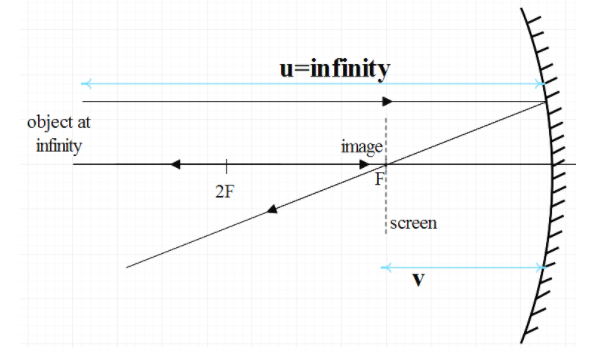
So, we can conclude that the focal length of a concave mirror can be found by measuring the image distance which is also equal to the distance between mirror and screen. This is valid only for distant objects. i.e. $u=\infty $.
Therefore, option C is correct.
Note:
Here in the question, we took the image distance as infinity because it is given that the object is a distant object. Always remember that in the case of a mirror, if an object is placed at infinity, image will be formed at the focus and if object is kept at the focus, image will be formed at infinity.
Formula used:
$\dfrac{1}{f} = \dfrac{1}{v} + \dfrac{1}{u}$
Complete answer:
A concave mirror can converge rays falling on it and thus produce real images of objects.
In general, the place where image forms depend on where the object is and mirror formula gives us the relation that tells the position of the image if we know the object distance.
Let us take $u$ as the distance to the object which is measured from the pole of the mirror and $v$ as the image distance from the pole. Then according to mirror formula,
$\dfrac{1}{f} = \dfrac{1}{v} + \dfrac{1}{u}$
Where, $f$ is the focal length of the concave mirror.
So, to measure the focal length of a concave mirror, we need to know the object distance $u$and image distance $v$. As images will be obtained on a screen, we can also call image distance as distance to the screen.
But here, the object is a distant object. So, let us take $u=\infty $. Then, focal length of the mirror will be,
$\begin{align}
& \dfrac{1}{f}=\dfrac{1}{v}+\dfrac{1}{u} \\
& \dfrac{1}{f}=\dfrac{1}{v}+\dfrac{1}{\infty } \\
& \dfrac{1}{f}=\dfrac{1}{v} \\
& f=v \\
\end{align}$
So, the focal length of this concave mirror will be the same as the image distance because the object is placed at infinity. i.e. a distant object.
So, we can conclude that the focal length of a concave mirror can be found by measuring the image distance which is also equal to the distance between mirror and screen. This is valid only for distant objects. i.e. $u=\infty $.
Therefore, option C is correct.
Note:
Here in the question, we took the image distance as infinity because it is given that the object is a distant object. Always remember that in the case of a mirror, if an object is placed at infinity, image will be formed at the focus and if object is kept at the focus, image will be formed at infinity.
Recently Updated Pages
Which of the following graphs shows the variation of class 12 physics CBSE

Draw a labelled diagram of the human male reproductive class 12 biology CBSE
Describe the experiment to compare the emf of two cells class 12 physics CBSE
What is standard hydrogen electrode
What is conventional current and electric current class 12 physics CBSE
2Bromopentane is treated with an alcoholic KOH solution class 12 chemistry CBSE
Trending doubts
Draw a labelled sketch of the human eye class 12 physics CBSE
Which are the Top 10 Largest Countries of the World?
Differentiate between homogeneous and heterogeneous class 12 chemistry CBSE
Draw ray diagrams each showing i myopic eye and ii class 12 physics CBSE
Which is the correct genotypic ratio of mendel dihybrid class 12 biology CBSE
What is the Full Form of PVC, PET, HDPE, LDPE, PP and PS ?