




The human eye forms the image of an object at its:
A. Cornea
B. Iris
C. Pupil
D. Retina
Answer
 Verified
588.9k+ views
Hint: Cornea is a thin outermost layer of the eye, which helps in refracting the light into the eye. Pupil is the opening at the centre of the eye, which regulates the amount of light that should enter. Iris controls the size of the pupil. Retina is a light sensitive membrane.
Complete answer:
We humans can see objects because of our eyes, when the visible light enters our eyes. Let us understand how we are able to see the objects in front of us. For better visualisation, we have a diagram too.
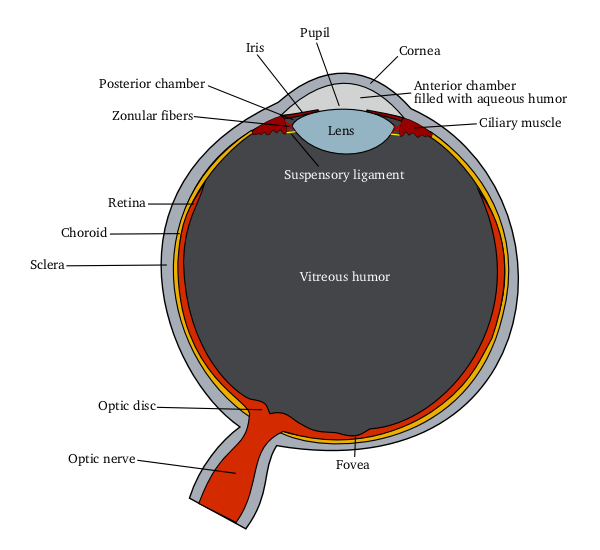
The light from the object in front of us enters the eye through a thin layer called cornea. This layer (cornea) has a higher refractive index than air and therefore helps in refracting the light into the eye.
At the centre of the eye there is an opening called the pupil of the eye. Light enters the inside portion of the eye through the pupil. This means that the pupil maintains the amount of light that should enter our eye. Where the light is very bright, the pupil contracts and when there is very little light, the pupil expands, allowing more light to enter.
The size of the pupil is controlled by the iris of the eye. After passing through the pupil, the light passes through a convex lens, which converges the rays of light at a point on a light sensitive membrane called the retina. Thus, the image of the object in front of us is formed on the retina.
After this, the retina sends the message of the image to the brain through nerve impulses. Then the brain interprets the data and this way sees the objects.
Note:
The colour of the objects that we see depends on the wavelength of light emitted by the object. Light is a wave of different wavelengths and different bodies emit different wavelengths. Also, note that the image must be formed on the retina and not at any point that is not in the retina. If the image is not formed on the retina then we will not be able to see the objects clearly. This is what happens when people suffer from eye defects.
Complete answer:
We humans can see objects because of our eyes, when the visible light enters our eyes. Let us understand how we are able to see the objects in front of us. For better visualisation, we have a diagram too.
The light from the object in front of us enters the eye through a thin layer called cornea. This layer (cornea) has a higher refractive index than air and therefore helps in refracting the light into the eye.
At the centre of the eye there is an opening called the pupil of the eye. Light enters the inside portion of the eye through the pupil. This means that the pupil maintains the amount of light that should enter our eye. Where the light is very bright, the pupil contracts and when there is very little light, the pupil expands, allowing more light to enter.
The size of the pupil is controlled by the iris of the eye. After passing through the pupil, the light passes through a convex lens, which converges the rays of light at a point on a light sensitive membrane called the retina. Thus, the image of the object in front of us is formed on the retina.
After this, the retina sends the message of the image to the brain through nerve impulses. Then the brain interprets the data and this way sees the objects.
Note:
The colour of the objects that we see depends on the wavelength of light emitted by the object. Light is a wave of different wavelengths and different bodies emit different wavelengths. Also, note that the image must be formed on the retina and not at any point that is not in the retina. If the image is not formed on the retina then we will not be able to see the objects clearly. This is what happens when people suffer from eye defects.
Recently Updated Pages
Master Class 12 Business Studies: Engaging Questions & Answers for Success

Master Class 12 Chemistry: Engaging Questions & Answers for Success
Master Class 12 Biology: Engaging Questions & Answers for Success
Class 12 Question and Answer - Your Ultimate Solutions Guide
Master Class 11 English: Engaging Questions & Answers for Success
Master Class 11 Social Science: Engaging Questions & Answers for Success
Trending doubts
Which are the Top 10 Largest Countries of the World?
Draw a labelled sketch of the human eye class 12 physics CBSE
Differentiate between homogeneous and heterogeneous class 12 chemistry CBSE
In order to find out the different types of gametes class 12 biology NEET_UG
Why is the cell called the structural and functional class 12 biology CBSE
Draw ray diagrams each showing i myopic eye and ii class 12 physics CBSE