




The height of the image formed by a converging lens on a screen is $8cm$. For the same position of the object and screen again an image of size $12.5cm$ is formed on the screen by shifting the lens. The height of the object:
A) $\dfrac{{625}}{{32}}cm$
B) $\dfrac{{64}}{{12.5}}cm$
C) $10cm$
D) None
Answer
 Verified
607.8k+ views
Hint: The two provided cases are obtained by having a normal step up and then by shifting the positions of the lens. Obtain mathematical expressions for both the cases using the magnification formula and lens formula. Then solve them together by value substitution of one into the other, using their relation to get the required answer.
Formula used:
$\dfrac{1}{f} = \dfrac{1}{v} - \dfrac{1}{u}$
${M_1} = \dfrac{{{h_1}}}{h} = \dfrac{v}{u}$
${M_2} = \dfrac{{{h_2}}}{h} = \dfrac{{v'}}{{u'}}$
Complete solution:
As we know there are no changes in the position of the object or the screen in this question, and the only displacement is occurring for the position of the lens.
This question can be easily understood with the idea of a magnifying glass, let me explain it to you. Suppose you are trying to read a book with extremely small letters that you can only do with the help of a magnifying glass. Now you use a magnifying glass to view the letters, as we know similar to the question asked, a magnifying glass too has a converging lens, which is a convex lens. Now to get a better vision of the text we move the glass, keeping our eyes and the book in the same place.
We can make a diagram of the situation, and then do the basic math to arrive at the answer.
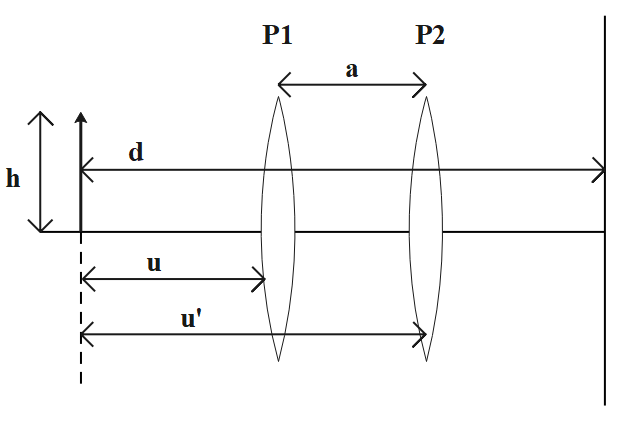
In the figure P1 is the first position and P2 is the second position. D is the distance between the object and the screen and h denotes the height of the object.
From lens formulae
$\dfrac{1}{f} = \dfrac{1}{v} - \dfrac{1}{u}$
$ \Rightarrow \dfrac{1}{f} = \dfrac{1}{{d - u}} - \dfrac{1}{u}$
Let ${h_1}$and ${h_2}$be the two image heights.
Magnification of first position can be written as
${M_1} = \dfrac{{{h_1}}}{h} = \dfrac{v}{u}$
And for second position
${M_2} = \dfrac{{{h_2}}}{h} = \dfrac{{v'}}{{u'}}$
Multiplying both equations and simplifying
${M_1}{M_2} = \dfrac{{{h_1}}}{h}\dfrac{{{h_2}}}{h} = \dfrac{v}{u}\dfrac{{v'}}{{u'}}$
On simplifying equations of image distance, we get
$\eqalign{
& v = u \cr
& v' = u' \cr} $
Therefore
${h_1}{h_2} = {h^2}$
Substituting the values
$\therefore h = \sqrt {8 \times 12.5} = 10cm$
Hence, the height of the object is $10cm$.
Therefore, option C is the correct answer.
Note:
Note that the above formula is independent of the distance between the two lenses, the effect is already included in the heights of the images. It is very important to use proper sign convention in solving this problem; otherwise it will lead to false results.
Formula used:
$\dfrac{1}{f} = \dfrac{1}{v} - \dfrac{1}{u}$
${M_1} = \dfrac{{{h_1}}}{h} = \dfrac{v}{u}$
${M_2} = \dfrac{{{h_2}}}{h} = \dfrac{{v'}}{{u'}}$
Complete solution:
As we know there are no changes in the position of the object or the screen in this question, and the only displacement is occurring for the position of the lens.
This question can be easily understood with the idea of a magnifying glass, let me explain it to you. Suppose you are trying to read a book with extremely small letters that you can only do with the help of a magnifying glass. Now you use a magnifying glass to view the letters, as we know similar to the question asked, a magnifying glass too has a converging lens, which is a convex lens. Now to get a better vision of the text we move the glass, keeping our eyes and the book in the same place.
We can make a diagram of the situation, and then do the basic math to arrive at the answer.
In the figure P1 is the first position and P2 is the second position. D is the distance between the object and the screen and h denotes the height of the object.
From lens formulae
$\dfrac{1}{f} = \dfrac{1}{v} - \dfrac{1}{u}$
$ \Rightarrow \dfrac{1}{f} = \dfrac{1}{{d - u}} - \dfrac{1}{u}$
Let ${h_1}$and ${h_2}$be the two image heights.
Magnification of first position can be written as
${M_1} = \dfrac{{{h_1}}}{h} = \dfrac{v}{u}$
And for second position
${M_2} = \dfrac{{{h_2}}}{h} = \dfrac{{v'}}{{u'}}$
Multiplying both equations and simplifying
${M_1}{M_2} = \dfrac{{{h_1}}}{h}\dfrac{{{h_2}}}{h} = \dfrac{v}{u}\dfrac{{v'}}{{u'}}$
On simplifying equations of image distance, we get
$\eqalign{
& v = u \cr
& v' = u' \cr} $
Therefore
${h_1}{h_2} = {h^2}$
Substituting the values
$\therefore h = \sqrt {8 \times 12.5} = 10cm$
Hence, the height of the object is $10cm$.
Therefore, option C is the correct answer.
Note:
Note that the above formula is independent of the distance between the two lenses, the effect is already included in the heights of the images. It is very important to use proper sign convention in solving this problem; otherwise it will lead to false results.
Recently Updated Pages
Master Class 12 Business Studies: Engaging Questions & Answers for Success

Master Class 12 Chemistry: Engaging Questions & Answers for Success
Master Class 12 Biology: Engaging Questions & Answers for Success
Class 12 Question and Answer - Your Ultimate Solutions Guide
Master Class 11 English: Engaging Questions & Answers for Success
Master Class 11 Social Science: Engaging Questions & Answers for Success
Trending doubts
Which are the Top 10 Largest Countries of the World?
Draw a labelled sketch of the human eye class 12 physics CBSE
Differentiate between homogeneous and heterogeneous class 12 chemistry CBSE
Differentiate between Pyramid of energy and pyramid class 12 biology CBSE
Why is the cell called the structural and functional class 12 biology CBSE
Draw the diagram of the pyramid of energy Explain In class 12 biology CBSE