




The height of the cylinder is 7 cm, its radius is 5 cm. Find its total surface area and curved surface area.
Answer
 Verified
625.2k+ views
Hint: The use of the formula given as $\text{curved surface area = 2}\pi \text{rh}$ and $\text{Total surface area = 2}\pi \text{rh}+\,2\pi {{\text{r}}^{\text{2}}}$ of the cylinder we can solve the question easily. In these formulas r is called the radius and h is the height of the cylinder. The value of $\pi $ is chosen here as $\dfrac{22}{7}$ into the formulas. By the use of this value we will find out the required areas to its simplest form.
Complete step-by-step answer:
The required figure of the cylinder in the question is given below.
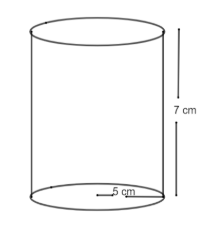
As we can clearly see that the length of the cylinder is 7 cm and the radius is 5 cm. We will now first find the curved surface area. The curved surface area of the cylinder is basically the round curved surface that is visible to us if we round the cylinder. As we can clearly see that the round surface of the cylinder includes height and radius so we will find the curved surface area by the formula $\text{curved surface area = 2}\pi \text{rh}$ where r = 5 cm is the radius and h = 7 cm is the height of the cylinder. By substituting the values into the formula we will get $\text{curved surface area = 2}\pi \left( 5\text{cm} \right)\left( 7\text{cm} \right)$. As we know that the value of $\pi =\dfrac{22}{7}$ therefore we now have that $\begin{align}
& \text{curved surface area = 2}\times \dfrac{22}{7}\times \left( 5\,\text{cm} \right)\left( 7\,\text{cm} \right) \\
& \Rightarrow \text{curved surface area = 2}\times 22\times \left( 5\,\text{cm} \right)\left( 1\,\text{cm} \right) \\
& \Rightarrow \text{curved surface area = 44}\times 5\,\text{c}{{\text{m}}^{2}} \\
& \Rightarrow \text{curved surface area = 220}\,\text{c}{{\text{m}}^{2}} \\
\end{align}$
Now, we will find the total surface area of the cylinder. The total surface area here includes the curved surface area and the area of the round plates that are on the top and the bottom of the cylinder. The formula therefore, is given by Total surface area = curved surface area + area of two circular plates.
As the area of the two circular plates is basically the area of the circle thus, we will have that the area of the two circles is = $2\,\times $ area of 1 circle. Thus we get the area of two circles as $2\pi {{\text{r}}^{\text{2}}}$. By substituting it into the formula of Total surface area we will get that Total surface area of the cylinder = curved surface area + $2\pi {{\text{r}}^{\text{2}}}$. Therefore, we have $\text{Total surface area = }220\text{ c}{{\text{m}}^{2}}+\,2\pi {{\text{r}}^{\text{2}}}$. As we know that the value of r is 5 cm and $\pi =\dfrac{22}{7}$ thus, we get $\begin{align}
& \text{Total surface area = }220\text{ c}{{\text{m}}^{2}}+\,2\times \dfrac{22}{7}\times {{\left( 5\,\text{cm} \right)}^{\text{2}}} \\
& \Rightarrow \text{Total surface area = }220\text{ c}{{\text{m}}^{2}}+\,2\times \dfrac{22}{7}\times 25\,\text{c}{{\text{m}}^{2}} \\
& \Rightarrow \text{Total surface area = }220\text{ c}{{\text{m}}^{2}}+\,\dfrac{1100}{7}\,\text{c}{{\text{m}}^{2}} \\
& \Rightarrow \text{Total surface area = }220\,\text{c}{{\text{m}}^{2}}\,+\,157.14\,\text{c}{{\text{m}}^{\text{2}}} \\
& \Rightarrow \text{Total surface area = 377}\text{.14}\,\text{c}{{\text{m}}^{2}} \\
\end{align}$
Hence, the curved surface area of the cylinder is 220 $\text{c}{{\text{m}}^{\text{2}}}$ and the total surface area of the cylinder is 377.14 $\text{c}{{\text{m}}^{\text{2}}}$.
Note: In the place of $\pi =\dfrac{22}{7}$ we can also put $\pi =3.14$ into the formula and solve it as usual. As both the dimensions of the cylinder are in the same unit which is centimetre so, we have started easily here but in case we have different dimensions then we first change the units into the same unit and then we will proceed further. We will focus while performing multiplication as if we multiply the numbers and we get wrong multiplication then the whole solution will be wrong. Even if they use the right method the answer will be not right.
Complete step-by-step answer:
The required figure of the cylinder in the question is given below.
As we can clearly see that the length of the cylinder is 7 cm and the radius is 5 cm. We will now first find the curved surface area. The curved surface area of the cylinder is basically the round curved surface that is visible to us if we round the cylinder. As we can clearly see that the round surface of the cylinder includes height and radius so we will find the curved surface area by the formula $\text{curved surface area = 2}\pi \text{rh}$ where r = 5 cm is the radius and h = 7 cm is the height of the cylinder. By substituting the values into the formula we will get $\text{curved surface area = 2}\pi \left( 5\text{cm} \right)\left( 7\text{cm} \right)$. As we know that the value of $\pi =\dfrac{22}{7}$ therefore we now have that $\begin{align}
& \text{curved surface area = 2}\times \dfrac{22}{7}\times \left( 5\,\text{cm} \right)\left( 7\,\text{cm} \right) \\
& \Rightarrow \text{curved surface area = 2}\times 22\times \left( 5\,\text{cm} \right)\left( 1\,\text{cm} \right) \\
& \Rightarrow \text{curved surface area = 44}\times 5\,\text{c}{{\text{m}}^{2}} \\
& \Rightarrow \text{curved surface area = 220}\,\text{c}{{\text{m}}^{2}} \\
\end{align}$
Now, we will find the total surface area of the cylinder. The total surface area here includes the curved surface area and the area of the round plates that are on the top and the bottom of the cylinder. The formula therefore, is given by Total surface area = curved surface area + area of two circular plates.
As the area of the two circular plates is basically the area of the circle thus, we will have that the area of the two circles is = $2\,\times $ area of 1 circle. Thus we get the area of two circles as $2\pi {{\text{r}}^{\text{2}}}$. By substituting it into the formula of Total surface area we will get that Total surface area of the cylinder = curved surface area + $2\pi {{\text{r}}^{\text{2}}}$. Therefore, we have $\text{Total surface area = }220\text{ c}{{\text{m}}^{2}}+\,2\pi {{\text{r}}^{\text{2}}}$. As we know that the value of r is 5 cm and $\pi =\dfrac{22}{7}$ thus, we get $\begin{align}
& \text{Total surface area = }220\text{ c}{{\text{m}}^{2}}+\,2\times \dfrac{22}{7}\times {{\left( 5\,\text{cm} \right)}^{\text{2}}} \\
& \Rightarrow \text{Total surface area = }220\text{ c}{{\text{m}}^{2}}+\,2\times \dfrac{22}{7}\times 25\,\text{c}{{\text{m}}^{2}} \\
& \Rightarrow \text{Total surface area = }220\text{ c}{{\text{m}}^{2}}+\,\dfrac{1100}{7}\,\text{c}{{\text{m}}^{2}} \\
& \Rightarrow \text{Total surface area = }220\,\text{c}{{\text{m}}^{2}}\,+\,157.14\,\text{c}{{\text{m}}^{\text{2}}} \\
& \Rightarrow \text{Total surface area = 377}\text{.14}\,\text{c}{{\text{m}}^{2}} \\
\end{align}$
Hence, the curved surface area of the cylinder is 220 $\text{c}{{\text{m}}^{\text{2}}}$ and the total surface area of the cylinder is 377.14 $\text{c}{{\text{m}}^{\text{2}}}$.
Note: In the place of $\pi =\dfrac{22}{7}$ we can also put $\pi =3.14$ into the formula and solve it as usual. As both the dimensions of the cylinder are in the same unit which is centimetre so, we have started easily here but in case we have different dimensions then we first change the units into the same unit and then we will proceed further. We will focus while performing multiplication as if we multiply the numbers and we get wrong multiplication then the whole solution will be wrong. Even if they use the right method the answer will be not right.
Recently Updated Pages
Three beakers labelled as A B and C each containing 25 mL of water were taken A small amount of NaOH anhydrous CuSO4 and NaCl were added to the beakers A B and C respectively It was observed that there was an increase in the temperature of the solutions contained in beakers A and B whereas in case of beaker C the temperature of the solution falls Which one of the following statements isarecorrect i In beakers A and B exothermic process has occurred ii In beakers A and B endothermic process has occurred iii In beaker C exothermic process has occurred iv In beaker C endothermic process has occurred

Master Class 9 Social Science: Engaging Questions & Answers for Success
Master Class 9 Science: Engaging Questions & Answers for Success
Master Class 9 Maths: Engaging Questions & Answers for Success
Master Class 9 General Knowledge: Engaging Questions & Answers for Success
Class 9 Question and Answer - Your Ultimate Solutions Guide
Three beakers labelled as A B and C each containing 25 mL of water were taken A small amount of NaOH anhydrous CuSO4 and NaCl were added to the beakers A B and C respectively It was observed that there was an increase in the temperature of the solutions contained in beakers A and B whereas in case of beaker C the temperature of the solution falls Which one of the following statements isarecorrect i In beakers A and B exothermic process has occurred ii In beakers A and B endothermic process has occurred iii In beaker C exothermic process has occurred iv In beaker C endothermic process has occurred
Master Class 9 Social Science: Engaging Questions & Answers for Success
Master Class 9 Science: Engaging Questions & Answers for Success
Trending doubts
Find the sum of series 1 + 2 + 3 + 4 + 5 + + 100 class 9 maths CBSE
Fill the blanks with the suitable prepositions 1 The class 9 english CBSE
Difference Between Plant Cell and Animal Cell
What is pollution? How many types of pollution? Define it
Name 10 Living and Non living things class 9 biology CBSE
Which are the Top 10 Largest States of India?