




The gravitational field in a region is $\vec{E} = (2\hat{i} +3\hat{j})\;Nkg^{-1}$. The equation for equipotential line is:
A.2x+3y=c
B.2y+3x=c
C.X+2y=c
D.1.5x+2y=c
Answer
 Verified
612.6k+ views
Hint: Recall that the equipotential line traces all point at the same gravitational potential. This means that the equipotential line is perpendicular to the gravitational field lines. From this perspective, find the slope of the field vector given to us. Then, find the corresponding slope of the equipotential line by taking the negative reciprocal of the slope of the field vector. Then substitute this into the straight line equation and you should arrive at the equipotential line equation.
Formula Used:
Slope of a line perpendicular to a line of slope m: $m^{\prime} = -\dfrac{1}{m}$
Equation of a straight line: $y = mx+c$
Complete answer:
We know that an equipotential line is the line along which the gravitational potential is constant. They provide a quantitative way of viewing the gravitational potential in two dimensions. Every point on this line will be at the same potential. In three dimensions, the lines from equipotential surfaces. Moving along an equipotential surface requires no work because this movement is always perpendicular to the gravitational field.
Let the equation of the equipotential line be $y = mx+c$, where m is the slope of the line, c is the y-intercept, and y and x denote the directional y and x axes respectively.
We know that the equipotential line is always perpendicular to the gravitational field lines.
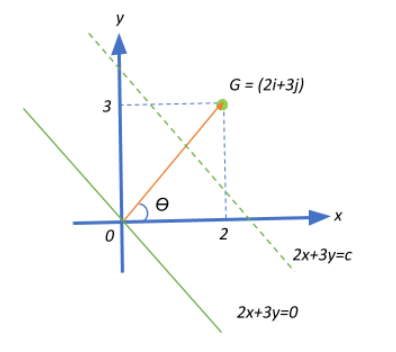
Given that $\vec{G} = (2\hat{i} +3\hat{j})\;Nkg^{-1}$ as shown in the diagram, we can calculate the slope of this vector, given by:
$tan\theta =\dfrac{3}{2}$.
Now, since the equipotential line will be perpendicular to the gravitational field, the slope of the equipotential line will be the negative reciprocal of the slope of the gravitational field vector, i.e.,
$m = -\dfrac{1}{tan\theta} = -\dfrac{1}{\dfrac{3}{2}} = -\dfrac{2}{3}$
Substituting this into our equipotential line equation:
$y = -\dfrac{2}{3}x+c \Rightarrow 3y=-2x+c \Rightarrow 2x+3y=c$
Therefore, the correct choice would be A. $2x+3y=c$
Note:
Note that though we got only one equation for the equipotential line, by varying the value of c we can get an infinite number of equipotential lines that are all perpendicular to the gravitational field. Thus, there is not one but many equipotential lines that are obtained for a given range of gravitational fields.
Formula Used:
Slope of a line perpendicular to a line of slope m: $m^{\prime} = -\dfrac{1}{m}$
Equation of a straight line: $y = mx+c$
Complete answer:
We know that an equipotential line is the line along which the gravitational potential is constant. They provide a quantitative way of viewing the gravitational potential in two dimensions. Every point on this line will be at the same potential. In three dimensions, the lines from equipotential surfaces. Moving along an equipotential surface requires no work because this movement is always perpendicular to the gravitational field.
Let the equation of the equipotential line be $y = mx+c$, where m is the slope of the line, c is the y-intercept, and y and x denote the directional y and x axes respectively.
We know that the equipotential line is always perpendicular to the gravitational field lines.
Given that $\vec{G} = (2\hat{i} +3\hat{j})\;Nkg^{-1}$ as shown in the diagram, we can calculate the slope of this vector, given by:
$tan\theta =\dfrac{3}{2}$.
Now, since the equipotential line will be perpendicular to the gravitational field, the slope of the equipotential line will be the negative reciprocal of the slope of the gravitational field vector, i.e.,
$m = -\dfrac{1}{tan\theta} = -\dfrac{1}{\dfrac{3}{2}} = -\dfrac{2}{3}$
Substituting this into our equipotential line equation:
$y = -\dfrac{2}{3}x+c \Rightarrow 3y=-2x+c \Rightarrow 2x+3y=c$
Therefore, the correct choice would be A. $2x+3y=c$
Note:
Note that though we got only one equation for the equipotential line, by varying the value of c we can get an infinite number of equipotential lines that are all perpendicular to the gravitational field. Thus, there is not one but many equipotential lines that are obtained for a given range of gravitational fields.
Recently Updated Pages
Master Class 12 Business Studies: Engaging Questions & Answers for Success

Master Class 12 Biology: Engaging Questions & Answers for Success
Master Class 12 Chemistry: Engaging Questions & Answers for Success
Class 12 Question and Answer - Your Ultimate Solutions Guide
Master Class 11 Social Science: Engaging Questions & Answers for Success
Master Class 11 English: Engaging Questions & Answers for Success
Trending doubts
Which is more stable and why class 12 chemistry CBSE
Which are the Top 10 Largest Countries of the World?
Draw a labelled sketch of the human eye class 12 physics CBSE
Differentiate between homogeneous and heterogeneous class 12 chemistry CBSE
What are the major means of transport Explain each class 12 social science CBSE
Sulphuric acid is known as the king of acids State class 12 chemistry CBSE