




The given graph shows the effect of substrate concentration on rate of reaction of enzyme green gram phosphatase.What does the graph indicate?
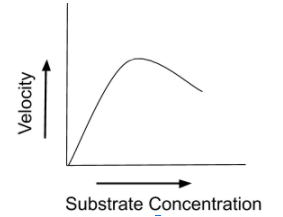
A) Formation of enzyme substrate complex
B) Increase of pH at higher concentration of substrate
C) Presence of enzyme inhibitor
D) Rate of reaction is directly proportional to the substrate concentration.
Answer
 Verified
569.1k+ views
Hint:A phosphatase is an enzyme which cleaves a monoester of phosphoric acid into a phosphate ion and an alcohol using water. Since a phosphatase enzyme catalyses the substrate hydrolysis, it is a hydrolase subcategory.
Complete answer:
For several biological functions, phosphatase enzymes are important because phosphorylation (e.g. by protein kinases) and dephosphorylation (by phosphatases) play various roles in cellular control and signalling. Whereas phosphatases detach groups of phosphates from molecules, kinases catalyse the transfer of groups of phosphates to ATP molecules. Kinases and phosphatases together direct a form of post-translational modification that is vital to the regulatory network of the cell.
It is obvious from the graph that the rate of the enzyme reaction is directly proportional to the concentration of the substrate. The effect of substrate concentration on the velocity of enzyme activity is indicated in this graph. Increasing substrate concentration improves the reaction rate. This is because there will be more substrate molecules colliding with enzyme molecules, so there will be more product creation.
After all, after a certain concentration, any improvement would have little effect on the reaction rate, as the limiting factor will no longer be the concentration of the substrate. The enzymes will become saturated efficiently and will function at their highest possible rate. The rate of reaction will be increased by increasing enzyme concentration, as more enzymes will collide with substrate molecules.
Thus the correct answer is option (A) ‘Formation of enzyme substrate complex’.
Note:Phosphatase enzymes, which catalyse the transfer of a phosphate group from hydrogen phosphate to an acceptor, should not be confused with phosphorylase enzymes. Phosphatases are a field of concern for pharmaceutical research because of their prevalence in cellular regulation.
Complete answer:
For several biological functions, phosphatase enzymes are important because phosphorylation (e.g. by protein kinases) and dephosphorylation (by phosphatases) play various roles in cellular control and signalling. Whereas phosphatases detach groups of phosphates from molecules, kinases catalyse the transfer of groups of phosphates to ATP molecules. Kinases and phosphatases together direct a form of post-translational modification that is vital to the regulatory network of the cell.
It is obvious from the graph that the rate of the enzyme reaction is directly proportional to the concentration of the substrate. The effect of substrate concentration on the velocity of enzyme activity is indicated in this graph. Increasing substrate concentration improves the reaction rate. This is because there will be more substrate molecules colliding with enzyme molecules, so there will be more product creation.
After all, after a certain concentration, any improvement would have little effect on the reaction rate, as the limiting factor will no longer be the concentration of the substrate. The enzymes will become saturated efficiently and will function at their highest possible rate. The rate of reaction will be increased by increasing enzyme concentration, as more enzymes will collide with substrate molecules.
Thus the correct answer is option (A) ‘Formation of enzyme substrate complex’.
Note:Phosphatase enzymes, which catalyse the transfer of a phosphate group from hydrogen phosphate to an acceptor, should not be confused with phosphorylase enzymes. Phosphatases are a field of concern for pharmaceutical research because of their prevalence in cellular regulation.
Recently Updated Pages
Master Class 12 Economics: Engaging Questions & Answers for Success

Master Class 12 Physics: Engaging Questions & Answers for Success
Master Class 12 English: Engaging Questions & Answers for Success
Master Class 12 Social Science: Engaging Questions & Answers for Success
Master Class 12 Maths: Engaging Questions & Answers for Success
Master Class 12 Business Studies: Engaging Questions & Answers for Success
Trending doubts
Which are the Top 10 Largest Countries of the World?
What are the major means of transport Explain each class 12 social science CBSE
Draw a labelled sketch of the human eye class 12 physics CBSE
Why cannot DNA pass through cell membranes class 12 biology CBSE
Differentiate between insitu conservation and exsitu class 12 biology CBSE
Draw a neat and well labeled diagram of TS of ovary class 12 biology CBSE