




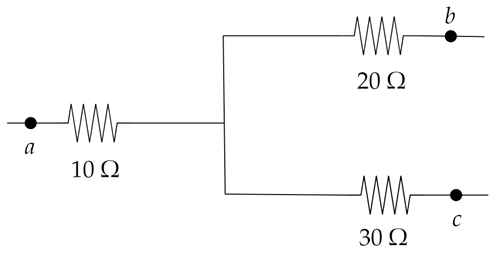
The given figure shows a part of an electrical circuit. The potentials at the points $a,b$ and $c$ are $30V,12V$ and $2V$ respectively. Find the currents through the three resistors.
Answer
 Verified
534.6k+ views
Hint: We have to consider the node as $d$ and then suppose a potential of $V$ exists there. As $b$ and $c$ are in parallel so the current from $a$ splits up into two equal values. We have to assume a current is flowing in the circuit $a$. Then by comparing the equations with the help of Kirchhoff’s Law we will find the value of the unknown potential. After that we will be using Ohm’s Law to find the values of current.
Complete step by step solution:
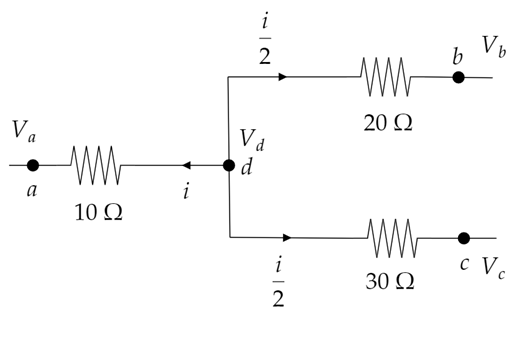
Let the potential at point $d$ as shown in figure be ${V_d}$. Let a current $i$ flows from $a$ to $d$.
Since, $d$ to $b$ circuit and the $d$ to $c$ circuit are in parallel so both have the same current flowing through it.
It means that current $i$ is being split up into two equal magnitudes of current $\dfrac{i}{2}$. So, $\dfrac{i}{2}$ current is flowing through the parallel circuit.
The potentials at the points $a,b$ and $c$ are $30V,12V$ and $2V$ respectively.
So, ${V_a} = 30V$, ${V_b} = 12V$ and ${V_c} = 2V$.
And the given resistances are, ${R_a} = 10\Omega $, ${R_b} = 20\Omega $ and ${R_c} = 30\Omega $
Now applying Kirchhoff’s Law we get,
${V_a} - {V_d} - \left( {i \times {R_a}} \right) = 0$
$ \Rightarrow 30 - {V_d} = 10i - - - - - \left( 1 \right)$
Similarly,
${V_d} - 12 = 20 \times \dfrac{i}{2} = 10i - - - - - \left( 2 \right)$
${V_d} - 2 = 30 \times \dfrac{i}{2} = 15i - - - - - \left( 3 \right)$
Comparing equation $\left( 1 \right)$ and $\left( 2 \right)$ we get,
$30 - {V_d} = {V_d} - 12$
$\therefore {V_d} = 25$
So, the potential at point $d$ is $25V$.
Now, we know that the currents flowing through resistances ${R_a}$, ${R_b}$ and ${R_c}$ is $i$, $\dfrac{i}{2}$ and $\dfrac{i}{2}$ respectively.
Now by using Ohm’s Law we get,
${V_a} - {V_d} = i \times {R_{}}$
$30 - 25 = i \times 10$
So the value of $i = 0.5{\text{ }}A$
Therefore, $\dfrac{i}{2} = 0.25{\text{ }}A$.
So, the currents flowing through resistances ${R_a}$, ${R_b}$ and ${R_c}$ is $0.5{\text{ }}A$, $0.25{\text{ }}A$ and $0.25{\text{ }}A$.
Note: It must be noted that we must consider a common potential point in this type of question. As the potential at point $d$ is greater than $b$ and $c$ so, the current flows outwards from $d$ with respect to $b$ and $c$ but as the potential at point $a$ is greater than $d$, the currents flows inwards or towards $d$.
Complete step by step solution:
Let the potential at point $d$ as shown in figure be ${V_d}$. Let a current $i$ flows from $a$ to $d$.
Since, $d$ to $b$ circuit and the $d$ to $c$ circuit are in parallel so both have the same current flowing through it.
It means that current $i$ is being split up into two equal magnitudes of current $\dfrac{i}{2}$. So, $\dfrac{i}{2}$ current is flowing through the parallel circuit.
The potentials at the points $a,b$ and $c$ are $30V,12V$ and $2V$ respectively.
So, ${V_a} = 30V$, ${V_b} = 12V$ and ${V_c} = 2V$.
And the given resistances are, ${R_a} = 10\Omega $, ${R_b} = 20\Omega $ and ${R_c} = 30\Omega $
Now applying Kirchhoff’s Law we get,
${V_a} - {V_d} - \left( {i \times {R_a}} \right) = 0$
$ \Rightarrow 30 - {V_d} = 10i - - - - - \left( 1 \right)$
Similarly,
${V_d} - 12 = 20 \times \dfrac{i}{2} = 10i - - - - - \left( 2 \right)$
${V_d} - 2 = 30 \times \dfrac{i}{2} = 15i - - - - - \left( 3 \right)$
Comparing equation $\left( 1 \right)$ and $\left( 2 \right)$ we get,
$30 - {V_d} = {V_d} - 12$
$\therefore {V_d} = 25$
So, the potential at point $d$ is $25V$.
Now, we know that the currents flowing through resistances ${R_a}$, ${R_b}$ and ${R_c}$ is $i$, $\dfrac{i}{2}$ and $\dfrac{i}{2}$ respectively.
Now by using Ohm’s Law we get,
${V_a} - {V_d} = i \times {R_{}}$
$30 - 25 = i \times 10$
So the value of $i = 0.5{\text{ }}A$
Therefore, $\dfrac{i}{2} = 0.25{\text{ }}A$.
So, the currents flowing through resistances ${R_a}$, ${R_b}$ and ${R_c}$ is $0.5{\text{ }}A$, $0.25{\text{ }}A$ and $0.25{\text{ }}A$.
Note: It must be noted that we must consider a common potential point in this type of question. As the potential at point $d$ is greater than $b$ and $c$ so, the current flows outwards from $d$ with respect to $b$ and $c$ but as the potential at point $a$ is greater than $d$, the currents flows inwards or towards $d$.
Recently Updated Pages
Master Class 12 Economics: Engaging Questions & Answers for Success

Master Class 12 English: Engaging Questions & Answers for Success
Master Class 12 Social Science: Engaging Questions & Answers for Success
Master Class 12 Maths: Engaging Questions & Answers for Success
Master Class 12 Physics: Engaging Questions & Answers for Success
Master Class 12 Business Studies: Engaging Questions & Answers for Success
Trending doubts
Which are the Top 10 Largest Countries of the World?
Draw a labelled sketch of the human eye class 12 physics CBSE
Differentiate between homogeneous and heterogeneous class 12 chemistry CBSE
Sulphuric acid is known as the king of acids State class 12 chemistry CBSE
Why is the cell called the structural and functional class 12 biology CBSE
Draw ray diagrams each showing i myopic eye and ii class 12 physics CBSE