




The given diagram refers to T.S. of testis showing a sectional view of a few seminiferous tubules. Identify the parts labeled.
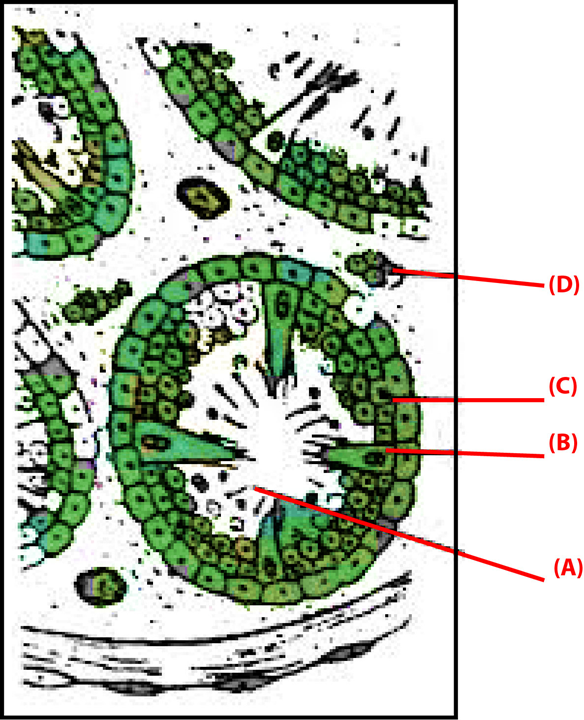
(a) A - Sertoli cells, B - spermatozoa, C - interstitial cells D - Sperms
(b) A - Sertoli cells, B - secondary spermatocyte, C - interstitial cells D - sperms
(c) A - interstitial cells, B - spermatogonia, C - Sefton cells, D - Sperms
(d) A - Sertoli cells, B - spermatozoa, C - interstitial cells, D - sperms
Answer
 Verified
614.4k+ views
Hint: Testis is the male reproductive organ in all animals including man. It is homologous to female ovaries. The function of the testis is to produce sperm and androgens, especially testosterone. Each test is covered by a fibrous capsule called tunica albuginea. Tunica albuginea divides testis into several compartments. Within each compartment, there are 3 to 10 coiled tubules called seminiferous tubules.
Complete step by step answer:
Males have two testes contained within the scrotum. The tests contain germ cells that differentiate into mature spermatozoa, supporting cells called Sertoli cells and testosterone- producing cells called Leydig cells or interstitial cells. The developing sperm travel through seminiferous tubules to rete testis, to the different ducts, and then to the epididymis where newly created sperm cells mature. The sperm moves into vas deferens and eventually expelled through the urethra. Germ cells develop into spermatogonia, spermatocytes, spermatids, and spermatozoa through the process of spermatogenesis. The Leydig cells are located between seminiferous tubules that produce and secrete testosterone. Sertoli cells help in the development of germ cells into spermatozoa.
Additional information:
- Males have two testes of similar in size, contained within the scrotum below the abdominal cavity
- They are ovoid - shaped, 4 cm to 6 cm in length.
- The scrotum is often asymmetric, with one testis extending further down than others.
- The descent of testis outside the body cavity is necessary because effective spermatogenesis requires temperatures that are $2^\circ - 3^\circ$ lower than body temperature.
- if testes fail to descend, spermatozoa cannot be produced.
So, the correct answer is ‘(d) A - Sertoli cells, B - spermatozoa, C - interstitial cells, D - sperm’.
Note: Testosterone release is controlled by the anterior pituitary legitimizing hormone, whereas sperm production is controlled by anterior pituitary follicle- stimulating hormone and gonadal testosterone. Testes get their oval shape from tissues known as lobules. Lobules are made up of coiled tubes surrounded by dense connective tissues. Seminal vesicles, prostate gland, and the bulbourethral glands are the accessory glands of male.
Complete step by step answer:
Males have two testes contained within the scrotum. The tests contain germ cells that differentiate into mature spermatozoa, supporting cells called Sertoli cells and testosterone- producing cells called Leydig cells or interstitial cells. The developing sperm travel through seminiferous tubules to rete testis, to the different ducts, and then to the epididymis where newly created sperm cells mature. The sperm moves into vas deferens and eventually expelled through the urethra. Germ cells develop into spermatogonia, spermatocytes, spermatids, and spermatozoa through the process of spermatogenesis. The Leydig cells are located between seminiferous tubules that produce and secrete testosterone. Sertoli cells help in the development of germ cells into spermatozoa.
Additional information:
- Males have two testes of similar in size, contained within the scrotum below the abdominal cavity
- They are ovoid - shaped, 4 cm to 6 cm in length.
- The scrotum is often asymmetric, with one testis extending further down than others.
- The descent of testis outside the body cavity is necessary because effective spermatogenesis requires temperatures that are $2^\circ - 3^\circ$ lower than body temperature.
- if testes fail to descend, spermatozoa cannot be produced.
So, the correct answer is ‘(d) A - Sertoli cells, B - spermatozoa, C - interstitial cells, D - sperm’.
Note: Testosterone release is controlled by the anterior pituitary legitimizing hormone, whereas sperm production is controlled by anterior pituitary follicle- stimulating hormone and gonadal testosterone. Testes get their oval shape from tissues known as lobules. Lobules are made up of coiled tubes surrounded by dense connective tissues. Seminal vesicles, prostate gland, and the bulbourethral glands are the accessory glands of male.
Recently Updated Pages
Master Class 12 Business Studies: Engaging Questions & Answers for Success

Master Class 12 Chemistry: Engaging Questions & Answers for Success
Master Class 12 Biology: Engaging Questions & Answers for Success
Class 12 Question and Answer - Your Ultimate Solutions Guide
Master Class 11 English: Engaging Questions & Answers for Success
Master Class 11 Social Science: Engaging Questions & Answers for Success
Trending doubts
Which are the Top 10 Largest Countries of the World?
Draw a labelled sketch of the human eye class 12 physics CBSE
The end of compass needle which points towards north class 12 physics CBSE
Differentiate between homogeneous and heterogeneous class 12 chemistry CBSE
In order to find out the different types of gametes class 12 biology NEET_UG
Why is the cell called the structural and functional class 12 biology CBSE