




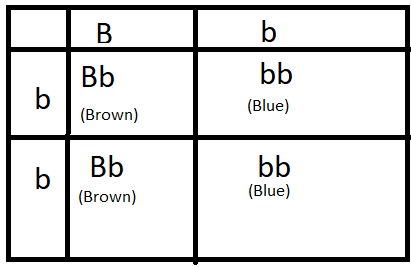
The gene for blue eyes (b) is recessive to the gene for brown eyes (B). The following figure is given: what is the % of individuals with brown eyes and blue eyes respectively?
Answer
 Verified
583.5k+ views
Hint: The genetic crossing is the crossing over of two individuals to produce offspring. There are two types of crosses: monohybrid cross and dihybrid cross.
Complete answer:
George Mendle was the first mathematician to determine an unknown genotype by crossing over. Crossing over is the crossing over of genetic material among two individuals.
Types of traits in a cross: dominant trait and recessive trait.
Dominant trait: The gene which decides the appearance of an organism in presence of another trait is called a dominant trait.
Recessive trait: It is a weak trait that has no effect on organism phenotype in heterozygous cross.
Type of individuals: heterozygous (having two different gene as Tt/Bb) and homozygous (both gene are same as TT/tt/BB/bb)
According to the question BB is brown eye and bb is blue. B is dominant over b. so in presence of B (brown gene) b(blue gene wont express).
F1 generation has bb (blue) Bb (Brown) Bb (brown) bb (blue) so Brown eyed $50\%$ and Blue eyed $50\%$.
Here is a diagrammatic representation of the cross
Note:
Monohybrid cross: crossing of two individuals that involve a single trait example height, colour, size etc. The mendelian ratio for monohybrid cross for F2 generation is 3:1.
Dihybrid cross: crossing over of two individuals that involves two traits for example height and colour of the flower. The mendelian ratio for dihybrid cross for F2 generation is 9:3:3:1.
Complete answer:
George Mendle was the first mathematician to determine an unknown genotype by crossing over. Crossing over is the crossing over of genetic material among two individuals.
Types of traits in a cross: dominant trait and recessive trait.
Dominant trait: The gene which decides the appearance of an organism in presence of another trait is called a dominant trait.
Recessive trait: It is a weak trait that has no effect on organism phenotype in heterozygous cross.
Type of individuals: heterozygous (having two different gene as Tt/Bb) and homozygous (both gene are same as TT/tt/BB/bb)
According to the question BB is brown eye and bb is blue. B is dominant over b. so in presence of B (brown gene) b(blue gene wont express).
F1 generation has bb (blue) Bb (Brown) Bb (brown) bb (blue) so Brown eyed $50\%$ and Blue eyed $50\%$.
Here is a diagrammatic representation of the cross
Note:
Monohybrid cross: crossing of two individuals that involve a single trait example height, colour, size etc. The mendelian ratio for monohybrid cross for F2 generation is 3:1.
Dihybrid cross: crossing over of two individuals that involves two traits for example height and colour of the flower. The mendelian ratio for dihybrid cross for F2 generation is 9:3:3:1.
Recently Updated Pages
Master Class 12 Economics: Engaging Questions & Answers for Success

Master Class 12 Social Science: Engaging Questions & Answers for Success
Master Class 12 English: Engaging Questions & Answers for Success
Master Class 12 Maths: Engaging Questions & Answers for Success
Master Class 12 Physics: Engaging Questions & Answers for Success
Master Class 12 Biology: Engaging Questions & Answers for Success
Trending doubts
Draw a labelled sketch of the human eye class 12 physics CBSE
Which are the Top 10 Largest Countries of the World?
Draw ray diagrams each showing i myopic eye and ii class 12 physics CBSE
Which is the correct genotypic ratio of mendel dihybrid class 12 biology CBSE
Differentiate between homogeneous and heterogeneous class 12 chemistry CBSE
Which animal never drinks water in its entire life class 12 biology CBSE