




The function of copper ions in copper releasing IUD’s is
(a) They inhibit ovulation
(b) They suppress sperm motility and fertilizing capacity of sperms
(c) They inhibit gametogenesis
(d) They make the uterus unsuitable for implantation
Answer
 Verified
614.7k+ views
Hint: A type of long-acting reversible birth control is the copper IUD. In copper releasing IUDs, the purpose of copper ions is to destroy the male reproductive cell. To produce a spermicidal effect, copper ions act on the cervical mucus at the opening of the uterus.
Complete step by step answer:
A type of intrauterine device containing copper is an intrauterine device (IUD) with copper, often referred to as an intrauterine coil.
Owing to the presence of copper ions, copper IUDs have additional contraceptive effects. An inflammatory reaction in the uterus is associated with copper ions, meaning sperm can not enter the egg to fertilize it and produce an embryo.
The IUD releases copper ions within the female reproductive tract that inhibit the movement or motility of sperm. As the motility of the sperm is suppressed, fertilization does not happen.
Sperm movement is interfered with by $C{ u }^{ 2+ }$ ions. Thus, IUDs releasing copper act as an effective contraceptive measure.
So, the correct answer is, ‘They suppress sperm motility and fertilizing capacity of sperms’.
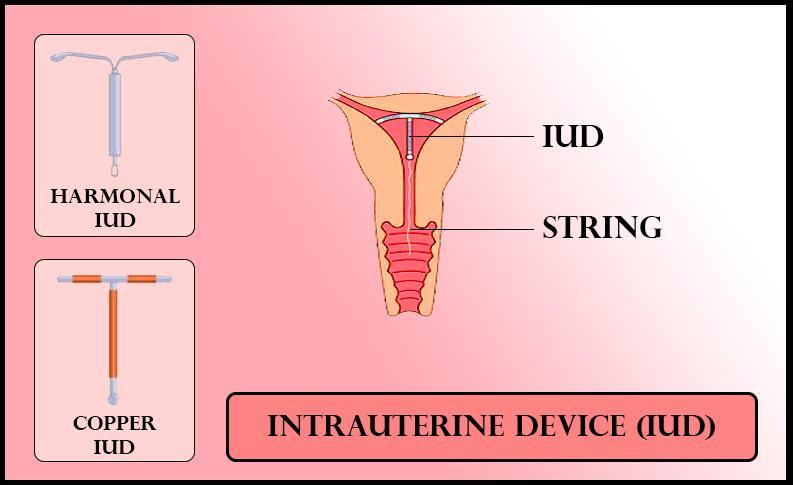
Note: Intrauterine (IUD) implants are used within five days of unprotected sex for birth control and emergency contraception. With a one-year failure rate of about 0.7 percent, it is one of the most successful forms of birth control. The system is mounted in the uterus and has a duration of up to 12 years. Fertility swiftly returns after elimination.
- Side effects include heavy periods of menstruation, painful periods, or the device comes out. In people at high risk for sexually transmitted diseases, it is less recommended as it may raise the risk of pelvic inflammatory disease within the first three weeks of insertion. Removal is advised if a woman becomes pregnant with an IUD in place. During insertion, uterine perforation can rarely occur.
Complete step by step answer:
A type of intrauterine device containing copper is an intrauterine device (IUD) with copper, often referred to as an intrauterine coil.
Owing to the presence of copper ions, copper IUDs have additional contraceptive effects. An inflammatory reaction in the uterus is associated with copper ions, meaning sperm can not enter the egg to fertilize it and produce an embryo.
The IUD releases copper ions within the female reproductive tract that inhibit the movement or motility of sperm. As the motility of the sperm is suppressed, fertilization does not happen.
Sperm movement is interfered with by $C{ u }^{ 2+ }$ ions. Thus, IUDs releasing copper act as an effective contraceptive measure.
So, the correct answer is, ‘They suppress sperm motility and fertilizing capacity of sperms’.
Note: Intrauterine (IUD) implants are used within five days of unprotected sex for birth control and emergency contraception. With a one-year failure rate of about 0.7 percent, it is one of the most successful forms of birth control. The system is mounted in the uterus and has a duration of up to 12 years. Fertility swiftly returns after elimination.
- Side effects include heavy periods of menstruation, painful periods, or the device comes out. In people at high risk for sexually transmitted diseases, it is less recommended as it may raise the risk of pelvic inflammatory disease within the first three weeks of insertion. Removal is advised if a woman becomes pregnant with an IUD in place. During insertion, uterine perforation can rarely occur.
Recently Updated Pages
Master Class 12 Economics: Engaging Questions & Answers for Success

Master Class 12 English: Engaging Questions & Answers for Success
Master Class 12 Social Science: Engaging Questions & Answers for Success
Master Class 12 Maths: Engaging Questions & Answers for Success
Master Class 12 Physics: Engaging Questions & Answers for Success
Master Class 9 General Knowledge: Engaging Questions & Answers for Success
Trending doubts
Which are the Top 10 Largest Countries of the World?
Draw a labelled sketch of the human eye class 12 physics CBSE
Differentiate between homogeneous and heterogeneous class 12 chemistry CBSE
Why is the cell called the structural and functional class 12 biology CBSE
Draw ray diagrams each showing i myopic eye and ii class 12 physics CBSE
Which is the correct genotypic ratio of mendel dihybrid class 12 biology CBSE