




The function $f\left( x \right)={{x}^{3}}-3x$ is,
A. Increasing on $\left( -\infty ,-1 \right)\cup \left( 1,\infty \right)$ and decreasing on $\left( -1,1 \right)$.
B. Decreasing on $\left( -\infty ,-1 \right)\cup \left( 1,\infty \right)$ and increasing on $\left( -1,1 \right)$.
C. Increasing on $\left( 0,\infty \right)$ and decreasing on $\left( -\infty ,0 \right)$.
D. Decreasing on $\left( 0,\infty \right)$ and increasing on $\left( -\infty ,0 \right)$.
Answer
 Verified
620.4k+ views
Hint: A function $y=f\left( x \right)$ is increasing when $\dfrac{dy}{dx}>0$ and decreasing when $\dfrac{dy}{dx}<0$. For $f\left( x \right)={{x}^{3}}-3x$, calculate $f'\left( x \right)$ and check where $f'\left( x \right)>0$ and where $f'\left( x \right)<0$. The interval where $f'\left( x \right)>0,f\left( x \right)$ will be increasing and the interval where $f'\left( x \right)<0,f\left( x \right)$ will be decreasing.
Complete step-by-step solution -
Given $f\left( x \right)={{x}^{3}}-3x$, we have to find the interval where $f\left( x \right)$ is increasing and the interval where $f\left( x \right)$ is decreasing.
We know that,
For a function $f\left( x \right)$ to be increasing in an interval, its derivative $f'\left( x \right)$ should be positive in that interval and for a function $f\left( x \right)$ to be decreasing in an interval its derivative $f'\left( x \right)$ should be negative in the interval.
Let us first find the derivative of $f\left( x \right)$,
$\begin{align}
& f\left( x \right)={{x}^{3}}-3x \\
& f'\left( x \right)=3{{x}^{2}}-3 \\
& \left[ \text{As}\ \text{we}\ \text{know}\ \text{that}\ \text{derivative}\ \text{of}\ {{x}^{n}}=n{{x}^{n-1}} \right] \\
\end{align}$
Let us find the region where $f'\left( x \right)>0$;
$\begin{align}
& f'\left( x \right)>0 \\
& \Rightarrow \left( 3{{x}^{2}}-3 \right)>0 \\
\end{align}$
Dividing both sides by ‘3’, we will get,
$\Rightarrow \left( {{x}^{2}}-1 \right)>0$
Factorising $\left( {{x}^{2}}-1 \right)=\left( x-1 \right)\left( x+1 \right)$ using $''{{a}^{2}}-{{b}^{2}}=\left( a-b \right)\left( a+b \right)''$, we will get,
$\Rightarrow \left( x-1 \right)\left( x+1 \right)>0$
Sign diagram for this equation,
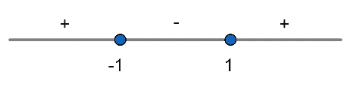
So, at $x=-1\ and\ x=1\ f'\left( x \right)=0$
And for $x\in \left( -\infty ,-1 \right)\cup \left( 1,\infty \right),f'\left( x \right)>0$
And for $x\in \left( -1,1 \right),f'\left( x \right)<0$
Thus, $f\left( x \right)$ is increasing in interval $\left( -\infty ,-1 \right)\cup \left( 1,\infty \right)$ and decreasing in the interval $\left( -1,1 \right)$.
And option (A) is the correct answer.
Note: Be careful that $x=-1\ and\ x=1\ $won’t be included in either increasing interval or decreasing interval. There will be either a local maxima or local minima at $x=1\ and\ x=-1\ \ as\ f'\left( x \right)=0$ at $x=1\ and\ x=-1\ $.
Complete step-by-step solution -
Given $f\left( x \right)={{x}^{3}}-3x$, we have to find the interval where $f\left( x \right)$ is increasing and the interval where $f\left( x \right)$ is decreasing.
We know that,
For a function $f\left( x \right)$ to be increasing in an interval, its derivative $f'\left( x \right)$ should be positive in that interval and for a function $f\left( x \right)$ to be decreasing in an interval its derivative $f'\left( x \right)$ should be negative in the interval.
Let us first find the derivative of $f\left( x \right)$,
$\begin{align}
& f\left( x \right)={{x}^{3}}-3x \\
& f'\left( x \right)=3{{x}^{2}}-3 \\
& \left[ \text{As}\ \text{we}\ \text{know}\ \text{that}\ \text{derivative}\ \text{of}\ {{x}^{n}}=n{{x}^{n-1}} \right] \\
\end{align}$
Let us find the region where $f'\left( x \right)>0$;
$\begin{align}
& f'\left( x \right)>0 \\
& \Rightarrow \left( 3{{x}^{2}}-3 \right)>0 \\
\end{align}$
Dividing both sides by ‘3’, we will get,
$\Rightarrow \left( {{x}^{2}}-1 \right)>0$
Factorising $\left( {{x}^{2}}-1 \right)=\left( x-1 \right)\left( x+1 \right)$ using $''{{a}^{2}}-{{b}^{2}}=\left( a-b \right)\left( a+b \right)''$, we will get,
$\Rightarrow \left( x-1 \right)\left( x+1 \right)>0$
Sign diagram for this equation,
So, at $x=-1\ and\ x=1\ f'\left( x \right)=0$
And for $x\in \left( -\infty ,-1 \right)\cup \left( 1,\infty \right),f'\left( x \right)>0$
And for $x\in \left( -1,1 \right),f'\left( x \right)<0$
Thus, $f\left( x \right)$ is increasing in interval $\left( -\infty ,-1 \right)\cup \left( 1,\infty \right)$ and decreasing in the interval $\left( -1,1 \right)$.
And option (A) is the correct answer.
Note: Be careful that $x=-1\ and\ x=1\ $won’t be included in either increasing interval or decreasing interval. There will be either a local maxima or local minima at $x=1\ and\ x=-1\ \ as\ f'\left( x \right)=0$ at $x=1\ and\ x=-1\ $.
Recently Updated Pages
Master Class 12 Business Studies: Engaging Questions & Answers for Success

Master Class 12 Biology: Engaging Questions & Answers for Success
Master Class 12 Chemistry: Engaging Questions & Answers for Success
Class 12 Question and Answer - Your Ultimate Solutions Guide
Master Class 12 Economics: Engaging Questions & Answers for Success
Master Class 12 English: Engaging Questions & Answers for Success
Trending doubts
Which are the Top 10 Largest Countries of the World?
Prove that a parallelogram circumscribing a circle-class-12-maths-CBSE
Differentiate between lanthanoids and actinoids class 12 chemistry CBSE
Draw a labelled sketch of the human eye class 12 physics CBSE
Derive Lens Makers formula for a convex lens class 12 physics CBSE
a Draw Labelled diagram of Standard Hydrogen Electrode class 12 chemistry CBSE