




The function \[\dfrac{\ln \left( 1+x \right)}{x}\] in \[\left( 0,\infty \right)\] is
\[\begin{align}
& \begin{array}{*{35}{l}}
A.\text{ }increasing \\
B.\text{ }decreasing \\
C.\text{ }not\text{ }decreasing \\
\end{array} \\
& D.\text{ }not\text{ }increasing \\
\end{align}\].
Answer
 Verified
531.6k+ views
Hint: To understand the concept of a limit in calculus for functions in a limit, we need to understand the continuous functions and also to define the derivative. A limit is the value of a function approaches as the given input approaches some value. Limits are used to define derivatives, integrals and continuity. Generally, many problems are solved by using L’ hospital Rule. But we are doing it by using differentiating and finding out critical points.
Complete step-by-step solution:
Formula: a limit of a function is generally written as
\[\displaystyle \lim_{x \to c}f\left( x \right)=L\]
The above formula is read as ‘the limit of f(x) as x approaches to c which equals to L’.
Limit of a sequence is generally represented as
\[\displaystyle \lim_{n\to \infty }{{a}_{n}}=L\]
It is read as ‘the limit of \[{{a}_{n}}\] as n approaches infinity which equals L’.
Let us solve the question,
Given the function \[\dfrac{\ln \left( 1+x \right)}{x}\] in \[\left( 0,\infty \right)\], it can be written as
\[f\left( x \right)=\displaystyle \lim_{x \to \infty }\dfrac{\ln \left( 1+x \right)}{x}\]
It is read as ‘the limit natural logarithm \[\dfrac{\ln \left( 1+x \right)}{x}\] as x approaches to infinity
We can solve the given function by using differentiating and finding the critical points,
We have \[f\left( x \right)=\dfrac{\ln \left( 1+x \right)}{x}\]……………………. (1)
Differentiating equation (1) with respect to x
\[\Rightarrow {{f}^{'}}\left( x \right)=\dfrac{\dfrac{x}{1+x}-\ln \left( 1+x \right)}{{{x}^{2}}}=0\]
\[\Rightarrow {{f}^{'}}\left( x \right)=\dfrac{x}{1+x}-\ln \left( 1+x \right)=0\]
\[\therefore x=0;{{f}^{'}}\left( x \right)<0\]
If \[{{f}^{'}}\left( x \right)>0\] , then the function is increasing.
If \[{{f}^{'}}\left( x \right)<0\],then the function is decreasing.
given function \[\dfrac{\ln \left( 1+x \right)}{x}\] in \[\left( 0,\infty \right)\] is “decreasing”
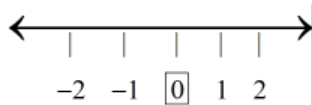
x=0 is denoted on the number line.
Correct option is (B).
Note: Using the infinity symbol in the correct place is the main criteria in the concept of limits and functions. Students make more mistakes by placing the infinity at incorrect places. By practicing the formulas recurrently, we can easily solve the problem based on limits easily.
Complete step-by-step solution:
Formula: a limit of a function is generally written as
\[\displaystyle \lim_{x \to c}f\left( x \right)=L\]
The above formula is read as ‘the limit of f(x) as x approaches to c which equals to L’.
Limit of a sequence is generally represented as
\[\displaystyle \lim_{n\to \infty }{{a}_{n}}=L\]
It is read as ‘the limit of \[{{a}_{n}}\] as n approaches infinity which equals L’.
Let us solve the question,
Given the function \[\dfrac{\ln \left( 1+x \right)}{x}\] in \[\left( 0,\infty \right)\], it can be written as
\[f\left( x \right)=\displaystyle \lim_{x \to \infty }\dfrac{\ln \left( 1+x \right)}{x}\]
It is read as ‘the limit natural logarithm \[\dfrac{\ln \left( 1+x \right)}{x}\] as x approaches to infinity
We can solve the given function by using differentiating and finding the critical points,
We have \[f\left( x \right)=\dfrac{\ln \left( 1+x \right)}{x}\]……………………. (1)
Differentiating equation (1) with respect to x
\[\Rightarrow {{f}^{'}}\left( x \right)=\dfrac{\dfrac{x}{1+x}-\ln \left( 1+x \right)}{{{x}^{2}}}=0\]
\[\Rightarrow {{f}^{'}}\left( x \right)=\dfrac{x}{1+x}-\ln \left( 1+x \right)=0\]
\[\therefore x=0;{{f}^{'}}\left( x \right)<0\]
If \[{{f}^{'}}\left( x \right)>0\] , then the function is increasing.
If \[{{f}^{'}}\left( x \right)<0\],then the function is decreasing.
given function \[\dfrac{\ln \left( 1+x \right)}{x}\] in \[\left( 0,\infty \right)\] is “decreasing”
x=0 is denoted on the number line.
Correct option is (B).
Note: Using the infinity symbol in the correct place is the main criteria in the concept of limits and functions. Students make more mistakes by placing the infinity at incorrect places. By practicing the formulas recurrently, we can easily solve the problem based on limits easily.
Recently Updated Pages
Master Class 12 Economics: Engaging Questions & Answers for Success

Master Class 12 Physics: Engaging Questions & Answers for Success
Master Class 12 English: Engaging Questions & Answers for Success
Master Class 12 Social Science: Engaging Questions & Answers for Success
Master Class 12 Maths: Engaging Questions & Answers for Success
Master Class 12 Business Studies: Engaging Questions & Answers for Success
Trending doubts
Which are the Top 10 Largest Countries of the World?
What are the major means of transport Explain each class 12 social science CBSE
Draw a labelled sketch of the human eye class 12 physics CBSE
Why cannot DNA pass through cell membranes class 12 biology CBSE
Differentiate between insitu conservation and exsitu class 12 biology CBSE
Draw a neat and well labeled diagram of TS of ovary class 12 biology CBSE