




The frequency of direct current (DC) is:
$A)0Hz$
$B)25Hz$
$C)75Hz$
$D)100Hz$
Answer
 Verified
624.3k+ views
Hint: Direct current (DC) is the flow of electric charge in one direction. Frequency of current refers to the number of times the direction of flow of electric charge, gets reversed, in one second. A direct current can be converted to alternating current and vice versa.
Complete step by step answer:
We know that current is the flow of electric charge. Current is mainly differentiated into AC current as well as DC current, on the basis of direction of flow of electric charge. A direct current (DC) source produces a constant current, and thus, a constant voltage whereas an alternating current (AC) source produces an alternating current, and thus, an alternating voltage. The most common examples of DC current sources are batteries and torchlights.
DC current refers to the unidirectional flow of electric charge. In a battery, electrons move from negative region to positive region, to produce DC current from positive region to negative region. If alternating current (AC) is flowing through a circuit, the direction of current gets reversed at definite intervals. But if direct current (DC) is flowing through a circuit, the direction of current flow remains the same, in a single direction.
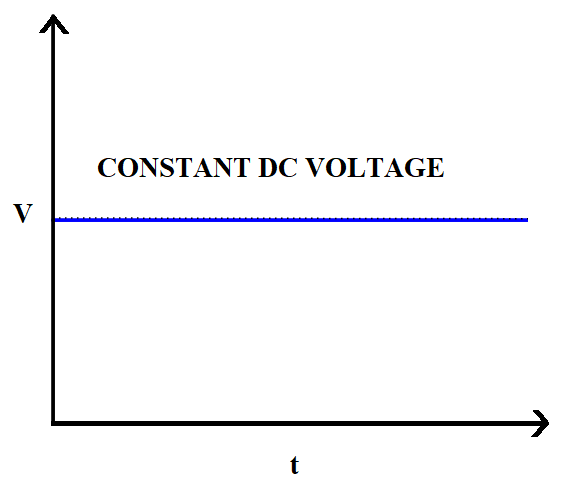
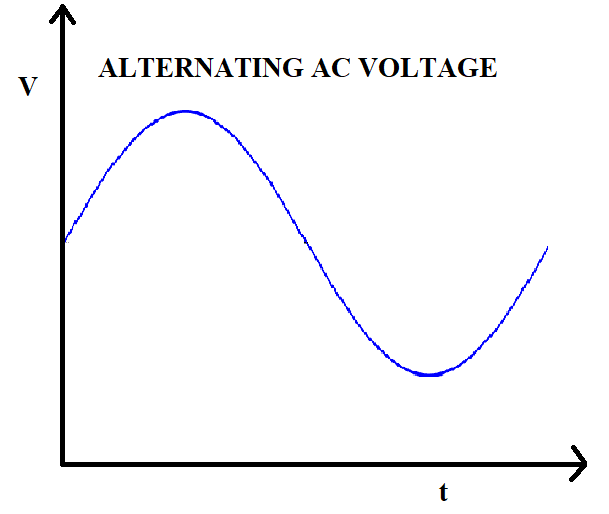
Frequency of alternating current (AC) refers to the number of times, the current reverses its direction, in one second. It is said that the frequency of alternating current is $60Hz$, if the current reverses its direction $60$ times, in one second. Frequency of direct current (DC) is zero because the flow of current is unidirectional here. There is no scope for a reverse in direction and the frequency of direct current (DC) always remains zero. Additionally, the magnitude of current produced from a DC current source is always constant whereas that produced from an AC current source keeps on alternating. Thus, a DC source produces a constant voltage while an AC source produces an alternating voltage as shown in the following figures.
Therefore, the correct answer is option $A$.
Additional information:
An AC current can be converted to a DC current with the help of a rectifier. At the same time, a DC current can be converted to an AC current with the help of an inverter.
Note:
Students need to understand the type of current used in daily life situations. For example, as already mentioned, a battery generates DC current. Our mobile phones and chargers too, use DC current. So do electric vehicles and telecommunication networks. Another important application of DC is high voltage direct current (HVDC) power transmission system, in which DC is used for bulk transmission of power. This method of using HVDC transmission for long distance transmission is cost efficient and suffers less energy loss.
Complete step by step answer:
We know that current is the flow of electric charge. Current is mainly differentiated into AC current as well as DC current, on the basis of direction of flow of electric charge. A direct current (DC) source produces a constant current, and thus, a constant voltage whereas an alternating current (AC) source produces an alternating current, and thus, an alternating voltage. The most common examples of DC current sources are batteries and torchlights.
DC current refers to the unidirectional flow of electric charge. In a battery, electrons move from negative region to positive region, to produce DC current from positive region to negative region. If alternating current (AC) is flowing through a circuit, the direction of current gets reversed at definite intervals. But if direct current (DC) is flowing through a circuit, the direction of current flow remains the same, in a single direction.
Frequency of alternating current (AC) refers to the number of times, the current reverses its direction, in one second. It is said that the frequency of alternating current is $60Hz$, if the current reverses its direction $60$ times, in one second. Frequency of direct current (DC) is zero because the flow of current is unidirectional here. There is no scope for a reverse in direction and the frequency of direct current (DC) always remains zero. Additionally, the magnitude of current produced from a DC current source is always constant whereas that produced from an AC current source keeps on alternating. Thus, a DC source produces a constant voltage while an AC source produces an alternating voltage as shown in the following figures.
Therefore, the correct answer is option $A$.
Additional information:
An AC current can be converted to a DC current with the help of a rectifier. At the same time, a DC current can be converted to an AC current with the help of an inverter.
Note:
Students need to understand the type of current used in daily life situations. For example, as already mentioned, a battery generates DC current. Our mobile phones and chargers too, use DC current. So do electric vehicles and telecommunication networks. Another important application of DC is high voltage direct current (HVDC) power transmission system, in which DC is used for bulk transmission of power. This method of using HVDC transmission for long distance transmission is cost efficient and suffers less energy loss.
Recently Updated Pages
Master Class 12 Business Studies: Engaging Questions & Answers for Success

Master Class 12 Biology: Engaging Questions & Answers for Success
Master Class 12 Chemistry: Engaging Questions & Answers for Success
Class 12 Question and Answer - Your Ultimate Solutions Guide
Master Class 11 English: Engaging Questions & Answers for Success
Master Class 11 Social Science: Engaging Questions & Answers for Success
Trending doubts
Which are the Top 10 Largest Countries of the World?
Draw a labelled sketch of the human eye class 12 physics CBSE
Differentiate between homogeneous and heterogeneous class 12 chemistry CBSE
Why is the cell called the structural and functional class 12 biology CBSE
Draw ray diagrams each showing i myopic eye and ii class 12 physics CBSE
Which is the correct genotypic ratio of mendel dihybrid class 12 biology CBSE