




What will be the frequency of an alternating current, if its direction changes after every 0.01s?
$\left( A \right)20$ Hz.
$\left( B \right)10$ Hz.
$\left( C \right)$ 15 Hz.
$\left( D \right)$ 50 Hz.
Answer
 Verified
681.3k+ views
Hint: In this question use the concept that frequency of any signal is equal to the inverse of the time period of the given signal i.e. the time in which an alternative wave completes one cycle so use these concepts to reach the solution of the question.
Formula used – $f = \dfrac{1}{T}$
Complete step-by-step solution -
Given data:
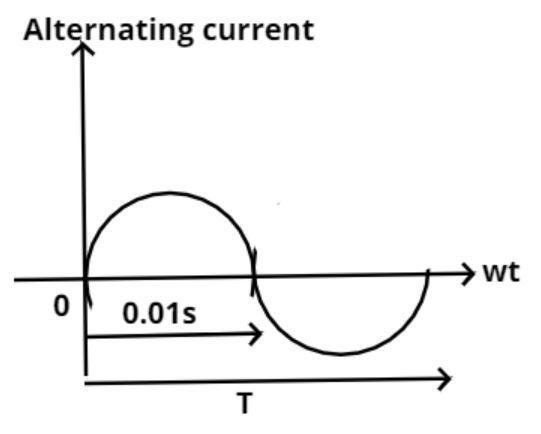
Alternating current direction changes after every 0.01s as shown in the above figure.
So this is the half time of the complete time period (i.e. the time in which an alternating wave completes one cycle) as for an alternating current after half cycle the direction changes and this another half time is also equal to 0.01s.
So the complete time period (T) = $2 \times 0.01 = 0.02s$
Now as we know that frequency (f) is the inverse of the time period (T).
$ \Rightarrow f = \dfrac{1}{T}$ Hz.
Now substitute the value in this question we have,
$ \Rightarrow f = \dfrac{1}{{0.02}}$
Now simplify this equation we have,
$ \Rightarrow f = \dfrac{{100}}{2} = 50$ Hz.
So this is the required answer.
Hence, option (D) is the correct answer.
Additional information –
In India single phase alternating current (A.C) is supplied in normal households having voltage 230 volts and frequency 50 Hz.
Note – Whenever we face such types of question always remember that the complete time interval or time period of an alternating current is twice of time after which alternating current start changing its direction, then apply the formula that frequency of complete time interval is the inverse of time period so simply substitute the value we will get the required answer.
Formula used – $f = \dfrac{1}{T}$
Complete step-by-step solution -
Given data:
Alternating current direction changes after every 0.01s as shown in the above figure.
So this is the half time of the complete time period (i.e. the time in which an alternating wave completes one cycle) as for an alternating current after half cycle the direction changes and this another half time is also equal to 0.01s.
So the complete time period (T) = $2 \times 0.01 = 0.02s$
Now as we know that frequency (f) is the inverse of the time period (T).
$ \Rightarrow f = \dfrac{1}{T}$ Hz.
Now substitute the value in this question we have,
$ \Rightarrow f = \dfrac{1}{{0.02}}$
Now simplify this equation we have,
$ \Rightarrow f = \dfrac{{100}}{2} = 50$ Hz.
So this is the required answer.
Hence, option (D) is the correct answer.
Additional information –
In India single phase alternating current (A.C) is supplied in normal households having voltage 230 volts and frequency 50 Hz.
Note – Whenever we face such types of question always remember that the complete time interval or time period of an alternating current is twice of time after which alternating current start changing its direction, then apply the formula that frequency of complete time interval is the inverse of time period so simply substitute the value we will get the required answer.
Recently Updated Pages
Master Class 12 Physics: Engaging Questions & Answers for Success

Master Class 12 Social Science: Engaging Questions & Answers for Success
Master Class 12 English: Engaging Questions & Answers for Success
Master Class 12 Maths: Engaging Questions & Answers for Success
Master Class 12 Business Studies: Engaging Questions & Answers for Success
Master Class 12 Chemistry: Engaging Questions & Answers for Success
Trending doubts
Draw a labelled sketch of the human eye class 12 physics CBSE
Which are the Top 10 Largest Countries of the World?
Draw ray diagrams each showing i myopic eye and ii class 12 physics CBSE
One megawatt is equal to how many units of electri class 12 physics CBSE
Which is the correct genotypic ratio of mendel dihybrid class 12 biology CBSE
Give 10 examples of unisexual and bisexual flowers