




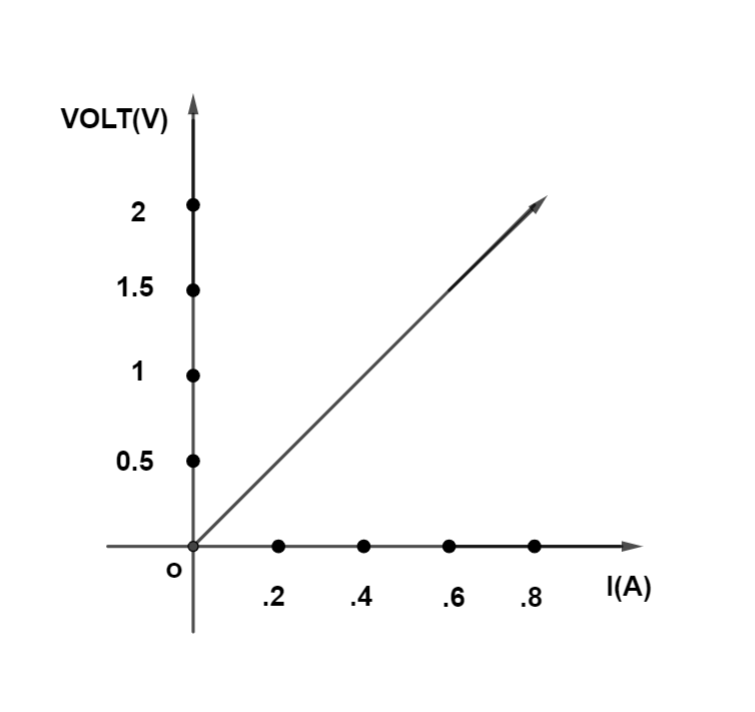
The following graph was plotted between V and I value. What would be the values of $\dfrac{V}{I}$ ratios when the potential difference is 0.5 V and 1 V?
Answer
 Verified
524.4k+ views
Hint: To solve this question students should have a clear-cut idea about what is ohm’s law and equation of ohm’s law. Ohm’s law gives the relation between current passing and voltage applied across any circuit. Observe the graph and relate it with the equation of ohms then solve for the solution.
Complete step by step solution:
Ohm’s Law states that the current flowing through a conductor is directly proportional to the potential difference applied across its ends, provided the temperature and other physical conditions remain unchanged.
As per ohm’s law Current is directly proportional to voltage difference through a resistor. That is, if the current doubles, then so does the voltage. To make a current flow through a resistance there must be a voltage across that resistance. Ohm's Law shows the relationship between the voltage (V), current (I) and resistance (R)
$I\alpha V$
$ \Rightarrow V = IR$
Where R is a constant called resistance of the conductor. The value of this constant depends on the nature, length, area of cross section and temperature of the conductor.
We have to find the ratio of $\dfrac{V}{I}$ when the potential difference between them is $0.5{\text{ }}V$ and \[1{\text{ }}V\] .
When the potential difference is $0.5{\text{ V}}$ the corresponding value of current from the graph is $0.2{\text{ A}}$
Therefore, by ohm's law we have
$\dfrac{V}{I} = R$
By substituting the values.
$\dfrac{{0.5{\text{ V}}}}{{0.2{\text{ A}}}} = R$
$R = 2.5{\text{ }}\Omega $
Now when the potential difference is ${\text{1 V}}$ the corresponding value of current from the graph is ${\text{0}}{\text{.4 A}}$
Therefore, by ohm's law we have
$\dfrac{V}{I} = R$
By substituting the values.
$\dfrac{{{\text{1V}}}}{{0.4{\text{ A}}}} = R$
$R = 2.5{\text{ }}\Omega $
Note: Ohm's law is not applicable to non-linear devices and it is also not applicable to non ohmic devices. It is necessary that the temperature must be constant to obey the ohm's law. Ohm's law is used to calculate the voltage, resistance or current of an electric circuit. It is used to maintain the desired voltage drop across the electronic components. Ohm's law is also used in dc ammeter and other dc shunts to divert the current.
Complete step by step solution:
Ohm’s Law states that the current flowing through a conductor is directly proportional to the potential difference applied across its ends, provided the temperature and other physical conditions remain unchanged.
As per ohm’s law Current is directly proportional to voltage difference through a resistor. That is, if the current doubles, then so does the voltage. To make a current flow through a resistance there must be a voltage across that resistance. Ohm's Law shows the relationship between the voltage (V), current (I) and resistance (R)
$I\alpha V$
$ \Rightarrow V = IR$
Where R is a constant called resistance of the conductor. The value of this constant depends on the nature, length, area of cross section and temperature of the conductor.
We have to find the ratio of $\dfrac{V}{I}$ when the potential difference between them is $0.5{\text{ }}V$ and \[1{\text{ }}V\] .
When the potential difference is $0.5{\text{ V}}$ the corresponding value of current from the graph is $0.2{\text{ A}}$
Therefore, by ohm's law we have
$\dfrac{V}{I} = R$
By substituting the values.
$\dfrac{{0.5{\text{ V}}}}{{0.2{\text{ A}}}} = R$
$R = 2.5{\text{ }}\Omega $
Now when the potential difference is ${\text{1 V}}$ the corresponding value of current from the graph is ${\text{0}}{\text{.4 A}}$
Therefore, by ohm's law we have
$\dfrac{V}{I} = R$
By substituting the values.
$\dfrac{{{\text{1V}}}}{{0.4{\text{ A}}}} = R$
$R = 2.5{\text{ }}\Omega $
Note: Ohm's law is not applicable to non-linear devices and it is also not applicable to non ohmic devices. It is necessary that the temperature must be constant to obey the ohm's law. Ohm's law is used to calculate the voltage, resistance or current of an electric circuit. It is used to maintain the desired voltage drop across the electronic components. Ohm's law is also used in dc ammeter and other dc shunts to divert the current.
Recently Updated Pages
Master Class 12 Business Studies: Engaging Questions & Answers for Success

Master Class 12 Biology: Engaging Questions & Answers for Success
Master Class 12 Chemistry: Engaging Questions & Answers for Success
Class 12 Question and Answer - Your Ultimate Solutions Guide
Master Class 11 Social Science: Engaging Questions & Answers for Success
Master Class 11 English: Engaging Questions & Answers for Success
Trending doubts
Which is more stable and why class 12 chemistry CBSE
Which are the Top 10 Largest Countries of the World?
Draw a labelled sketch of the human eye class 12 physics CBSE
Differentiate between homogeneous and heterogeneous class 12 chemistry CBSE
What are the major means of transport Explain each class 12 social science CBSE
Sulphuric acid is known as the king of acids State class 12 chemistry CBSE