




The focal length of a thin biconvex lens is 20 cm. When an object is moved from a distance of 25 cm in front of it to 50 cm, the magnification of its image changes from ${{m}_{25}}$ to ${{m}_{50}}$. Then what is the value of the ratio $\dfrac{{{m}_{25}}}{{{m}_{50}}}$?
Answer
 Verified
605.4k+ views
Hint: Magnification is the increase in size of an image produced by an optical system compared to its actual size. Magnification of an object from an optical lens is the ratio of distance of the image to the distance of the object as measured from the optical centre.
Use lens formula to find distance of image and use it in magnification expression.
Formula used:
Magnification formula for lens, $m=\dfrac{v}{u}$; Lens formula $\dfrac{1}{f}=\dfrac{1}{v}+\dfrac{1}{u}$
Complete answer:
Magnification is the increase in size of an image produced by an optical system compared to its actual size. In other words, it is the ratio of the height of an image produced by an optical system to the height of an object.
Magnification of an object from an optical lens is the ratio of distance of the image to the distance of the object as measured from the optical centre.
$m=\dfrac{v}{u}$
Lens formula of an optical relates its focal length, distance of object and distance of image. It is given as
$\dfrac{1}{f}=\dfrac{1}{v}+\dfrac{1}{u}$
Focal length of convex lens $f=20cm$
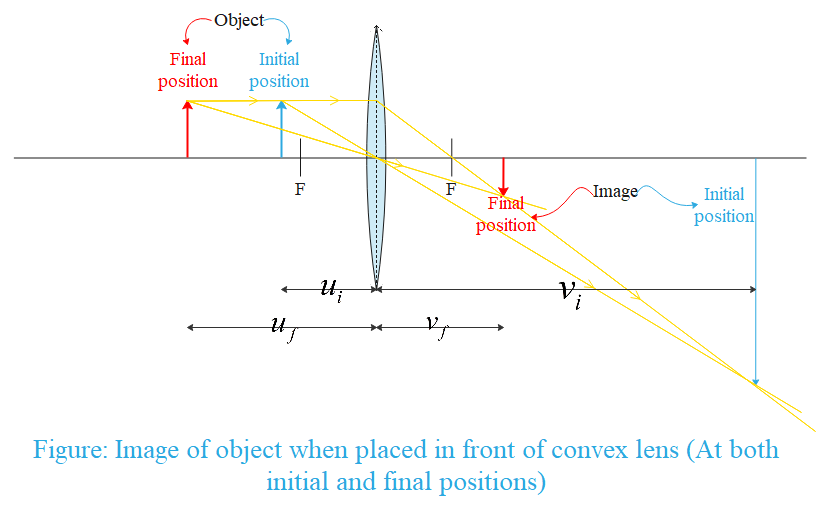
Initially the object is placed at a distance of 25 cm i.e. ${{u}_{i}}=-25cm$. Using lens formula
$\dfrac{1}{f}=\dfrac{1}{{{v}_{i}}}+\dfrac{1}{{{u}_{i}}}\Rightarrow \dfrac{1}{{{v}_{i}}}=\dfrac{1}{{{u}_{i}}}+\dfrac{1}{f}$
$\dfrac{1}{{{v}_{i}}}=\dfrac{1}{-25}-\dfrac{1}{-20}=\dfrac{1}{100}\Rightarrow {{v}_{i}}=100cm$
Finally the object is placed at a distance of 50 cm i.e. ${{u}_{i}}=-50cm$. Using lens formula as we did for obtaining ${{v}_{i}}$
${{v}_{f}}=\dfrac{100}{3}cm$
Since magnification is $m=\dfrac{v}{u}$.
$\dfrac{{{m}_{25}}}{{{m}_{50}}}=\dfrac{{{v}_{i}}/{{u}_{i}}}{{{v}_{f}}/{{u}_{f}}}=\dfrac{100/(-25)}{(100/3)/\left( -50 \right)}=6$
Note:
In mirror as well as optical lens problems, the most important thing to consider is sign conventions. Therefore, students should understand the sign conventions properly and then proceed with the solution. Diagrams are very helpful in understanding the sign conventions.
Focal length of a convex lens is always taken positively.
Use lens formula to find distance of image and use it in magnification expression.
Formula used:
Magnification formula for lens, $m=\dfrac{v}{u}$; Lens formula $\dfrac{1}{f}=\dfrac{1}{v}+\dfrac{1}{u}$
Complete answer:
Magnification is the increase in size of an image produced by an optical system compared to its actual size. In other words, it is the ratio of the height of an image produced by an optical system to the height of an object.
Magnification of an object from an optical lens is the ratio of distance of the image to the distance of the object as measured from the optical centre.
$m=\dfrac{v}{u}$
Lens formula of an optical relates its focal length, distance of object and distance of image. It is given as
$\dfrac{1}{f}=\dfrac{1}{v}+\dfrac{1}{u}$
Focal length of convex lens $f=20cm$
Initially the object is placed at a distance of 25 cm i.e. ${{u}_{i}}=-25cm$. Using lens formula
$\dfrac{1}{f}=\dfrac{1}{{{v}_{i}}}+\dfrac{1}{{{u}_{i}}}\Rightarrow \dfrac{1}{{{v}_{i}}}=\dfrac{1}{{{u}_{i}}}+\dfrac{1}{f}$
$\dfrac{1}{{{v}_{i}}}=\dfrac{1}{-25}-\dfrac{1}{-20}=\dfrac{1}{100}\Rightarrow {{v}_{i}}=100cm$
Finally the object is placed at a distance of 50 cm i.e. ${{u}_{i}}=-50cm$. Using lens formula as we did for obtaining ${{v}_{i}}$
${{v}_{f}}=\dfrac{100}{3}cm$
Since magnification is $m=\dfrac{v}{u}$.
$\dfrac{{{m}_{25}}}{{{m}_{50}}}=\dfrac{{{v}_{i}}/{{u}_{i}}}{{{v}_{f}}/{{u}_{f}}}=\dfrac{100/(-25)}{(100/3)/\left( -50 \right)}=6$
Note:
In mirror as well as optical lens problems, the most important thing to consider is sign conventions. Therefore, students should understand the sign conventions properly and then proceed with the solution. Diagrams are very helpful in understanding the sign conventions.
Focal length of a convex lens is always taken positively.
Recently Updated Pages
Master Class 12 Business Studies: Engaging Questions & Answers for Success

Master Class 12 Biology: Engaging Questions & Answers for Success
Master Class 12 Chemistry: Engaging Questions & Answers for Success
Class 12 Question and Answer - Your Ultimate Solutions Guide
Master Class 11 Social Science: Engaging Questions & Answers for Success
Master Class 11 English: Engaging Questions & Answers for Success
Trending doubts
Which is more stable and why class 12 chemistry CBSE
What are the major means of transport Explain each class 12 social science CBSE
The value of constant k in coulombs law is beginalign class 12 physics CBSE
Why should a magnesium ribbon be cleaned before burning class 12 chemistry CBSE
Quantisation of charge implies a Charge does not exist class 12 physics CBSE
How much time does it take to bleed after eating p class 12 biology CBSE