




The flat surface of a solid is called as
a) Edge
b) Vertices
c) Face
d) None of these
Answer
 Verified
657.3k+ views
Hint: Know the difference between different terms. The 3 important terms are vertex, edge and a face. Face is generally enclosed within sides and can be flat or curved or irregular.
Complete step-by-step answer:
In Geometry, the shape or the figure that has three (even higher) dimensions, are known as solids or three-dimensional shapes. The study of the properties, volume and surface area of such figures is called Solid Geometry
Solid geometry is concerned with three-dimensional shapes. Some examples of three-dimensional shapes are cubes, rectangular solids, prisms, cylinders, spheres, cones and pyramids.
In geometry, there are various types of solids. Solids are three-dimensional shapes because they have three dimensions such as length, breadth and height. The bodies which occupy space are called solids.
Solids are classified in terms of their properties. To analyse characteristics and properties of 3-D geometric shapes, count the number of faces, edges, and vertices in various geometric solids
The flat surface is called as a face of the solid and when 2 solids meet, they form an edge.
Likewise, when 2 Edges meet, they form a point. So, we can conclude that the flat surface present on any solid is referred to as a face. Here is a diagram to understand the above terms better.
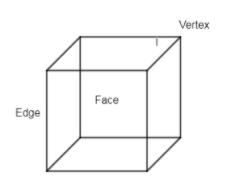
Hence, option c is the answer.
Note: Study the anatomy of solids carefully so as to avoid confusion between surface, edge and point. A surface can be curved or irregular also so make sure you choose an answer carefully. You can also confer any solid object for clarity like a cube and see that it has 6 faces, 8 vertices and 12 edges.
Complete step-by-step answer:
In Geometry, the shape or the figure that has three (even higher) dimensions, are known as solids or three-dimensional shapes. The study of the properties, volume and surface area of such figures is called Solid Geometry
Solid geometry is concerned with three-dimensional shapes. Some examples of three-dimensional shapes are cubes, rectangular solids, prisms, cylinders, spheres, cones and pyramids.
In geometry, there are various types of solids. Solids are three-dimensional shapes because they have three dimensions such as length, breadth and height. The bodies which occupy space are called solids.
Solids are classified in terms of their properties. To analyse characteristics and properties of 3-D geometric shapes, count the number of faces, edges, and vertices in various geometric solids
The flat surface is called as a face of the solid and when 2 solids meet, they form an edge.
Likewise, when 2 Edges meet, they form a point. So, we can conclude that the flat surface present on any solid is referred to as a face. Here is a diagram to understand the above terms better.
Hence, option c is the answer.
Note: Study the anatomy of solids carefully so as to avoid confusion between surface, edge and point. A surface can be curved or irregular also so make sure you choose an answer carefully. You can also confer any solid object for clarity like a cube and see that it has 6 faces, 8 vertices and 12 edges.
Recently Updated Pages
Master Class 12 Economics: Engaging Questions & Answers for Success

Master Class 12 Social Science: Engaging Questions & Answers for Success
Master Class 12 English: Engaging Questions & Answers for Success
Master Class 12 Maths: Engaging Questions & Answers for Success
Master Class 12 Physics: Engaging Questions & Answers for Success
Master Class 12 Biology: Engaging Questions & Answers for Success
Trending doubts
How many sides does a circle have a 10 sides b 20 sides class 8 maths CBSE
What is BLO What is the full form of BLO class 8 social science CBSE
What does the color green in the national flag of India class 8 social science CBSE
Citizens of India can vote at the age of A 18 years class 8 social science CBSE
Full form of STD, ISD and PCO
One cusec is equal to how many liters class 8 maths CBSE