




The five-kingdom system of classification suggested by R.H.Whittaker is based on
A.Presence or absence of a well-defined nucleus.
B.Complexity of body organization
C.Mode of nutrition
D.All of the above.
Answer
 Verified
606.3k+ views
Hint:R.H Whittaker propped the five-kingdom classification in. In this, the organisms are divided into five different kingdoms namely Monera, Protista, Fungi, Plantae, and Animalia.
Complete step by step answer:The basis of this classification is by different criteria, it considers multiple factors in the classification.
The various criteria used in the classification are:
Presence or absence of a well-defined nucleus: The organisms are divided into prokaryotes and eukaryotes. Prokaryotic organisms that do not possess a well-defined nucleus with a nuclear membrane and are even devoid of proper membrane-bound organelles. The only organelles found in the cytoplasm are ribosomes. The kingdom Monera is the only kingdom falling under prokaryotes. Eukaryotic organisms contain a well-defined proper nucleus and typical cell organelles. Kingdoms from Protista to Animalia fall under the category eukaryotes.
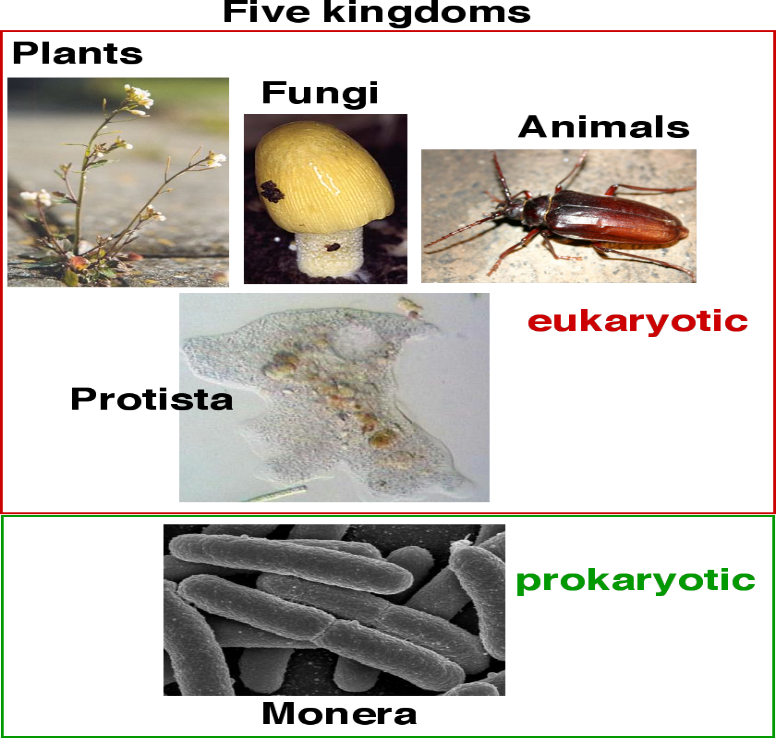
Figure: The five-kingdom classification based on the cell type.
The complexity of body organization: It is based on whether the organization is unicellular or multicellular. Some organisms are made of a single cell and are known as unicellular organisms which are included in the kingdom Monera and Protista and some organisms found in Fungi such as Yeast. Multicellular organisms possess the organization of different cells further into tissues and then to organs and organ systems. Tissue level of organization is found in kingdom Fungi, organ and organ system levels of an organization are found primarily in kingdom Plantae and Animalia.
Mode of nutrition: It is based on the source and process of obtaining nutrition. It is broadly classified as autotrophs and heterotrophs. Autotrophic organisms mainly produce their own source of energy, through different mechanisms. The major autotrophic organisms are found in Kingdom Plantae, through the process of photosynthesis. Various chemoautotrophs are also found in other kingdoms such as Protista. Heterotrophs depend on other organisms for their energy sources such as Kingdom Animalia and Fungi out of which Fungi are involved in saprophytic nutrition, where the energy is derived from dead and decaying organic matter.
Thus from the above options the most appropriate one is option D, that is the various bases for classification are the presence or absence of cell wall, the complexity of the organization, and mode of nutrition.
Note:Another system of classification is the six kingdom type of classification. Which includes Protista, Fungi, Plantae, Animalia, Arch bacteria, and Eubacteria. The difference from the five-kingdom classification is that kingdom Monera was further split into two further kingdoms into Archea and eubacteria, mainly on the basis of habitat.
Complete step by step answer:The basis of this classification is by different criteria, it considers multiple factors in the classification.
The various criteria used in the classification are:
Presence or absence of a well-defined nucleus: The organisms are divided into prokaryotes and eukaryotes. Prokaryotic organisms that do not possess a well-defined nucleus with a nuclear membrane and are even devoid of proper membrane-bound organelles. The only organelles found in the cytoplasm are ribosomes. The kingdom Monera is the only kingdom falling under prokaryotes. Eukaryotic organisms contain a well-defined proper nucleus and typical cell organelles. Kingdoms from Protista to Animalia fall under the category eukaryotes.
Figure: The five-kingdom classification based on the cell type.
The complexity of body organization: It is based on whether the organization is unicellular or multicellular. Some organisms are made of a single cell and are known as unicellular organisms which are included in the kingdom Monera and Protista and some organisms found in Fungi such as Yeast. Multicellular organisms possess the organization of different cells further into tissues and then to organs and organ systems. Tissue level of organization is found in kingdom Fungi, organ and organ system levels of an organization are found primarily in kingdom Plantae and Animalia.
Mode of nutrition: It is based on the source and process of obtaining nutrition. It is broadly classified as autotrophs and heterotrophs. Autotrophic organisms mainly produce their own source of energy, through different mechanisms. The major autotrophic organisms are found in Kingdom Plantae, through the process of photosynthesis. Various chemoautotrophs are also found in other kingdoms such as Protista. Heterotrophs depend on other organisms for their energy sources such as Kingdom Animalia and Fungi out of which Fungi are involved in saprophytic nutrition, where the energy is derived from dead and decaying organic matter.
Thus from the above options the most appropriate one is option D, that is the various bases for classification are the presence or absence of cell wall, the complexity of the organization, and mode of nutrition.
Note:Another system of classification is the six kingdom type of classification. Which includes Protista, Fungi, Plantae, Animalia, Arch bacteria, and Eubacteria. The difference from the five-kingdom classification is that kingdom Monera was further split into two further kingdoms into Archea and eubacteria, mainly on the basis of habitat.
Recently Updated Pages
Master Class 12 Economics: Engaging Questions & Answers for Success

Master Class 12 English: Engaging Questions & Answers for Success
Master Class 12 Social Science: Engaging Questions & Answers for Success
Master Class 12 Maths: Engaging Questions & Answers for Success
Master Class 12 Physics: Engaging Questions & Answers for Success
Master Class 9 General Knowledge: Engaging Questions & Answers for Success
Trending doubts
Which are the Top 10 Largest Countries of the World?
Draw a labelled sketch of the human eye class 12 physics CBSE
Differentiate between homogeneous and heterogeneous class 12 chemistry CBSE
Sulphuric acid is known as the king of acids State class 12 chemistry CBSE
Why is the cell called the structural and functional class 12 biology CBSE
Draw ray diagrams each showing i myopic eye and ii class 12 physics CBSE