




The first operation involved in Carnot cycle is:
A. Isothermal Expansion
B. Adiabatic Expansion
C. Isothermal Compression
D. Adiabatic Compression
Answer
 Verified
565.5k+ views
Hint: Carnot cycle is basically an ideal reversible closed thermodynamic cycle in which the substance will undergo four successive operations. We will study about the very first operation of the Carnot cycle in which the substance interacts with the system and does some amount of work.
Complete answer:
When a system undergoes through different states successively and then finally returns to its original state is known as thermodynamic cycle. The Carnot cycle is also one such cycle which is ideal and reversible. Carnot cycle comprises of four successive operations which are listed below serially:
-Isothermal Expansion
-Adiabatic Compression
-Isothermal Compression
-Adiabatic Expansion
These operation can be shown as:
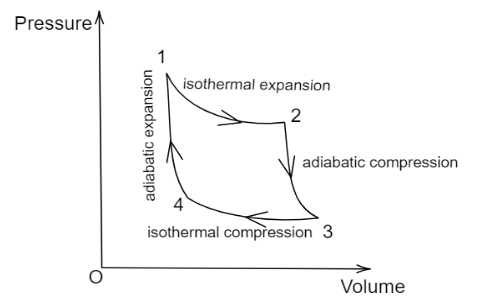
Thus the very first operation of the Carnot cycle is Isothermal Expansion where the heat is transferred reversibly from a high temperature source (reservoir) at constant temperature. During the first operation of the Carnot cycle the given gas is allowed to expand thus it does some work on the surroundings. But we can see that pressure drops from points \[1\] to point \[2\] but the temperature of the gas remains constant, therefore we call it isothermal expansion of gas and the process is known as isothermal expansion. Similarly other operations take place in successive order as mentioned.
Therefore the correct option is A.
Note: Carnot cycle is an example of an ideal heat engine whose efficiency is almost \[100\% \] which is practically not possible. This engine is only limited to the theoretical part. The word isothermal means at constant temperature means while during isothermal process the temperature of the system does not change, it remains constant. The above graph of Carnot engine is made between the pressure and volume variables.
Complete answer:
When a system undergoes through different states successively and then finally returns to its original state is known as thermodynamic cycle. The Carnot cycle is also one such cycle which is ideal and reversible. Carnot cycle comprises of four successive operations which are listed below serially:
-Isothermal Expansion
-Adiabatic Compression
-Isothermal Compression
-Adiabatic Expansion
These operation can be shown as:
Thus the very first operation of the Carnot cycle is Isothermal Expansion where the heat is transferred reversibly from a high temperature source (reservoir) at constant temperature. During the first operation of the Carnot cycle the given gas is allowed to expand thus it does some work on the surroundings. But we can see that pressure drops from points \[1\] to point \[2\] but the temperature of the gas remains constant, therefore we call it isothermal expansion of gas and the process is known as isothermal expansion. Similarly other operations take place in successive order as mentioned.
Therefore the correct option is A.
Note: Carnot cycle is an example of an ideal heat engine whose efficiency is almost \[100\% \] which is practically not possible. This engine is only limited to the theoretical part. The word isothermal means at constant temperature means while during isothermal process the temperature of the system does not change, it remains constant. The above graph of Carnot engine is made between the pressure and volume variables.
Recently Updated Pages
If x a + bt + ct2 where x is in meters and t is in class 11 physics CBSE

A car covers the first half distance between two places class 11 physics CBSE
The resultant of two vectors overrightarrow P and overrightarrow class 11 physics CBSE
Find the value of cos 135 class 11 maths CBSE
A mass M is held in place by an applied force F and class 11 physics CBSE
A solution of glucose in water is labelled as 10 dfracwv class 11 chemistry CBSE
Trending doubts
One Metric ton is equal to kg A 10000 B 1000 C 100 class 11 physics CBSE
Find the value of the expression given below sin 30circ class 11 maths CBSE
What do you mean by retardation What is its SI uni class 11 physics CBSE
Draw a diagram of nephron and explain its structur class 11 biology CBSE
10 examples of friction in our daily life
Difference between physical and chemical change class 11 chemistry CBSE