




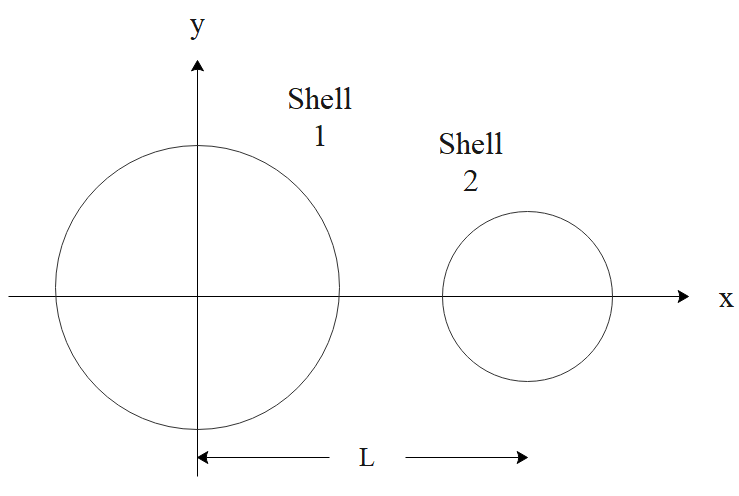
The figure shows two nonconducting spherical shells fixed in place. Shell 1 has a uniform surface charge density $6.0 \mu \mathrm{C} / \mathrm{m}^{2}$ on its outer surface and radius $43.0 \mathrm{cm} ;$ shell 2 has a uniform surface charge density $4.0 \mu \mathrm{C} / \mathrm{m}^{2}$ on its outer surface and radius $2.0 \mathrm{cm} ;$ the shell centres are separated by $\mathrm{L}=10 \mathrm{cm} .$ In unit-vector notation, what is the net electric field at $x=2.0 \mathrm{cm} ?$
Answer
 Verified
580.8k+ views
Hint: We know that electric field, an electric property associated with each point in space when charge is present in any form. The magnitude and direction of the electric field are expressed by the value of E, called electric field strength or electric field intensity or simply the electric field. The space around an electric charge in which its influence can be felt is known as the electric field. The electric field Intensity at a point is the force experienced by a unit positive charge placed at that point. Electric Field Intensity is a vector quantity.
Complete step by step answer
We know that the electric field is defined as the electric force per unit charge. The direction of the field is taken to be the direction of the force it would exert on a positive test charge. The electric field is radially outward from a positive charge and radially in toward a negative point charge.
Electric field is not negative. It is a vector and thus has negative and positive directions. An electron being negatively charged experiences a force against the direction of the field. For a positive charge, the force is along the field.
We note that only the smaller shell contributes a (nonzero) field at the designated point since the point is inside the radius of the large sphere (and $\mathrm{E}=0$ inside of a spherical charge) and the field
points toward the - $x$ direction. Thus, with $R=0.020 \mathrm{m}$ (the radius of the smaller shell), $\mathrm{L}=0.10 \mathrm{m}$ and $\mathrm{x}=0.020 \mathrm{m},$ we obtain
$\quad \overrightarrow{\mathrm{E}}=\mathrm{E}(\mathrm{j})=-\dfrac{\mathrm{q}}{4 \pi \mathrm{er}^{2}} \mathrm{j}=-\dfrac{4 \pi \mathrm{R}^{2} \sigma_{2}}{4 \pi \epsilon_{0}(\mathrm{L}-\mathrm{x})^{2}} \mathrm{j}=$ $-\dfrac{\mathrm{R}^{2} \sigma_{2}}{\epsilon_{0}(\mathrm{L}-\mathrm{x})^{2}} \mathrm{j}$
After we put the values, we get that:
$=-\dfrac{(0.020 \mathrm{m})^{2}\left(4.0 \times 10^{-6} \mathrm{C} / \mathrm{m}^{2}\right)}{\left(8.85 \times 10^{-12} \mathrm{C}^{2} / \mathrm{N} \cdot \mathrm{m}\right)(0.10 \mathrm{m}-0.020 \mathrm{m})^{2}} \mathrm{j}$
After the evaluation we get: $\left(-2.8 \times 10^{4} \mathrm{N} / \mathrm{C}\right) \mathrm{j}$
Note: We know that electric fields (e-fields) are an important tool in understanding how electricity begins and continues to flow. The electric fields of single charges. A negative charge has an inward electric field because it attracts positive charges. The positive charge has an outward electric field, pushing away like charges. Electric field is defined as the electric force per unit charge. The direction of the field is taken to be the direction of the force it would exert on a positive test charge. The electric field is radially outward from a positive charge and radially in toward a negative point charge. Electric field lines cannot cross. This is because they are, by definition, a line of constant potential. The equipotential at a given point in space can only have a single value. If lines for two different values of the potential were to cross, then they would no longer represent equipotential lines.
Complete step by step answer
We know that the electric field is defined as the electric force per unit charge. The direction of the field is taken to be the direction of the force it would exert on a positive test charge. The electric field is radially outward from a positive charge and radially in toward a negative point charge.
Electric field is not negative. It is a vector and thus has negative and positive directions. An electron being negatively charged experiences a force against the direction of the field. For a positive charge, the force is along the field.
We note that only the smaller shell contributes a (nonzero) field at the designated point since the point is inside the radius of the large sphere (and $\mathrm{E}=0$ inside of a spherical charge) and the field
points toward the - $x$ direction. Thus, with $R=0.020 \mathrm{m}$ (the radius of the smaller shell), $\mathrm{L}=0.10 \mathrm{m}$ and $\mathrm{x}=0.020 \mathrm{m},$ we obtain
$\quad \overrightarrow{\mathrm{E}}=\mathrm{E}(\mathrm{j})=-\dfrac{\mathrm{q}}{4 \pi \mathrm{er}^{2}} \mathrm{j}=-\dfrac{4 \pi \mathrm{R}^{2} \sigma_{2}}{4 \pi \epsilon_{0}(\mathrm{L}-\mathrm{x})^{2}} \mathrm{j}=$ $-\dfrac{\mathrm{R}^{2} \sigma_{2}}{\epsilon_{0}(\mathrm{L}-\mathrm{x})^{2}} \mathrm{j}$
After we put the values, we get that:
$=-\dfrac{(0.020 \mathrm{m})^{2}\left(4.0 \times 10^{-6} \mathrm{C} / \mathrm{m}^{2}\right)}{\left(8.85 \times 10^{-12} \mathrm{C}^{2} / \mathrm{N} \cdot \mathrm{m}\right)(0.10 \mathrm{m}-0.020 \mathrm{m})^{2}} \mathrm{j}$
After the evaluation we get: $\left(-2.8 \times 10^{4} \mathrm{N} / \mathrm{C}\right) \mathrm{j}$
Note: We know that electric fields (e-fields) are an important tool in understanding how electricity begins and continues to flow. The electric fields of single charges. A negative charge has an inward electric field because it attracts positive charges. The positive charge has an outward electric field, pushing away like charges. Electric field is defined as the electric force per unit charge. The direction of the field is taken to be the direction of the force it would exert on a positive test charge. The electric field is radially outward from a positive charge and radially in toward a negative point charge. Electric field lines cannot cross. This is because they are, by definition, a line of constant potential. The equipotential at a given point in space can only have a single value. If lines for two different values of the potential were to cross, then they would no longer represent equipotential lines.
Recently Updated Pages
Master Class 12 Economics: Engaging Questions & Answers for Success

Master Class 12 Physics: Engaging Questions & Answers for Success
Master Class 12 English: Engaging Questions & Answers for Success
Master Class 12 Social Science: Engaging Questions & Answers for Success
Master Class 12 Maths: Engaging Questions & Answers for Success
Master Class 12 Business Studies: Engaging Questions & Answers for Success
Trending doubts
Which are the Top 10 Largest Countries of the World?
What are the major means of transport Explain each class 12 social science CBSE
Draw a labelled sketch of the human eye class 12 physics CBSE
Why cannot DNA pass through cell membranes class 12 biology CBSE
Differentiate between insitu conservation and exsitu class 12 biology CBSE
Draw a neat and well labeled diagram of TS of ovary class 12 biology CBSE