




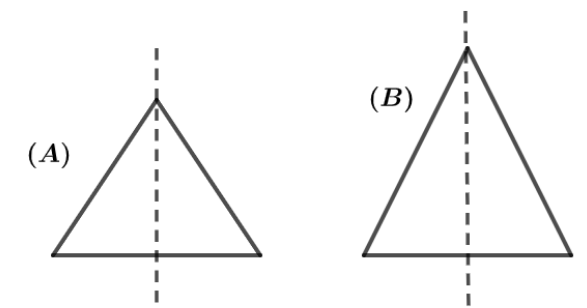
The figure shows two cones A and B with the conditions ${h_A} < {h_B}$ , ${\rho _A} > {\rho _B}$ , ${R_A} = {R_B}$ and ${m_A} = {m_B}$. Identify the correct statement about their axes of symmetry.
A. Both have same moment of inertia
B. $A$ has greater moment of inertia
C. $B$ has greater moment of inertia
D. Nothing can be said
Answer
 Verified
516.9k+ views
Hint: In physics, Moment of inertia of a body is defined as the tendency of a body to oppose or to resist the angular acceleration produced in the body due to rotational motion. Moment of inertia is a scalar quantity and its general mathematical formula can be written as $I = m{r^2}$ where $m$ is the mass of the body and $r$ is the perpendicular distance between the body and the axis of rotation.
Complete step by step answer:
As we know that, the general formula for the moment of inertia for a solid cone about the axes of symmetry of the cone having a mass of $M$ and radius of circular base $R$ is given by $I = \dfrac{3}{{10}}M{R^2}$ . We can see that the moment of inertia of a solid cone about the axes of symmetry is independent of its height. So, according to the given conditions for cones $A$ and $B$ we have, ${h_A} < {h_B}$ which will have no effect on the magnitude of moment of inertia of both cones.
And we have, the radii of both cones A and B are related as ${R_A} = {R_B}$ and their masses are related as ${m_A} = {m_B}$. So,
Moment of inertia of cone $A$ will be ${I_A} = \dfrac{3}{{10}}{m_A}{R_A}^2$
Moment of inertia of cone $B$ will be ${I_B} = \dfrac{3}{{10}}{m_B}{R_B}^2$
Since we have, ${R_A} = {R_B}$ and ${m_A} = {m_B}$ so, we can say that ${I_A} = {I_B}$
So, both cones $A$ and $B$ will have the same moment of inertia.
Hence, the correct option is A.
Note: It should be remembered that, Moment of inertia is independent of the height of the cone. The SI unit of moment of inertia is $kg{m^2}$ and since moment of inertia is the capacity to oppose angular acceleration in it, the mathematical formula between moment of inertia and angular acceleration is written as $\vec \tau = I\vec \alpha $ where $\vec \tau $ is the torque acting on a body and $\vec \alpha $ is the angular acceleration produced in the body.
Complete step by step answer:
As we know that, the general formula for the moment of inertia for a solid cone about the axes of symmetry of the cone having a mass of $M$ and radius of circular base $R$ is given by $I = \dfrac{3}{{10}}M{R^2}$ . We can see that the moment of inertia of a solid cone about the axes of symmetry is independent of its height. So, according to the given conditions for cones $A$ and $B$ we have, ${h_A} < {h_B}$ which will have no effect on the magnitude of moment of inertia of both cones.
And we have, the radii of both cones A and B are related as ${R_A} = {R_B}$ and their masses are related as ${m_A} = {m_B}$. So,
Moment of inertia of cone $A$ will be ${I_A} = \dfrac{3}{{10}}{m_A}{R_A}^2$
Moment of inertia of cone $B$ will be ${I_B} = \dfrac{3}{{10}}{m_B}{R_B}^2$
Since we have, ${R_A} = {R_B}$ and ${m_A} = {m_B}$ so, we can say that ${I_A} = {I_B}$
So, both cones $A$ and $B$ will have the same moment of inertia.
Hence, the correct option is A.
Note: It should be remembered that, Moment of inertia is independent of the height of the cone. The SI unit of moment of inertia is $kg{m^2}$ and since moment of inertia is the capacity to oppose angular acceleration in it, the mathematical formula between moment of inertia and angular acceleration is written as $\vec \tau = I\vec \alpha $ where $\vec \tau $ is the torque acting on a body and $\vec \alpha $ is the angular acceleration produced in the body.
Recently Updated Pages
Master Class 11 Computer Science: Engaging Questions & Answers for Success

Master Class 11 Business Studies: Engaging Questions & Answers for Success
Master Class 11 Economics: Engaging Questions & Answers for Success
Master Class 11 English: Engaging Questions & Answers for Success
Master Class 11 Maths: Engaging Questions & Answers for Success
Master Class 11 Biology: Engaging Questions & Answers for Success
Trending doubts
There are 720 permutations of the digits 1 2 3 4 5 class 11 maths CBSE
Discuss the various forms of bacteria class 11 biology CBSE
Draw a diagram of a plant cell and label at least eight class 11 biology CBSE
Explain zero factorial class 11 maths CBSE
What organs are located on the left side of your body class 11 biology CBSE
Draw a diagram of nephron and explain its structur class 11 biology CBSE